Rounding off Decimal Fractions
Last Updated :
23 Jul, 2025
Rounding off decimal fractions is a method used to simplify numbers by reducing the number of decimal places while maintaining a value that is approximately equal to the original number. We use this in many aspects of our lives.
For Example:
- Suppose, you weigh 68.4 kg. For ease of understanding when discussing your weight with others, you might round this to 68 kg.
- A piece of wood measures 2.375 meters long. When ordering supplies, a contractor might round this to 2.4 meters for simplicity in calculations.
- Suppose, you earn $2,452.75 a month. When discussing your salary with friends or planning a budget, you might round this to $2,450 or even $2,500 to make calculations easier.
How to Round Off Decimal Fractions
Follow the steps below to round decimal fractions:
Step 1: Identify the Place Value: Decide which place value you want to round to (e.g., whole number, tenth, hundredth, etc.).
Step 2: Look at the Next Digit: Check the digit immediately to the right of that place value.
- If it's 5 or more, round up i.e., add 1 to the preceding digit.
- If it's 4 or less, round down i.e., keep the preceding digit unchanged.
Step 3: Adjust the Number: After rounding, remove the digits following the rounding place.
Let's consider an example for better understanding.
Example: Round of 3.576 to tenth decimal place.
Solution:
For 3.576,
- The tenths place is the first digit after the decimal point (in this case, 5).
- As the hundredths place is 7. Since 7 is greater than 5, round the digit in the tenths place (5) up by 1.
- Thus, the digit in the tenths place becomes 6.
So, 3.576 rounded to 1 decimal place is 3.6.
Solved Questions on Rounding off Decimal Fractions
Question 1: Round off 5.6745.6745.674 to the nearest tenth.
Solution:
To round to the nearest tenth, look at the digit in the hundredths place (the second digit after the decimal point).
- The hundredths digit in 5.674 is 7 (which is greater than or equal to 5).
- Since it’s greater than or equal to 5, we round the tenths place (first digit after the decimal point) up by 1.
Thus, 5.674 rounds to 5.7.
Question 2: Round off 3.4567 to the nearest hundredth.
Solution:
To round to the nearest hundredth, look at the thousandths place (third digit after the decimal point).
- The thousandths digit in 3.4567 is 6 (which is greater than or equal to 5).
- Since it’s greater than or equal to 5, we round the hundredths place (second digit after the decimal point) up by 1.
Thus, 3.4567 rounds to 3.46.
Question 3: Round off 9.49 to the nearest whole number.
Solution:
To round to the nearest whole number, look at the tenths place.
- The tenths digit in 9.49 is 4 (which is less than 5).
- Since it’s less than 5, we round down, keeping the whole number as it is.
Thus, 9.49 rounds to 9.
Question 4: Round off 12.98765 to the nearest thousandth.
Solution:
To round to the nearest thousandth, look at the digit in the ten-thousandths place (fourth digit after the decimal point).
- The ten-thousandths digit in 12.98765 is 6 (which is greater than or equal to 5).
- Since it’s greater than or equal to 5, we round the thousandths place (third digit after the decimal point) up by 1.
Thus, 12.98765 rounds to 12.988.
Worksheet on Rounding off Decimal Fractions
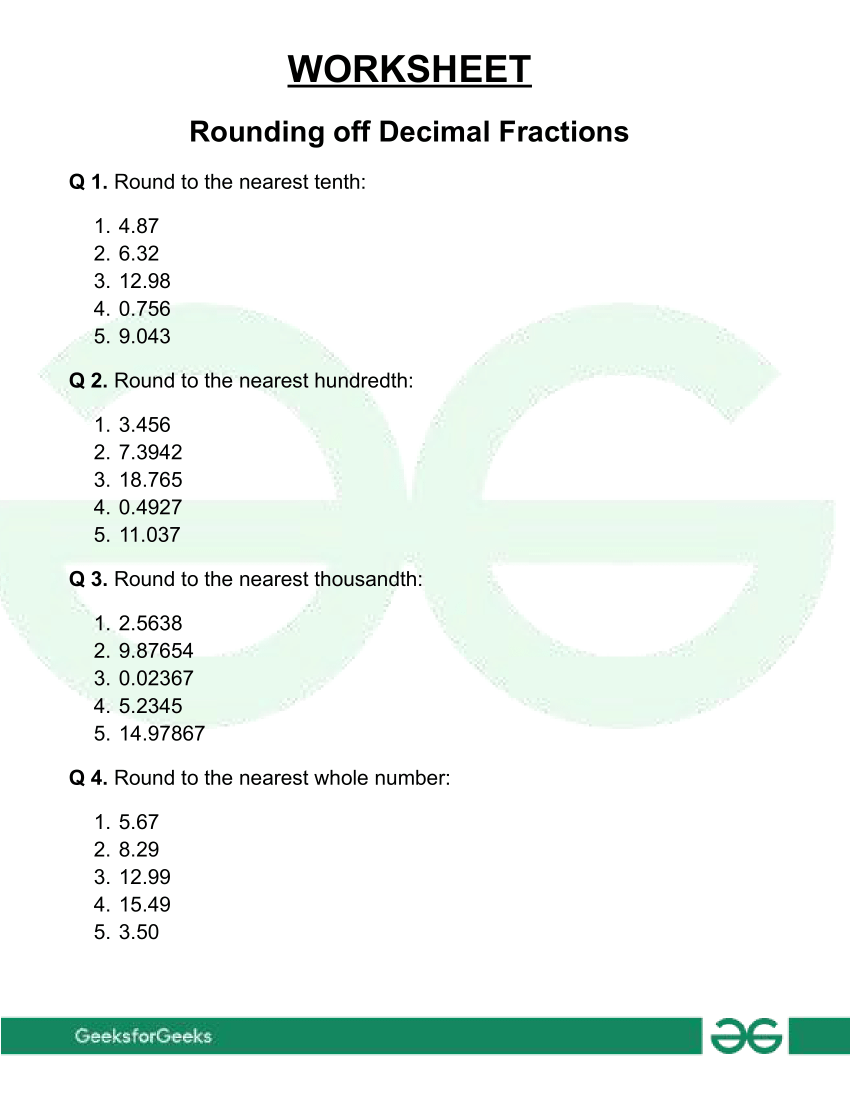
You can download free worksheet on Rounding off Decimal Fractions from below:
Read More,
Explore
Basic Arithmetic
Algebra
Geometry
Trigonometry & Vector Algebra
Calculus
Probability and Statistics
Practice