Introduction to Cognitive theories of
Learning
Understanding Learning:MOD001256
Learning Objectives
By the end of the session, you will:
• Review some of the research of the cognitivist
learning theorists: Piaget, Vygotsky and Bruner.
• Consider how cognitivist learning approaches are
used currently in a range of learning contexts and
settings.
Cognitivist theory
•Learning is an internal process, associating previous knowledge with new
information, and organising knowledge and reinforcing memories
• Input (Attention) receiving information
• Process (Encoding) Translating information into a meaningful form which
can be remembered
• Output (Retrieval) identifying and recalling information for a particular
purpose
•Learning is a meaning making process where individuals CONSTRUCT their
own meaning of experiences.
Cognitivist theory
•Learning is a search for meaning.
•Meaning requires understanding of ‘wholes’ as well as parts.
•Teachers need to understand the mental models students use and
the assumptions they make.
•Students have to construct their own meaning rather than memorise
the ‘right’ answers.
•Assessment has to be part of the learning process.
Timeline
J. Piaget (1896-1980) [active 1920’s – 1970’s]
L. Vygotsky (1896–1934) [active 1920’s – 1930’s, but
translations influenced mainly in 1960’s – 1970’s]
J. Bruner (1915) [active 1950’s – 1990’s]
•Swiss, natural scientist: biologist and epistemologist (the theory of
knowledge).
•Best known for his research on children’s cognitive development.
•Interested in how children learnt and their increasing capacity to
understand the world through the process of maturation (growing up).
• Studied children from infancy to adolescence (including his own) through
observation and setting exercises and tests for the children to complete.
Jean Piaget (1896-1980)
Vygotsky (1986 [first pub. 1936], p.12) on Piaget:
‘Psychology owes a great deal to Jean Piaget. It is not an exaggeration to
say that he revolutionized the study of the child’s speech and thought. He
developed the clinical method for exploring children’s ideas that has since
been widely used. He was the first to investigate the child’s perception and
logic systematically; moreover, he brought to his subject a fresh approach
of unusual amplitude and boldness.’
Jean Piaget (1896-1980)
Key areas to Piaget’s Cognitive Theory
•Schema – innate and acquired.
•Children are actively engaged in the learning process.
•Changing cognitive structures: equilibrium, assimilation
and accommodation.
•Developmental stages of children which are age
defined.
Jean Piaget (1896-1980)
• Understanding and knowledge of the world.
• How you make sense of and categorise knowledge.
•Representations in the mind of a set of perceptions, ideas, objects and
actions.
•Schemas can be acquired/learnt or innate (e.g. reflex).
•Schemas are not fixed but develop with experience.
•For example, part of an 8 months old baby’s schematic knowledge is that
when a rattle is shook, it will make a noise.
Schema
Cognitivists to Constructivists
Understanding Learning
Week 4
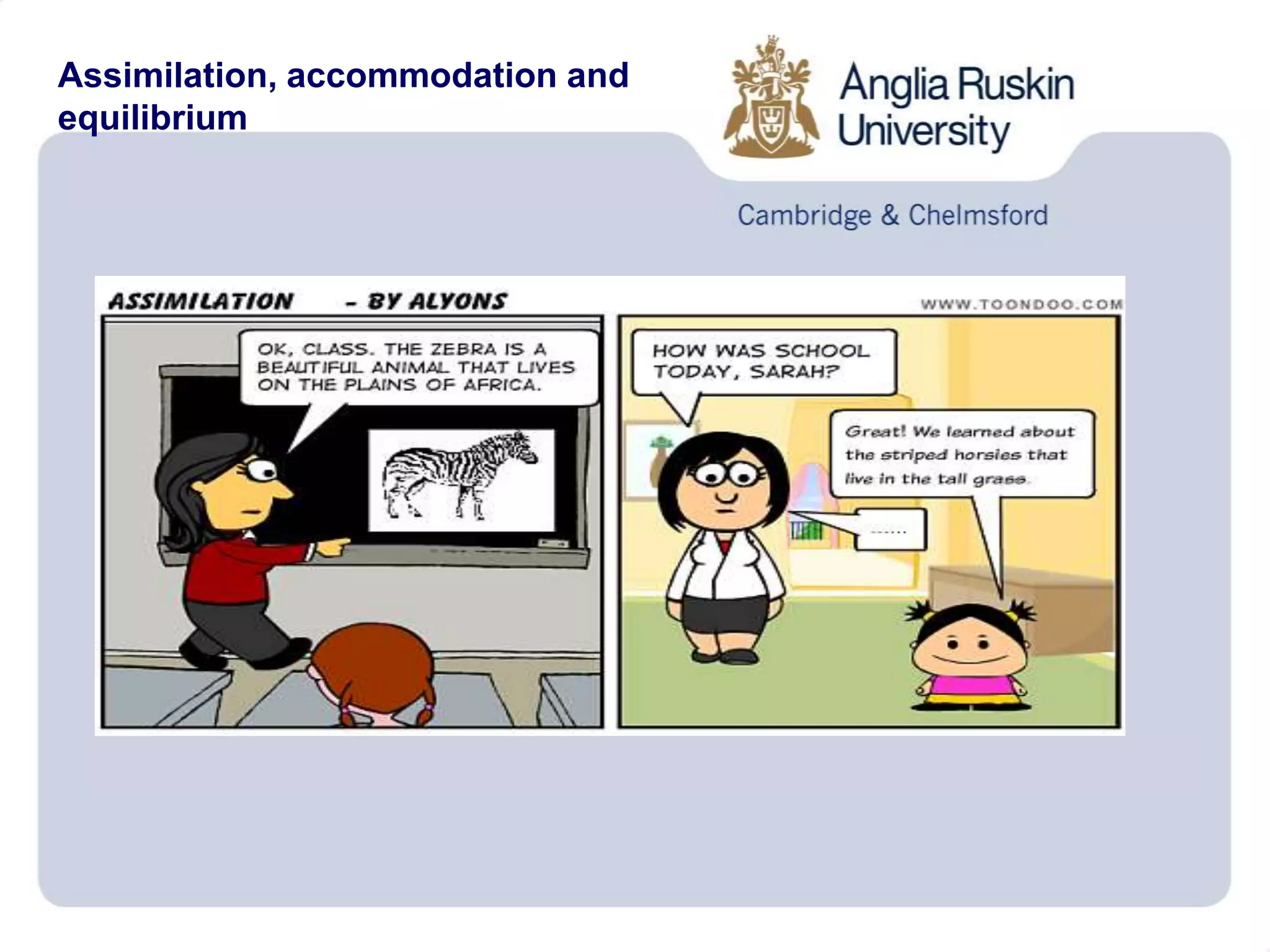
Assimilation
“…is the integration of external elements into evolving or completed
structures” (Piaget, 1970, p.706)
“The process by which a person takes material into their minds from the
environment”. (Atherton 2011)
Accommodation
“The difference made to one’s mind or concepts by the process of
assimilation…. assimilation and accommodation go together: you can’t
have one without the other.” (Atherton, 2011)
The adjustment or modification of schemas as new information is
assimilated.
Assimilation, accommodation and
equilibrium
The Developing Brain
to the Constructing
Brain
• Cognitivism
– The growing and maturing brain able to engage with its
environments
• Constructivism
– The child constructing its identity and understandings of its
environments
• Social constructivism
– The child constructing its identity and understandings within
her/his social environments
Assimilation, accommodation and
equilibrium
Equilibrium
“…is the force which drives the learning process, as we
do not like to be frustrated and will seek to restore the
balance by mastering new challenges…an unpleasant
state of disequilibrium occurs when new information
cannot be fitted into existing schemas.” (McLeod, 2012)
Equilibration is Piaget’s equivalent to the notion of ‘motivation’
http://www.simplypsychology.org/piaget.html
Assimilation, accommodation
and equilibrium
Jean Piaget -
developmental stages
1. Sensorimotor Stage (Birth to 2 years)
Children:
• Differentiate self from objects.
• Develop knowledge of touch, smell, sight and taste.
• Develop knowledge of object permanence – children recognise
that objects exist even when they are no longer in their
presence.
(http://www.youtube.com/watch?v=ue8y-JVhjS0&feature=related)
Jean Piaget -
developmental stages
2. Pre-operational Stage (2 – 7 years)
Children learn to use language and to represent objects by words
and images.
Their thinking is egocentric. They have difficulty taking the
viewpoint of others.
Children have difficulty in adjusting to changes in appearances of
matter – lack of conservation.
http://www.youtube.com/watch?v=GLj0IZFLKvg&feature=relate
d
Jean Piaget -
developmental stages
Concrete Operational Stage (7 – 11 years)
Children:
• Can think logically about objects and events.
• Can use logical rules to solve problems.
• Objects can be ordered to features such as height, weight or
speed.
• Concept of conservation is developed and grasped.
http://www.youtube.com/watch?v=aMgb42EBpMc&feature=related
Jean Piaget -
developmental stages
Formal operational stage (11 – 15 years)
• Thinking becomes more flexible.
• Children/teenagers can think logically about abstract concepts.
• Thinking becomes more symbolic. For example: symbols can stand for
numbers in Maths. What is Y in the sum 3 x X = Y, if X is 4?
• Children/teenagers become concerned with the hypothetical and the
future.
http://www.youtube.com/watch?v=zjJdcXA1KH8&feature=related
Jean Piaget – in practice
Learning should be child centred and tailored to meet the child’s
readiness to learn.
Learning should be constructive and active. There should be an
emphasis on practical activities.
The teacher is a facilitator rather than an instructor.
Materials and learning activities should help children to construct
learning and to progress from discovery to discovery.
Gray and McBlain, 2012
Jean Piaget - Critiques
Piaget does not consider how factors such as environment and culture impact on
children’s cognitive development and learning.
Piaget’s stages are too rigid. Children develop at different rates. Some will never
attain the formal operation level or may not be asked to display this level of
knowledge.
Piaget’s theory places less emphasis on the role of the teacher, where theorist such
as Bruner and Vygotsky believe the role of the teacher is essential.
Criticism of the research methods use by Piaget:
• The language used in tests was too complicated for the children to understand.
(Meadows 1993)
• Sample sizes were too small. They did not include a range of children from
different cultures and also included Piaget’s own children (Calloway, 2001)
Social Constructivism
Understanding Learning
Week 5
Lev Vygotsky (1896-1934)
• Russian psychologist (originally studied law) – active
in 1920’s & 1930’s. Came to influence Western
researchers mainly in 1960’s and 1980’s when
translations of his work became available
• Much of his research is based on language learning in
children.
Lev Vygotsky: Ideas
•Key ideas/concepts: cognitive development is essentially a social
process.
• Thought development is determined by language.
• Intellectual growth is contingent upon the development of the
social key of language.
Social Development/Constructivist Theory
•Definition: Social construction emphasizes the importance of culture
and context in understanding what occurs in society and constructing
knowledge based on this understanding (Pagram and McMahon,
1997)
•Zone of Proximal Development (ZPD)
Lev Vygotsky: Social
Development/Constructivist theory
•Children do not develop in isolation but in a social world.
•The child’s environment, age, culture and life experiences, social
relationships and their interactions with other adults and children,
need to be considered when reaching conclusions about children’s
development. (socio-cultural influences)
•Learning is based in real life experiences. Social and cultural
interaction is vital for learning to take place.
Lev Vygotsky: Social
Development/Constructivist theory
•Language is essential to learning. It is the main means by
which adults communicate and transmit information to
children.
•Children internalise language as thought and ‘inner speech’.
Therefore, thought is the result of language. This is criticised
by Fox (2001), who argued that if thought cannot exist
without language, then until a child speaks; they must be
devoid of thought.
Lev Vygotsky: Ideas
• Zone of Proximal Development (ZPD)
•Learning is accelerated through the learner working with or the
teaching of a ‘More Knowledgeable Other’
Source
http://www.instructionaldesign.o
rg/theories/social-
development.html
Zone of Proximal
Development
• “…not a specific quality of the child, nor is it a specific
quality of the educational setting or educators…it is…
collaboratively produced in the interaction between the
child and more knowledgeable others. The aim of the
collaborative interaction is to lift the learner to become a
‘head taller’” (Vygotsky, 1978, p.102)
Jerome Bruner (1915)
• American psychologist. Focused on schooling in
1950’s. Bruner believed the role, purpose and method
of education should reflect the values of society.
• Influenced by Vygotsky and the social constructivist
approach to learning. Bruner was interested in how
context and culture influenced learning.
Jerome Bruner - Key ideas:
Three modes of learning
Bruner proposed they are three ways or modes of making sense of our
world…
Enactive: actions
Muscle memory: a baby remembers how to shake a rattle, adult: how to type
or drive a car.
Iconic: images and pictures
Information is stored as mental pictures. This is why diagram and images are
useful to learning.
Symbolic: Information is stored as a code, symbols and language.
Symbols offer flexibility in that they can be manipulated, ordered and
classified. They can also be used to describe and explain abstract
information that cannot be explored through the enactive and iconic modes.
Jerome Bruner - Key ideas:
Constructivist
Learning is an active process. Learners construct new
ideas/concepts based on current and previous learning.
Bruner’s work supported discovery learning and
children engaging in problem solving activities.
Smidt (2011, p. 10) comments,
“For Bruner, meaning has always been at the heart of any
investigation into mind and cognition. When we talk of meaning
we are talking about making sense of something, of
understanding or comprehending it.”
Jerome Bruner - Key ideas:
Language
Language is important in learning, as it helps learners to develop thinking
skills, to problem solve and to deal with abstract concepts.
Motivation
Learners need to be interested and motivated to learn.
Social learning
Bruner like Vygostsky emphasised the social nature of learning and felt
adults should play an active role in children’s learning. The teacher role is to
facilitate learning and to encourage and support children to learn.
Scaffolding
Complex tasks are broken down into smaller tasks for the child to achieve.
The adult works along side the child offering support. The support is
gradually reduced as learning takes place and the child can work
independently.
Jerome Bruner - Key
ideas:
Spiral curriculum – This opposes Piaget’s stages of learning and his
concept of readiness to learn.
Bruner argued that:
•Schools waste time trying to match the complexity of subject
material to a child’s cognitive stage of development.
•Children are held back by teachers as certain topics are seen as too
difficult to understand.
Spiral Approach
Different topics are studied more
than once. Each time they are
revisited, it is at a deeper and
more complex level.
‘We begin with the hypothesis that
any subject can be taught
effectively in some intellectually
honest form to any child at any
stage of development.’
(Bruner, J., 1960, The Process of Learning,
Cambridge, Mass.: Harvard University
Press)
Advantage: A spiral curriculum
can help learners to link a topic to
a range of concepts, as it is
revisited.
Criticism: Some learners may view
the spiral approach as too repetitive.
Image from: Neary, M., 2002, Curriculum Studies in Post-compulsory
and Adult Education. Cheltenham: Nelson Thornes Ltd
Cognitivist: key impacts on
learning
• Child/learner centred approach to teaching and learning:
Discovery learning; Active learning; Inquiry based learning;
Reciprocal learning.
• Teacher as facilitator: Role is guiding/helping student to learn
rather than transmission of information – zone of proximal
development and scaffolding.
• Education is shaped by Society: Alignment with values and
belief systems
References
Atherton J. S., 2011. Learning and Teaching; Piaget's developmental theory. Accessed 5 October 2012 from:
http://www.learningandteaching.info/learning/piaget.htm
Calloway, W. R., 2001. Jean Piaget: A Most Outrageous Deception. New York: NOVA
Fox, R. 2001. Constructivism examined. Oxford Review of Education, 27, 1 23-35.
Gray, C. & MacBlain, S. 2012. Learning Theories in Childhood. London: Sage
McLeod, S., 2012. Jean Piaget. Accessed 2 October 2012 from: http://www.simplypsychology.org/piaget.html
Meadows, M., 1993. The Young Child as Thinker: The Cognitive Development and Acquisition of Cognition in Childhood. London:
Routledge
Pagram, J. & McMahon, M. 1997. WeB-CD: An Interactive Learning Experience for Distance Education Students Studying
Interactive Multimedia. Poster presented at ICCE97 International Conference on Computers in Education, Kuching, Malaysia, 2-6
December.
Piaget, J. P., 1970. Science of Education and the Psychology of the Child. New York: Orion.
Smidt, S., 2011. Introducing Bruner: A Guide for Practitioners and Students in Early Years Education. London: Routledge
Vygotsky, L. S. 1978 [first published together]. Mind in Society: The Development of Higher Psychological Processes. Cambridge,
MA: Harvard University Press.
Vygotksy, L.S. 1986 [1934]. Thought and Language. Newly revised and edited by Alex Kozulin. Cambridge, Ma.: MIT Press.
Further reading & resources –
check the Weblinks section on
the VLE.
Cognitive Learning - general:
http://www.infed.org/biblio/learning-cognitive.htm
Piaget:
http://www.learningandteaching.info/learning/piaget.htm
http://tip.psychology.org/piaget.html
http://www.simplypsychology.pwp.blueyonder.co.uk/piaget.html
Vygotsky:
http://tip.psychology.org/vygotsky.html
http://www.learningandteaching.info/learning/constructivism.htm#Vygotsky
http://www.simplypsychology.pwp.blueyonder.co.uk/vygotsky.html
Bruner:
http://www.infed.org/biblio/learning-cognitive.htm
http://tip.psychology.org/bruner.html
http://www.infed.org/thinkers/bruner.htm
http://www.simplypsychology.pwp.blueyonder.co.uk/bruner.html
Chapter 4 Cognitivist Theories in: Jarvis, P., Holford, J., Griffin, C., 2003.
The Theory and Practice of Learning. 2nd edn. London: Routledge (E-
book - library)
Chapters 4, 5 & 7 in Gray, C. & MacBlain, S. 2012. Learning Theories in
Childhood. London: Sage Publications Limited.
pp.212-219 & pp. 225-233 in Barlett, S & Burton, D. 2012. Introduction to
Education Studies. Third Edition. London: Sage Publishing Limited.
pp. 37-62 & pp337-340 in Woolfolk, Hughes & Walkup. 2013. Psychology
in Education. Second Edition. Harlow: Pearson
Further reading: Cognitivist
theorists

Cognitive-approaches-to-learning-powerpoint.ppt

  • 1.
    Introduction to Cognitivetheories of Learning Understanding Learning:MOD001256
  • 2.
    Learning Objectives By theend of the session, you will: • Review some of the research of the cognitivist learning theorists: Piaget, Vygotsky and Bruner. • Consider how cognitivist learning approaches are used currently in a range of learning contexts and settings.
  • 3.
    Cognitivist theory •Learning isan internal process, associating previous knowledge with new information, and organising knowledge and reinforcing memories • Input (Attention) receiving information • Process (Encoding) Translating information into a meaningful form which can be remembered • Output (Retrieval) identifying and recalling information for a particular purpose •Learning is a meaning making process where individuals CONSTRUCT their own meaning of experiences.
  • 4.
    Cognitivist theory •Learning isa search for meaning. •Meaning requires understanding of ‘wholes’ as well as parts. •Teachers need to understand the mental models students use and the assumptions they make. •Students have to construct their own meaning rather than memorise the ‘right’ answers. •Assessment has to be part of the learning process.
  • 5.
    Timeline J. Piaget (1896-1980)[active 1920’s – 1970’s] L. Vygotsky (1896–1934) [active 1920’s – 1930’s, but translations influenced mainly in 1960’s – 1970’s] J. Bruner (1915) [active 1950’s – 1990’s]
  • 6.
    •Swiss, natural scientist:biologist and epistemologist (the theory of knowledge). •Best known for his research on children’s cognitive development. •Interested in how children learnt and their increasing capacity to understand the world through the process of maturation (growing up). • Studied children from infancy to adolescence (including his own) through observation and setting exercises and tests for the children to complete. Jean Piaget (1896-1980)
  • 7.
    Vygotsky (1986 [firstpub. 1936], p.12) on Piaget: ‘Psychology owes a great deal to Jean Piaget. It is not an exaggeration to say that he revolutionized the study of the child’s speech and thought. He developed the clinical method for exploring children’s ideas that has since been widely used. He was the first to investigate the child’s perception and logic systematically; moreover, he brought to his subject a fresh approach of unusual amplitude and boldness.’ Jean Piaget (1896-1980)
  • 8.
    Key areas toPiaget’s Cognitive Theory •Schema – innate and acquired. •Children are actively engaged in the learning process. •Changing cognitive structures: equilibrium, assimilation and accommodation. •Developmental stages of children which are age defined. Jean Piaget (1896-1980)
  • 9.
    • Understanding andknowledge of the world. • How you make sense of and categorise knowledge. •Representations in the mind of a set of perceptions, ideas, objects and actions. •Schemas can be acquired/learnt or innate (e.g. reflex). •Schemas are not fixed but develop with experience. •For example, part of an 8 months old baby’s schematic knowledge is that when a rattle is shook, it will make a noise. Schema
  • 10.
  • 11.
    Assimilation “…is the integrationof external elements into evolving or completed structures” (Piaget, 1970, p.706) “The process by which a person takes material into their minds from the environment”. (Atherton 2011) Accommodation “The difference made to one’s mind or concepts by the process of assimilation…. assimilation and accommodation go together: you can’t have one without the other.” (Atherton, 2011) The adjustment or modification of schemas as new information is assimilated. Assimilation, accommodation and equilibrium
  • 12.
    The Developing Brain tothe Constructing Brain • Cognitivism – The growing and maturing brain able to engage with its environments • Constructivism – The child constructing its identity and understandings of its environments • Social constructivism – The child constructing its identity and understandings within her/his social environments
  • 13.
  • 14.
    Equilibrium “…is the forcewhich drives the learning process, as we do not like to be frustrated and will seek to restore the balance by mastering new challenges…an unpleasant state of disequilibrium occurs when new information cannot be fitted into existing schemas.” (McLeod, 2012) Equilibration is Piaget’s equivalent to the notion of ‘motivation’ http://www.simplypsychology.org/piaget.html Assimilation, accommodation and equilibrium
  • 15.
    Jean Piaget - developmentalstages 1. Sensorimotor Stage (Birth to 2 years) Children: • Differentiate self from objects. • Develop knowledge of touch, smell, sight and taste. • Develop knowledge of object permanence – children recognise that objects exist even when they are no longer in their presence. (http://www.youtube.com/watch?v=ue8y-JVhjS0&feature=related)
  • 16.
    Jean Piaget - developmentalstages 2. Pre-operational Stage (2 – 7 years) Children learn to use language and to represent objects by words and images. Their thinking is egocentric. They have difficulty taking the viewpoint of others. Children have difficulty in adjusting to changes in appearances of matter – lack of conservation. http://www.youtube.com/watch?v=GLj0IZFLKvg&feature=relate d
  • 17.
    Jean Piaget - developmentalstages Concrete Operational Stage (7 – 11 years) Children: • Can think logically about objects and events. • Can use logical rules to solve problems. • Objects can be ordered to features such as height, weight or speed. • Concept of conservation is developed and grasped. http://www.youtube.com/watch?v=aMgb42EBpMc&feature=related
  • 18.
    Jean Piaget - developmentalstages Formal operational stage (11 – 15 years) • Thinking becomes more flexible. • Children/teenagers can think logically about abstract concepts. • Thinking becomes more symbolic. For example: symbols can stand for numbers in Maths. What is Y in the sum 3 x X = Y, if X is 4? • Children/teenagers become concerned with the hypothetical and the future. http://www.youtube.com/watch?v=zjJdcXA1KH8&feature=related
  • 19.
    Jean Piaget –in practice Learning should be child centred and tailored to meet the child’s readiness to learn. Learning should be constructive and active. There should be an emphasis on practical activities. The teacher is a facilitator rather than an instructor. Materials and learning activities should help children to construct learning and to progress from discovery to discovery. Gray and McBlain, 2012
  • 20.
    Jean Piaget -Critiques Piaget does not consider how factors such as environment and culture impact on children’s cognitive development and learning. Piaget’s stages are too rigid. Children develop at different rates. Some will never attain the formal operation level or may not be asked to display this level of knowledge. Piaget’s theory places less emphasis on the role of the teacher, where theorist such as Bruner and Vygotsky believe the role of the teacher is essential. Criticism of the research methods use by Piaget: • The language used in tests was too complicated for the children to understand. (Meadows 1993) • Sample sizes were too small. They did not include a range of children from different cultures and also included Piaget’s own children (Calloway, 2001)
  • 21.
  • 22.
    Lev Vygotsky (1896-1934) •Russian psychologist (originally studied law) – active in 1920’s & 1930’s. Came to influence Western researchers mainly in 1960’s and 1980’s when translations of his work became available • Much of his research is based on language learning in children.
  • 23.
    Lev Vygotsky: Ideas •Keyideas/concepts: cognitive development is essentially a social process. • Thought development is determined by language. • Intellectual growth is contingent upon the development of the social key of language. Social Development/Constructivist Theory •Definition: Social construction emphasizes the importance of culture and context in understanding what occurs in society and constructing knowledge based on this understanding (Pagram and McMahon, 1997) •Zone of Proximal Development (ZPD)
  • 24.
    Lev Vygotsky: Social Development/Constructivisttheory •Children do not develop in isolation but in a social world. •The child’s environment, age, culture and life experiences, social relationships and their interactions with other adults and children, need to be considered when reaching conclusions about children’s development. (socio-cultural influences) •Learning is based in real life experiences. Social and cultural interaction is vital for learning to take place.
  • 25.
    Lev Vygotsky: Social Development/Constructivisttheory •Language is essential to learning. It is the main means by which adults communicate and transmit information to children. •Children internalise language as thought and ‘inner speech’. Therefore, thought is the result of language. This is criticised by Fox (2001), who argued that if thought cannot exist without language, then until a child speaks; they must be devoid of thought.
  • 26.
    Lev Vygotsky: Ideas •Zone of Proximal Development (ZPD) •Learning is accelerated through the learner working with or the teaching of a ‘More Knowledgeable Other’ Source http://www.instructionaldesign.o rg/theories/social- development.html
  • 27.
    Zone of Proximal Development •“…not a specific quality of the child, nor is it a specific quality of the educational setting or educators…it is… collaboratively produced in the interaction between the child and more knowledgeable others. The aim of the collaborative interaction is to lift the learner to become a ‘head taller’” (Vygotsky, 1978, p.102)
  • 28.
    Jerome Bruner (1915) •American psychologist. Focused on schooling in 1950’s. Bruner believed the role, purpose and method of education should reflect the values of society. • Influenced by Vygotsky and the social constructivist approach to learning. Bruner was interested in how context and culture influenced learning.
  • 29.
    Jerome Bruner -Key ideas: Three modes of learning Bruner proposed they are three ways or modes of making sense of our world… Enactive: actions Muscle memory: a baby remembers how to shake a rattle, adult: how to type or drive a car. Iconic: images and pictures Information is stored as mental pictures. This is why diagram and images are useful to learning. Symbolic: Information is stored as a code, symbols and language. Symbols offer flexibility in that they can be manipulated, ordered and classified. They can also be used to describe and explain abstract information that cannot be explored through the enactive and iconic modes.
  • 30.
    Jerome Bruner -Key ideas: Constructivist Learning is an active process. Learners construct new ideas/concepts based on current and previous learning. Bruner’s work supported discovery learning and children engaging in problem solving activities. Smidt (2011, p. 10) comments, “For Bruner, meaning has always been at the heart of any investigation into mind and cognition. When we talk of meaning we are talking about making sense of something, of understanding or comprehending it.”
  • 31.
    Jerome Bruner -Key ideas: Language Language is important in learning, as it helps learners to develop thinking skills, to problem solve and to deal with abstract concepts. Motivation Learners need to be interested and motivated to learn. Social learning Bruner like Vygostsky emphasised the social nature of learning and felt adults should play an active role in children’s learning. The teacher role is to facilitate learning and to encourage and support children to learn. Scaffolding Complex tasks are broken down into smaller tasks for the child to achieve. The adult works along side the child offering support. The support is gradually reduced as learning takes place and the child can work independently.
  • 32.
    Jerome Bruner -Key ideas: Spiral curriculum – This opposes Piaget’s stages of learning and his concept of readiness to learn. Bruner argued that: •Schools waste time trying to match the complexity of subject material to a child’s cognitive stage of development. •Children are held back by teachers as certain topics are seen as too difficult to understand.
  • 33.
    Spiral Approach Different topicsare studied more than once. Each time they are revisited, it is at a deeper and more complex level. ‘We begin with the hypothesis that any subject can be taught effectively in some intellectually honest form to any child at any stage of development.’ (Bruner, J., 1960, The Process of Learning, Cambridge, Mass.: Harvard University Press) Advantage: A spiral curriculum can help learners to link a topic to a range of concepts, as it is revisited. Criticism: Some learners may view the spiral approach as too repetitive. Image from: Neary, M., 2002, Curriculum Studies in Post-compulsory and Adult Education. Cheltenham: Nelson Thornes Ltd
  • 34.
    Cognitivist: key impactson learning • Child/learner centred approach to teaching and learning: Discovery learning; Active learning; Inquiry based learning; Reciprocal learning. • Teacher as facilitator: Role is guiding/helping student to learn rather than transmission of information – zone of proximal development and scaffolding. • Education is shaped by Society: Alignment with values and belief systems
  • 35.
    References Atherton J. S.,2011. Learning and Teaching; Piaget's developmental theory. Accessed 5 October 2012 from: http://www.learningandteaching.info/learning/piaget.htm Calloway, W. R., 2001. Jean Piaget: A Most Outrageous Deception. New York: NOVA Fox, R. 2001. Constructivism examined. Oxford Review of Education, 27, 1 23-35. Gray, C. & MacBlain, S. 2012. Learning Theories in Childhood. London: Sage McLeod, S., 2012. Jean Piaget. Accessed 2 October 2012 from: http://www.simplypsychology.org/piaget.html Meadows, M., 1993. The Young Child as Thinker: The Cognitive Development and Acquisition of Cognition in Childhood. London: Routledge Pagram, J. & McMahon, M. 1997. WeB-CD: An Interactive Learning Experience for Distance Education Students Studying Interactive Multimedia. Poster presented at ICCE97 International Conference on Computers in Education, Kuching, Malaysia, 2-6 December. Piaget, J. P., 1970. Science of Education and the Psychology of the Child. New York: Orion. Smidt, S., 2011. Introducing Bruner: A Guide for Practitioners and Students in Early Years Education. London: Routledge Vygotsky, L. S. 1978 [first published together]. Mind in Society: The Development of Higher Psychological Processes. Cambridge, MA: Harvard University Press. Vygotksy, L.S. 1986 [1934]. Thought and Language. Newly revised and edited by Alex Kozulin. Cambridge, Ma.: MIT Press.
  • 36.
    Further reading &resources – check the Weblinks section on the VLE. Cognitive Learning - general: http://www.infed.org/biblio/learning-cognitive.htm Piaget: http://www.learningandteaching.info/learning/piaget.htm http://tip.psychology.org/piaget.html http://www.simplypsychology.pwp.blueyonder.co.uk/piaget.html Vygotsky: http://tip.psychology.org/vygotsky.html http://www.learningandteaching.info/learning/constructivism.htm#Vygotsky http://www.simplypsychology.pwp.blueyonder.co.uk/vygotsky.html Bruner: http://www.infed.org/biblio/learning-cognitive.htm http://tip.psychology.org/bruner.html http://www.infed.org/thinkers/bruner.htm http://www.simplypsychology.pwp.blueyonder.co.uk/bruner.html
  • 37.
    Chapter 4 CognitivistTheories in: Jarvis, P., Holford, J., Griffin, C., 2003. The Theory and Practice of Learning. 2nd edn. London: Routledge (E- book - library) Chapters 4, 5 & 7 in Gray, C. & MacBlain, S. 2012. Learning Theories in Childhood. London: Sage Publications Limited. pp.212-219 & pp. 225-233 in Barlett, S & Burton, D. 2012. Introduction to Education Studies. Third Edition. London: Sage Publishing Limited. pp. 37-62 & pp337-340 in Woolfolk, Hughes & Walkup. 2013. Psychology in Education. Second Edition. Harlow: Pearson Further reading: Cognitivist theorists