Academic Recovery andAccessible
Learning (ARAL) Program
Act of 2024
2
Republic Act 12028
3.
A free andeffective national learning
intervention program to ensure that all
learners who are struggling in their
lessons, especially in Reading,
Mathematics, and Science, can attain the
competencies set by the Department of
Education (DepEd) in their respective
levels
2
RA 12028 Section 2
4.
A free andeffective national
learning intervention program to
ensure that all learners struggling in
Reading, Math, and Science
attain grade-level
competencies set by DepEd.
2
RA 12028 Section 2
ARAL Program Policy Mandate
1. Understand thestructure,
framework and the implementing
guidelines of the ARAL –Reading Program
2. Enumerate the roles of school heads,
monitors and teachers in the
implementation of ARAL- Reading on
the different aspects
2
Session Objectives
7.
3. Familiarize withthe delivery mode,
scheduling, implementation plan,
utilization of funds and other salients
of the program implementation
2
Session Objectives
8.
Milestone
s
01
03
04
Issuance of DepEdOrder
No. 18, s. 2025 -
Implementing Guidelines
of the ARAL Program
(June 13, 2025)
Release of Tutors’ 03
Guide and
Learners’ Workbook
(August 1
1
, 2025)
Issuance of DepEd Memo 64,
s. 2025 - Implementing
Guidelines for
ARAL-Reading Program for
Key Stages 1 to 3
(August 1, 2025)
Training of Trainers
and Tutors,
Orientation of
School Heads
(August 2025)
02
Issuance of DepEd Memo 56, s.
2025 - Supplemental Guidelines
for ARAL School Readiness and
Responsiveness Audit (ASRRA)
(July 18, 2025)
Start of the
ARAL Program
(Aug 26, 2025/S
ept 15)
9.
Milestone
s
01
03
04
Issuance of DepEd
OrderNo. 18, s. 2025
- Implementing
Guidelines of the
ARAL Program (June
13, 2025)
Release of Tutors’ 03
Guide and
Learners’ Workbook
(August 1
1
, 2025)
Issuance of DepEd Memo
64, s. 2025 - Implementing
Guidelines for
ARAL-Reading Program
for Key Stages 1 to 3
(August 1
, 2025)
Training of Trainers
and Tutors,
Orientation of
School Heads
(August 2025)
02
Issuance of DepEd Memo 56, s.
2025 - Supplemental Guidelines
for ARAL School Readiness and
Responsiveness Audit (ASRRA)
(July 18, 2025)
Start of the
ARAL Program
(Aug 26, 2025/S
ept 15)
10.
ASRRA: Preparing ourSchools for ARAL
ARAL School Readiness and Responsiveness Audit
11.
CLARIFICATION
ASRRA is anaudit system on readiness and
not a compliance survey. Ambiguities
and discrepancies indicate that some
schools may need system support to
better prepare for ARAL implementation.
12.
CLARIFICATION
A Not Metor Partially Met audit response should
prompt a deeper look into system-level challenges that
may require policy adjustments or new policy
development. The audit also guides more strategic
resource allocation. If many schools are found not ready,
this serves as immediate feedback to review and possibly
revise the ARAL Program design for greater flexibility and
improved implementation.
13.
Who are ourARAL Program Beneficiaries in SY 2025-
2026?
6,676,952 Grades 1-10 learners
(Based on G1-3 CRLA and G4-10 Phil-IRI BOSY assessment results)
445,130 tutors (1:15 tutor-learner ratio)
45,084 school heads
Data as of August 12, 2025 with ~98.9 % submission rate
14.
As of September7,
2025
LINK: https://tinyurl.com/ARAL-SRRA
SDO Camarines Norte Data
15.
Our Ways ofWorking (WOW)
Central
Office
TWG
Division
TWG
Regional
TWG
School
Head &
Focal/s
16.
Milestone
s
01
03
04
Issuance of DepEd
OrderNo. 18, s. 2025
- Implementing
Guidelines of the
ARAL Program (June
13, 2025)
Release of Tutors’ 03
Guide and
Learners’ Workbook
(August 1
1
, 2025)
Issuance of DepEd Memo
64, s. 2025 - Implementing
Guidelines for
ARAL-Reading Program
for Key Stages 1 to 3
(August 1, 2025)
Training of Trainers
and Tutors,
Orientation of
School Heads
(August 2025)
02
Issuance of DepEd Memo 56, s.
2025 - Supplemental Guidelines
for ARAL School Readiness and
Responsiveness Audit (ASRRA)
(July 18, 2025)
Start of the
ARAL Program
(Aug 26, 2025/S
ept 15)
Milestone
s
01
03
04
Issuance of DepEdOrder
No. 18, s. 2025 -
Implementing Guidelines
of the ARAL Program
(June 13, 2025)
Release of Tutors’ 03
Guide and
Learners’ Workbook
(August 1
1
, 2025)
Issuance of DepEd Memo
64, s. 2025 - Implementing
Guidelines for
ARAL-Reading Program
for Key Stages 1 to 3
(August 1
, 2025)
Training of Trainers
and Tutors,
Orientation of
School Heads
(August 2025)
02
Issuance of DepEd Memo 56, s.
2025 - Supplemental Guidelines
for ARAL School Readiness and
Responsiveness Audit (ASRRA)
(July 18, 2025)
Start of the
ARAL Program
(Aug 26, 2025/S
ept 15)
19.
Relevant Issuances Description
1.Republic Act No. 12028 or the
“Academic Recovery and Accessible
Learning (ARAL) Program Act of
2024”
Establishes a free and effective national learning intervention program to
ensure that all learners attain the competencies set by the DepEd in their
respective grade levels
2. DepEd Order No. 18, s. 2025,
Implementing Guidelines for the ARAL
Program
Provides guidance for schools, community learning centers (CLCs), and
concerned offices across governance levels, including qualified private
institutions, in implementing the ARAL Program
3. DepEd Memo No. 56, s.
2025, Supplemental Guidelines
on the Implementation the ARAL-
SRRA
Provides guidance on the implementation of the ARAL School Readiness and
Responsiveness Audit (ASRRA) as a quality assurance mechanism to assess
school-level readiness in delivering ARAL interventions.
4. DepEd Memo No. 64, s. 2025,
Implementing Guidelines for
ARAL-Reading for Key Stages 1 to 3
Operationalizes the implementation of the ARAL Program in Reading
(ARAL-Reading) for Key Stages 1 to 3 in accordance with RA No. 12028
[Academic Recovery and Accessible Learning Program Act], its Implementing
Rules and Regulations, and DepEd Order No. 18, s. 2025 [Implementing
Guidelines of the Academic Recovery and Accessible Learning Program].
5. Guidelines on the Budget
Allocation and Fund Utilization for
the ARAL Program for SY 2025-2026
Establishes the guidelines on the budget allocation and fund utilization for the
ARAL Program pursuant to funding mechanisms authorized under Section 10 of
DepEd Order No. 18, s. 2025
20.
DM 064 s.2025:
TheImplementing
Guidelines for the Academic
Recovery and Accessible
Learning Program in
Reading for KS1-3
Officially issued on August 1
,
2025.
21.
6
The ARAL Programshall be implemented in
phases starting SY 2025-2026.
ARAL Program Framework
See Annex A(p. 7) of Enclosure 1
, DepEd Memorandum No.
64, s. 2025 for the referral process.
Are learners with intellectual disabilities going to be a part of ARAL-
Reading?
● Learners showing signs of learning delays or difficulties should
be referred to the SCHOOL HEAD for appropriate
interventions
24.
6
ARAL Program Framework
MDT-Multidisciplinary Team
ILRC- Inclusive Learning Resource
Center
IEP- Individual Education Plan
25.
The ARAL Programshall be the umbrella program of DepEd for learning
recovery.
ARAL-Mathematics
ARAL-Reading ARAL-Science
For SY 2025-2026, ARAL Program shall focus
on ARAL-Reading only.
26.
Who will participatein the ARAL Program?
• Learners from Kindergarten to Grade 10, particularly:
○ Learners who have returned or are returning to school
after a furlough;
○ Learners who are below the minimum proficiency
levels required in reading, mathematics, and science; and
○ Learners who are failing in examinations and
tests, as assessed and evaluated by the teachers during the
course of the school year.
27.
What is thebasis for learners’ participation in ARAL-Reading?
Grade Level Basis for Learner’s Participation
Grade 1 CRLA MOSY results
Grade 2-3 CRLA BOSY results
Grades 4 to 10 Phil-IRI (English) BOSY results
For SY 2025–2026, ARAL-Reading shall prioritize Low and High
Emerging learners in Key Stage 1 and 3-Levels Down Learners in Key
Stages 2 and 3.
Schools with the necessary personnel and other resources are encouraged to extend the
program to Developing and Transitioning learners in Key Stage 1 and 2LD in Key
Stages 2 and 3.
28.
Grouping of Learnersin ARAL-Reading
Grade Level Basis for Grouping Language of Instruction
Grade 1
Results of CRLA in
Mother Tongue (MT)
or Filipino
Tutorial sessions will be in MT for
monolingual classes or Filipino for non-
monolingual classes
Grade 2 Results of CRLA in Filipino
Tutorial sessions will be in Filipino; Medium of
instruction will shift to English as soon as
learners demonstrate readiness for English
Grade 3 Results of CRLA English Tutorial sessions will be in English
Grade 4-6 Phil-IRI 3-LD English Filipino, then English
Grades 7-10 Phil-IRI 3-LD English English
ARAL-Reading tutorial classes may have a maximum of 15 learners.
29.
Who can betutors in ARAL?
DepEd teaching personnel
(Note: Teachers cannot be
tutors of their own learners)
● Pre-service teachers,
● para-teachers,
● Other individuals deemed
qualified, competent, and of
good character*
*Subject to provisions in relevant issuances
e.g. IRR, DO 18, s. 2025
30.
Teachers serving asARAL tutors will have
tutorial sessions integrated into their
teaching load, scheduled on weekdays,
weekends, or other available times within
the school calendar.
31.
School Form 7should reflect the program’s
schedule and manpower and be submitted
to the Schools Division Office (SDO) for
monitoring, evaluation, and technical
support.
32.
What will ARALtutors get?
ARAL Tutor Remuneration / Incentive Source/s
DepEd teaching
personnel
● Teaching overload pay for regular school days
● Vacation Service Credits (VSC) for weekends,
holidays, and long vacation based on the actual
services rendered
○ Earned service credits for ARAL are excluded from
the 30 day limit within the year
● Funds for the
payment of
teaching
overload
downloaded
to the ROs
Pre-service
teachers
● Services rendered shall be considered relevant teaching
experience when applying for a plantilla position in
DepEd
● N/A
● Others based on agreement with TEIs and LGUs ● TEI or LGU
Para-teachers and
other qualified
individuals
● Compensation for services with an amount not
below the minimum daily wage
● DepEd budget
(BEC)
● SEF
33.
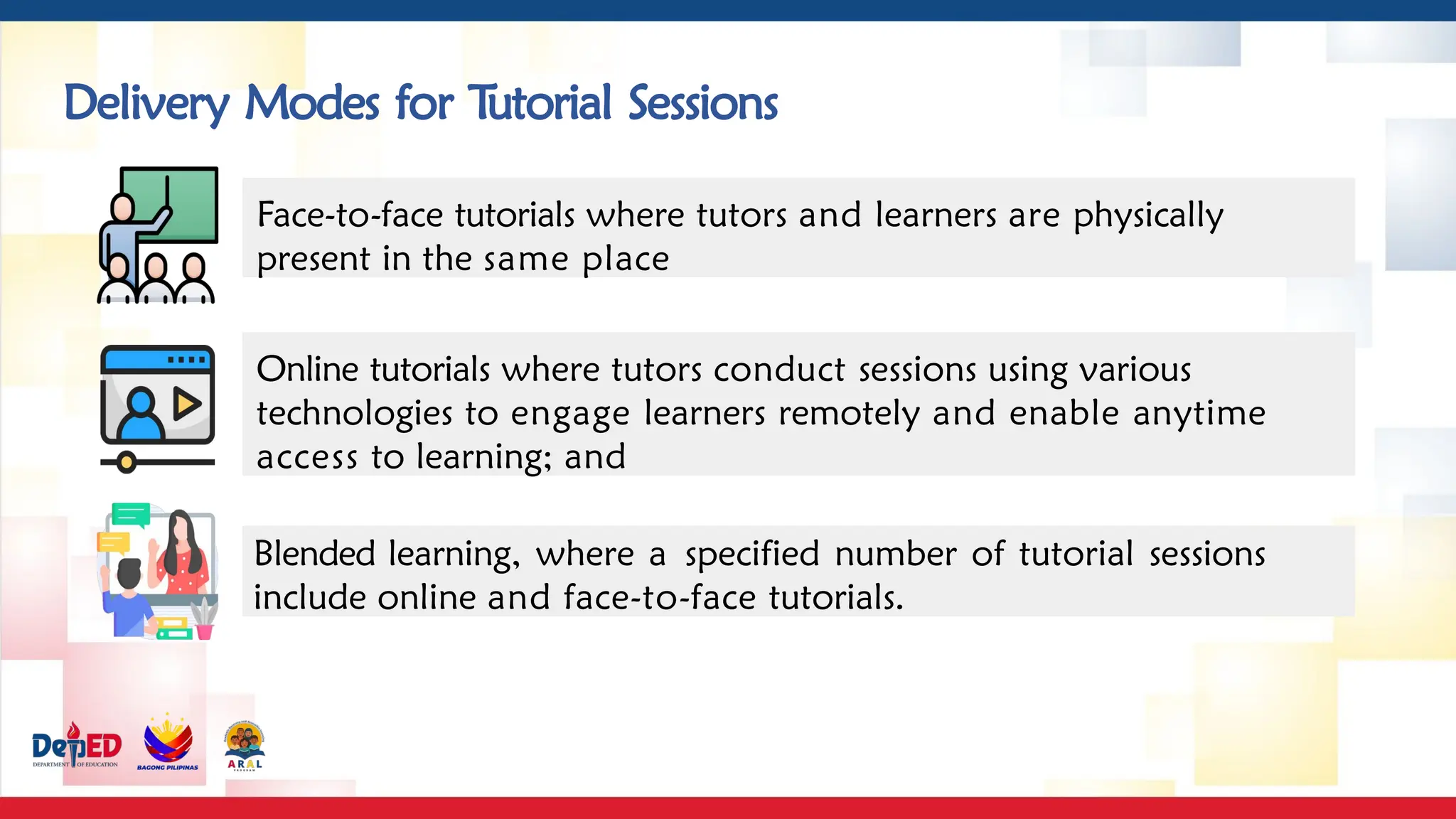
Delivery Modes forT
utorial Sessions
Blended learning, where a specified number of tutorial sessions
include online and face-to-face tutorials.
Face-to-face tutorials where tutors and learners are physically
present in the same place
Online tutorials where tutors conduct sessions using various
technologies to engage learners remotely and enable anytime
access to learning; and
34.
Delivery Modes forT
utorial Sessions
Tutorial sessions may be conducted in any or a combination of the
following:
Through a pull-out strategy or tutorial sessions during
regular class hours
As an add-on program where learners attend
intervention or tutorial sessions before or after school
hours, during weekends, or any time available within the
school calendar.
35.
What is theduration of ARAL-Reading sessions?
ARAL-Reading sessions shall not exceed one (1) hour during
weekdays and preferably be conducted daily.
Schools implementing multiple class shifts and special curricular
programs, may conduct ARAL-Reading on weekends, with each
session not exceeding two (2) hours.
TIME MON TUES WED THU FRI SAT
30-60
mins
√ √ √ √
Check
-in
TIME MON TUES WED THU FRI SAT
30-60
mins
√ √ √
TIME MON TUES WED THU FRI SAT
120
mins
√
Scenario 1: 4 times a week; daily Scenario 2: 2-3 times a week
Scenario 3: 2
hours on Saturday
When will theARAL-Reading Program start?
● Grade 1: 3rd Quarter SY 2025-2026
● Grades 2–3: 2nd Quarter SY 2025-2026
● Grades 4–10: 2nd Quarter SY 2025-2026 or
earlier, based on readiness.
Schools that require additional time to organize resources and personnel are
advised to coordinate with the Schools Division Office (SDO) regarding the
appropriate steps to take. They may also choose to begin implementation
at a later date, based on their readiness and contextual needs.
38.
BOSY
Assessment
(June 16-July 16)
Quarter1
(Jun 16-Aug 22)
MOSY
Assessment
(October 20-31)
EOSY
Assessment
(Feb 18-Mar 18)
Quarter 2
(Aug 26-Oct 24)
Quarter 3
(Nov 3-Jan 23)
Quarter 4
(Feb 18-Mar 20)
Start of ARAL
Program for Grades
1
November 3 – Jan 23
Start of ARAL
Program for Grades
2 to 10
(Aug 26/Sept 15)
If ARAL starts on Aug
26, MOSY is Oct 20-31
If ARAL starts on Sept
15, MOSY is Nov 10-21
Grade
1
Grade 2-3
Assessments
CRLA,
MFAT
CRLA,
MFAT
Phil-IRI,
MFAT
Grades 4-
10
CRLA
for 3-
Levels
Down
Implementation Timeline of the ARAL
Program
39.
Grade
Level
Quarter 1
(June 16-Aug22)
Level/
Milestone
Quarter 2
(Aug 26-Oct 24)
Level/
Milestone
Quarter 3
(Nov 3-Jan 23)
Quarter 4
(Jan 26-Mar 20)
Level/
Milestone EOSY
BOSY
Assessment
(June 16-July 16)
Intervention Intervention
MOSY
Assessment
(Oct 20-31)
Intervention
Level/
Milestone Assessment
Intervention
( Jan 26-Mar
18)
EOSY
Assessment
(Feb 18-Mar 18)
Grade 1 CRLA, MFAT
Classroom
remediation
Emerging
Classroom
remediation
CRLA
Emerging
8-week
tutorials
(with
check-ins)
Emerging
MFAT/ Other
screening
8-week
tutorials
(with
check-ins)
CRLA Emerging
Join
ARAL-
Summer
Emerging
8-week
tutorials
(with
check-ins)
Developing
Check-in;
Summative
Assessment
Classroom
remediation
CRLA
Developin
g/Transitio
ning
Exit ARAL
or Join
ARAL-
Summer
Grades
2-3
CRLA, MFAT
Classroom
remediation
Emerging
8-week
tutorials
(with
check-ins)
CRLA Emerging
8-week
tutorials
(with
check-ins)
Developing
Check-in;
Summative
Assessment
Classroom
remediation
CRLA
Developin
g/Transitio
ning
Exit ARAL
or Join
ARAL-
Summer
Grades
4 to 10
(Basic)
Phil-IRI,
MFAT
CRLA
for
3-Level
s Down
Classroom
remediation
Basic
8-week
tutorials
(with
check-ins)
Phil-IRI
CRLA for
3-Levels
Down
Basic
8-week
tutorials
(with
check-ins)
Basic
MFAT/ Other
screening
8-week
tutorials
(with
check-ins)
Phil-IR
I
CRLA for
3-Levels
Down
Plus
Exit ARAL
or Join
ARAL-
Summer
Grades
4 to 10
(Basic)
Plus
8-week
tutorials
(with
check-ins)
Plus
MFAT/ Other
screening
8-week
tutorials
(with
check-ins)
Phil-IR
I
CRLA for
3-Levels
Down
Plus
Exit ARAL
or Join
ARAL-
Summer
Grades
4 to 10
(Plus)
Phil-IRI,
MFAT
CRLA
for
3-Level
s Down
Classroom
remediation
Plus
Classroom
remediation
Phil-IRI
CRLA for
3-Levels
Down
Plus
8-week
tutorials
(with
check-ins)
Plus
MFAT/ Other
screening
8-week
tutorials
(with
check-ins)
Phil-IR
I
CRLA for
3-Levels
Down
Plus
Exit ARAL
or Join
ARAL-
Summer
ARAL Journey if ARAL-Reading starts on Aug
26
40.
Grade
Level
Quarter 1
(June 16-Aug22)
Quarter 2
(Aug 26-Oct
24)
Quarter 3
(Nov 3-Jan 23)
Quarter 4
(Jan 26-Mar 20)
EOSY
BOSY
Assessment
(June 16-July 16)
Intervention
Level/
Milestone
Intervention
(Sept 15-Nov
7)
MOSY
Assessment
(Nov 10-21)
Level/
Milestone
Intervention
(Nov 24-Jan
23)
Assessment
Intervention
(Jan
26-Feb 18)
EOSY
Assessment
(Feb 18-Mar
18)
Level/
Milestone
Grade 1 CRLA, MFAT
Classroom
remediation
Emerging
Classroom
remediation CRLA Emerging
6-week
tutorials (with
check-ins)
MFAT/
Other
screening
6-week
tutorials (with
check-ins)
CRLA Emerging
Join
ARAL-
Summer
Grades
2-3
CRLA
Classroom
remediation
Emerging
8-week tutorials
(with
check-ins)
CRLA Emerging
6-week
tutorials (with
check-ins)
MFAT/
Other
screening
6-week
tutorials (with
check-ins)
CRLA
Developi
ng
Exit ARAL
or Join
ARAL-
Summer
Grades 4
to 10
(Basic)
Phil-IR
I, MFAT
CRLA
for
3-Level
s Down
Classroom
remediation
Basic
8-week tutorials
(with
check-ins)
Phil-I
RI
CRLA for
3-Levels
Down
Basic
6-week
tutorials (with
check-ins)
MFAT/
Other
screening
6-week
tutorials (with
check-ins)
Phil-I
RI
CRLA
for
3-Leve
ls
Down
Plus
Exit ARAL
or Join
ARAL-
Summer
Grades 4
to 10
(Basic)
Phil-IR
I, MFAT
CRLA
for
3-Level
s Down
Classroom
remediation
Basic
8-week tutorials
(with
check-ins)
Phil-I
RI
CRLA for
3-Levels
Down
Plus
6-week
tutorials (with
check-ins)
MFAT/
Other
screening
6-week
tutorials (with
check-ins)
Phil-I
RI
CRLA
for
3-Leve
ls
Down
Plus
Exit ARAL
or Join
ARAL-
Summer
Grades 4
to 10
(Plus)
Phil-IR
I, MFAT
CRLA
for
3-Level
s Down
Classroom
remediation
Plus
8-week tutorials
(with
check-ins)
Phil-I
RI
CRLA for
3-Levels
Down
Plus
6-week
tutorials (with
check-ins)
MFAT/
Other
screening
6-week
tutorials (with
check-ins)
Phil-I
RI
CRLA
for
3-Leve
ls
Down
Plus
Exit ARAL
or Join
ARAL-
Summer
ARAL Journey if ARAL-Reading starts on Sept
15
Guidelines on theBudget Allocation and Fund
Utilization for the ARAL Program
The funds downloaded to the Regions shall be used to support activities and
expenses under the ARAL Program, which includes but are not limited to:
● Provision and distribution of Teacher and Learner Resources;
● Orientation Activities;
● Training Activities, including payments for external resource persons;
● School Readiness and Responsiveness Audit;
● Monitoring and Evaluation Activities;
● Other program-related expenses in compliance with the provisions of
the program guidelines, subject to the existing budgeting,
accounting, auditing, and procurement rules and regulations.
Milestone
s
01
03
04
Issuance of DepEdOrder
No. 18, s. 2025 -
Implementing Guidelines
of the ARAL Program
(June 13, 2025)
Release of Tutors’ 03
Guide and
Learners’ Workbook
(August 1
1
, 2025)
Issuance of DepEd Memo
64, s. 2025 - Implementing
Guidelines for
ARAL-Reading Program
for Key Stages 1 to 3
(August 1
, 2025)
Training of Trainers
and Tutors,
Orientation of
School Heads
(August 2025)
02
Issuance of DepEd Memo 56,
s. 2025 - Supplemental
Guidelines for ARAL School
Readiness and
Responsiveness Audit (ASRRA)
(July 18, 2025)
Start of the
ARAL Program
(Aug 26, 2025/S
ept 15)
46.
Training Plan: RegionalApproach
TRAINING OF TRAINERS
RESOURCE PERSONS (2)
SDO TRAINERS
SCHOOL TEACHERS / TUTORS
REGIONAL TRAINING
1-DAY SCHOOL
HEADS’
ORIENTATION
2-DAY
TRAINING OF
TRAINERS
2-DAY
TRAINING OF
TUTORS
DIVISION TRAINING
1-DAY SCHOOL
HEADS’
ORIENTATION
SCHOOL – BASED
TRAINING OF TUTORS
Mandatory
Milestone
s
01
03
04
Issuance of DepEdOrder
No. 18, s. 2025 -
Implementing Guidelines
of the ARAL Program
(June 13, 2025)
Release of Tutors’ 03
Guide and
Learners’ Workbook
(August 1
1
, 2025)
Issuance of DepEd Memo
64, s. 2025 - Implementing
Guidelines for
ARAL-Reading Program
for Key Stages 1 to 3
(August 1
, 2025)
Training of Trainers
and Tutors,
Orientation of
School Heads
(August 2025)
02
Issuance of DepEd Memo
56, s. 2025 - Supplemental
Guidelines for ARAL School
Readiness and
Responsiveness Audit
(ASRRA) ( July 18, 2025)
Start of the
ARAL Program
(Aug 26, 2025/S
ept 15)
49.
What materials willbe provided for ARAL-Reading?
Materials for Key Stage 1 Materials for Key Stages 2-3
Learners
● Learner’s Workbook
● Letter tiles
● Alphabet cards
● Pencils and crayons
● Activity
Sheets/Workbook
Tutors
● Alphabet cards
● Word - picture cards
● Teacher’s Guide
● Teacher’s Guide
1 : 1 is the ratio for Teacher’s
Guide and Learner’s Workbook
50.
What materials willbe provided for ARAL-
Reading?
ARAL-Reading Resources are now available
through: https://tinyurl.com/ARAL-
ReadingResources
What is therole of school heads in the ARAL-Reading Program?
School heads are responsible for managing the program at the school level. They
shall ensure:
●
● Effective delivery and implementation of the program
Administration of assessments and use of results to improve teaching
and learning
Submission of pre- and post-assessment data to the Schools Division
Office (SDO)
Participation of teachers and tutors in learning and development
activities (e.g., collaborative expertise sessions, benchmarking, etc.)
Submission of relevant reports to the SDO, including learners’ progress,
challenges encountered, and actions taken
●
●
●
54.
PARENT SUPPORT ISKEY to ARAL!
● Parental consent is needed when learners attend
ARAL sessions beyond regular school hours. It’s
essential to help parents understand that remediation
supports long-term success Active parent support
reinforces reading habits at home and motivates
learner progress
●
●
55.
How can wesupport our ARAL Parents?
●
●
●
●
Oriented PRIOR to a learner’s ARAL journey
Updated on the learner’s progress (after
assessments)
Activities or sessions with parents to be
documented
Provided with home support guidance
#1 DO: Greet the participants.
SAY:
Results of the national and regional assessments reveal low proficiency levels in reading among our Filipino learners. We can correlate this with the findings of the World Bank in 2022, that in the Philippines, we have 91% learning poverty, or 9 out of 10 learners are struggling. With this, a law was created in the Congress in line with the 8-point socio-economic agenda of President Ferdinand R. Marcos, Jr. as articulated in the Philippine Development Plan 2023-2028 and the 5-point Reform Agenda of DepEd. This law is entitled: (click)
#2 DO: Read the text.
SAY:
What does this law establish? (click)
#3 DO: Read the text.
SAY:
What is the policy mandate of the ARAL Program?
#4 SAY:
The policy emphasizes that the schools shall be able establish a free and effective national learning intervention program to ensure that all learners struggling in Reading, Math, and Science attain grade-level competencies set by DepEd at the end of each grade level as mandated by RA 12028 Section 2.
With this, the Department of Education released (click to the next slide deck)
#5 DO: Read the text.
SAY:
What does this law establish? (click)
#6 DO: Read the text.
SAY:
What does this law establish? (click)
#7 DO: Read the text.
SAY:
What does this law establish? (click)
#8 DO: Read the text in the red box. Click to the next slide deck.
#9 DO: Read the text in the red box. Click to the next slide deck.
#10 SAY:
The ARAL School Readiness and Responsiveness Audit looks at five main areas that show how ready a school is to carry out the ARAL Program. Each area has clear indicators that help point out what the school is doing well and what still needs to be improved.
#11 SAY:
ASRRA is a tool that checks how ready schools are, not a checklist for compliance. If there are unclear or inconsistent results, it means some schools may need extra support to prepare better for ARAL implementation.
#12 SAY:
If the audit shows “Not Met” or “Partially Met,” it means schools may be facing bigger challenges that need attention, such as changes in policies or new guidelines. The audit also helps decide where resources should go. If many schools are found unprepared, this is a signal to review and adjust the ARAL Program so it can be more flexible and easier to implement.
#13 SAY:
As of August 12, 2025, ASRRA reveals that (read the data in the slide deck).
#14 SAY:
This slide deck shows the status of submission of each region as of August 13, 2025.
#15 SAY:
The Technical Working Group (TWG) at every governance level—school, district, division, region, and central office—are established and that there’s a need for close coordination between them to ensure effective implementation of the ARAL Program. This multi-level collaboration allows for:
Efficient Planning and Decision-Making – ensuring strategies are responsive to actual school needs.
Stronger Feedback Loops – addressing concerns quickly by relaying issues up and down the governance levels.
Better Resource Allocation – making sure funds, materials, and training are directed where they are most needed.
Policy Alignment and Adjustment – refining guidelines and strategies based on real-time challenges.
Continuous Improvement – through monitoring, evaluation, and timely sharing of best practices.
By working together, the TWGs ensure that ARAL implementation is not only coordinated but also responsive, equitable, and sustainable.
#16 SAY:
On August 1, 2025, DepEd released Memorandum No. 64, s. 2025, titled Implementing Guidelines for the ARAL Reading Program for Key Stages 1 to 3.
#17 SAY:
Before we go back to the ARAL Reading Program guidelines, let’s take a quick look at the key issuances and what each one means.
#18 DO: Read the text in the red box. Click to the next slide deck.
#20 SAY:
This is the DM 064, s. 2025 - The Implementing Guidelines for the Academic Recovery and Accessible Program in Reading for Key Stages 1 to 3, which was officially issued on August 1, 2025.
#21 SAY:
This illustrates the framework of the ARAL Program, highlighting its key components, which include the beneficiaries, determination and assessment of learners, intervention delivery, progress monitoring, and post-assessment. The ARAL Program shall commence with the beginning-of-the-school-year (BOSY) assessment to determine the learners needing intervention in each type of beneficiary. Identified learners shall undergo the ARAL intervention programs with continuous monitoring of their progress through formative assessments. Learners who meet the grade-level competencies shall exit the ARAL Program, while those who do not shall continue under the program. At the end of the school year, learners shall be administered the end-of-the-school-year (EOSY) assessment, and those who need further support shall participate in ARAL-Summer Programs for additional intervention.
#22 SAY:
This illustrates the framework of the ARAL Program, highlighting its key components, which include the beneficiaries, determination and assessment of learners, intervention delivery, progress monitoring, and post-assessment. The ARAL Program shall commence with the beginning-of-the-school-year (BOSY) assessment to determine the learners needing intervention in each type of beneficiary. Identified learners shall undergo the ARAL intervention programs with continuous monitoring of their progress through formative assessments. Learners who meet the grade-level competencies shall exit the ARAL Program, while those who do not shall continue under the program. At the end of the school year, learners shall be administered the end-of-the-school-year (EOSY) assessment, and those who need further support shall participate in ARAL-Summer Programs for additional intervention.
#24 SAY:
This illustrates the framework of the ARAL Program, highlighting its key components, which include the beneficiaries, determination and assessment of learners, intervention delivery, progress monitoring, and post-assessment. The ARAL Program shall commence with the beginning-of-the-school-year (BOSY) assessment to determine the learners needing intervention in each type of beneficiary. Identified learners shall undergo the ARAL intervention programs with continuous monitoring of their progress through formative assessments. Learners who meet the grade-level competencies shall exit the ARAL Program, while those who do not shall continue under the program. At the end of the school year, learners shall be administered the end-of-the-school-year (EOSY) assessment, and those who need further support shall participate in ARAL-Summer Programs for additional intervention.
#25 SAY:
The ARAL Program has four components: ARAL-Reading, ARAL-Mathematics, ARAL-Science, and ARAL-Summer.
● DepEd had to prioritize because of the limited funding and resources.
● For this school year, implementation will focus on ARAL-Reading, as it is the most prepared in terms of available assessments and learning materials.
● ARAL-Mathematics may be rolled out by the third quarter or during summer next year, pending the completion of the RMA review. Meanwhile, ARAL-Science will be implementing in SY 2026-2027
#26 DO: Read the text.
SAY:
Learners who meet the minimum proficiency levels may be allowed to enroll in supplemental classes under the ARAL Program during the summer break. Priority shall be given to the learners as enumerated above. Learners in qualified private basic education institutions who are below the minimum proficiency levels required in reading, mathematics, and science and failing in formative and summative assessments shall be provided the same interventions upon request under RA 12028. In case of limited slots for enrollment, preference shall be given to beneficiaries of the Educational Service Contracting Scheme.
#27 SAY:
Learner’s participation in ARAL-Reading shall be based on the results of the BOSY Assessments. For Grade 1, the basis shall be CRLA MOSY assessment results. For Grades 2-3, the basis shall be the CRLA BOSY results. For Grades 4 to 10, the basis shall be Phil-IRI BOSY in ENGLISH (Emphasize that in accordance with the law, the focus
shall be English).
DO: Emphasize: For SY 2025–2026, ARAL-Reading shall prioritize Low and High Emerging learners in Key Stage 1 and Frustration learners (3- levels down) in Key Stages 2 and 3. Schools with the needed personnel and other resources are encouraged to extend the program to Developing and Transitioning learners in Key Stage 1 and 2 Levels Down learners in Key Stages 2 and 3.
#28 SAY:
A small class size in reading remediation offers several key benefits:
1. Individualized Instruction – Teachers can tailor lessons to each learner’s specific reading level and needs.
2. More Interaction – Learners have more opportunities to read aloud, ask questions, and receive feedback
3. Focused Attention – Struggling readers get more one-on-one support, which helps address gaps more effectively
4. Better Classroom Management – Fewer students make it easier to maintain a supportive, low-stress learning environment
5. Increased Confidence – Learners may feel less intimidated and more willing to participate in a smaller group.
#32 SAY:
For DepEd teachers: Teaching overload pay (based on RA 4670 or the Magna Carta for Public School Teachers, DBM guidelines, and DO 005, s. 2024) and vacation
service credits (VCS) based on DO 013, s. 2024.
● Pre-service teachers: Services rendered shall be considered relevant teaching experience when applying for a plantilla position in DepEd.
● Para-teachers and other trained individuals: Compensation for services with an amount not below the minimum daily wage; may be engaged under Contract of Service or Job Order (based on CSC-COA-DBM Joint Circular No. 2, s. 2022)
#33 SAY:
This is pursuant to RA 12028, and DO 18, s. 2025.
● Face to face is the recommended modality to ensure quality and effective instruction (teacher-factor)
● Modular + Instructional video for areas that need long term recovery or in high-risk areas.
● Agreement is that ARAL has different models of tutorial sessions, depending on the capacity (and needs) of the school to implement in various modality.
● Switching to a different modality may be considered as part of the school’s risk-management plan
#34 DO: Read the text.
SAY:
The choice of strategy depends on the resources and capacity of schools.
#35 SAY:
ARAL-Reading sessions shall not exceed one (1) hour during weekdays. A session can be conducted for 30 mins, 45 mins, or 60 mins. It is also preferred to be conducted daily or more than once a week.
DO: Reiterate that the configuration shall depend on the resources and capacity of schools.
#45 DO: Read the text in the red box. Click to the next slide deck.
#46 SAY:
This is the Training Plan for the ARAL Program.
● Resource persons (RPs) from the regions were trained by Central Office last August 8-9, 2025 and August 14-15.
● These RPs were assigned to train identified SDO trainers in the region.
● The SDO trainers will be assigned to train school teachers/tutors
● Regional training will consist of 1-day school head’s orientation and 2-day training of trainers.
#48 DO: Read the text in the red box. Click to the next slide deck.


![Relevant Issuances Description
1. Republic Act No. 12028 or the
“Academic Recovery and Accessible
Learning (ARAL) Program Act of
2024”
Establishes a free and effective national learning intervention program to
ensure that all learners attain the competencies set by the DepEd in their
respective grade levels
2. DepEd Order No. 18, s. 2025,
Implementing Guidelines for the ARAL
Program
Provides guidance for schools, community learning centers (CLCs), and
concerned offices across governance levels, including qualified private
institutions, in implementing the ARAL Program
3. DepEd Memo No. 56, s.
2025, Supplemental Guidelines
on the Implementation the ARAL-
SRRA
Provides guidance on the implementation of the ARAL School Readiness and
Responsiveness Audit (ASRRA) as a quality assurance mechanism to assess
school-level readiness in delivering ARAL interventions.
4. DepEd Memo No. 64, s. 2025,
Implementing Guidelines for
ARAL-Reading for Key Stages 1 to 3
Operationalizes the implementation of the ARAL Program in Reading
(ARAL-Reading) for Key Stages 1 to 3 in accordance with RA No. 12028
[Academic Recovery and Accessible Learning Program Act], its Implementing
Rules and Regulations, and DepEd Order No. 18, s. 2025 [Implementing
Guidelines of the Academic Recovery and Accessible Learning Program].
5. Guidelines on the Budget
Allocation and Fund Utilization for
the ARAL Program for SY 2025-2026
Establishes the guidelines on the budget allocation and fund utilization for the
ARAL Program pursuant to funding mechanisms authorized under Section 10 of
DepEd Order No. 18, s. 2025](https://image.slidesharecdn.com/improved02-implementing-guidelines-of-the-aral-reading-program-251021010936-002d49b5/75/improved02-Implementing-Guidelines-of-the-ARAL-Reading-Program-pptx-19-2048.jpg)