Refresh Your Home For Fall
To see product details, add this item to your cart. You can always remove it later.
Shipper / Seller
Amazon.com
Amazon.com
Shipper / Seller
Amazon.com
Returns
30-day refund / replacement
This item can be returned in its original condition for a full refund or replacement within 30 days of receipt.
Read full return policy
Gift options
Available at checkout
Available at checkout This item is a gift. Change
At checkout, you can add a custom message, a gift receipt for easy returns and have the item gift-wrapped
Payment
Secure transaction
Your transaction is secure
We work hard to protect your security and privacy. Our payment security system encrypts your information during transmission. We don’t share your credit card details with third-party sellers, and we don’t sell your information to others. Learn more
Added to

Sorry, there was a problem.

There was an error retrieving your Wish Lists. Please try again.

Sorry, there was a problem.

List unavailable.
Kindle app logo image

Download the free Kindle app and start reading Kindle books instantly on your smartphone, tablet, or computer - no Kindle device required.

Read instantly on your browser with Kindle for Web.

Using your mobile phone camera - scan the code below and download the Kindle app.

QR code to download the Kindle App

  • Designing Data-Intensive Applications: The Big Ideas Behind Reliable, Scalable, and Maintainable Systems

Follow the author

Get new release updates & improved recommendations
Something went wrong. Please try your request again later.

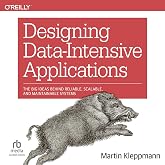
Designing Data-Intensive Applications: The Big Ideas Behind Reliable, Scalable, and Maintainable Systems

3.7 out of 5 stars (252)

Purchase options and add-ons

Data is at the center of many challenges in system design today. Difficult issues such as scalability, consistency, reliability, efficiency, and maintainability need to be resolved. In addition, there's an overwhelming variety of systems, including relational databases, NoSQL datastores, data warehouses, and data lakes. There are cloud services, on-premises services, and embedded databases. What are the right choices for your application? How do you make sense of all these buzzwords?

In this second edition, authors Martin Kleppmann and Chris Riccomini build on the foundation laid in the acclaimed first edition, integrating new technologies and emerging trends. You'll be guided through the maze of decisions and trade-offs involved in building a modern data system, learn how to choose the right tools for your needs, and understand the fundamentals of distributed systems.

  • Peer under the hood of the systems you already use, and learn to use them more effectively
  • Make informed decisions by identifying the strengths and weaknesses of different tools
  • Learn how major cloud services are designed for scalability, fault tolerance, and consistency
  • Understand the core principles upon which modern databases are built

Frequently bought together

This item: Designing Data-Intensive Applications: The Big Ideas Behind Reliable, Scalable, and Maintainable Systems
$56.86
Get it as soon as Saturday, Sep 19
In Stock
Ships from and sold by Amazon.com.
+
$52.40
Get it as soon as Saturday, Sep 19
In Stock
Ships from and sold by Amazon.com.
+
$52.40
Get it as soon as Saturday, Sep 19
In Stock
Ships from and sold by Amazon.com.
Total price: $00
To see our price, add these items to your cart.
Details
Added to Cart
Choose items to buy together.

Customers also bought or read

Loading...

From the brand


From the Publisher

From the Preface

Who Should Read This Book?

If any of the following are true for you, you’ll find this book valuable:

  • You’re a software engineer, software architect, or technical manager who needs to make decisions about the architecture of the systems you work on—for example, you need to choose tools for solving a given problem and figure out how best to apply them. This applies especially to backend systems.
  • You’re a data engineer who wants to understand the wider context of the systems you deal with, or a cloud engineer who wants insights into the underpinnings of the systems you’re using. You will find that even though modern distributed systems hide a lot of complexity from you, understanding their underlying principles is extremely useful for performance optimization and debugging.
  • You want to learn how to make data systems scalable (e.g., to support apps with millions of users), highly available (minimizing downtime), operationally robust, and easier to maintain in the long run (even as they grow and as requirements and technologies change).
  • You are preparing for a “system design” job interview in which you will be asked to sketch an architecture for an application, and you need to learn the principles for good data architectures.
  • You are curious to find out what goes on behind the scenes at major websites and online services, and inside various databases and data processing systems—especially if you like to dig deeper than buzzwords to gain a technically accurate and precise understanding of various technologies and their trade-offs.

This book assumes that you already have some experience building web-based applications and that you are familiar with relational databases and SQL. A high-level understanding of common network protocols like TCP and HTTP is helpful. Your choice of programming language or framework makes no difference for this book.

Designing Data-Intensive Applications

What’s New in the Second Edition?

This second edition has the same goals and scope as the first edition of Designing Data-Intensive Applications, which was published in 2017. However, we have thoroughly revised the entire book to reflect technological changes that have happened in the last decade and to improve the clarity of the explanations.

The biggest technical changes that have affected this book since the first edition are the explosion of interest in AI and the rise of cloud native data systems architectures. While this book is not about AI per se, we have added coverage of data systems that support AI and machine learning, including vector indexes (used for semantic search), DataFrames (used for training datasets), and batch processing systems for preparing large amounts of training data. Cloud native ideas, such as building data systems on top of object stores instead of local disks, have been woven in throughout the book.

We have also added discussions of sync engines and local-first software, workflow engines and durable execution, formal methods and randomized testing, GraphQL, and various other technologies that are worth knowing about. We have included a bit of legal context as well, by exploring the impact of the EU General Data Protection Regulation (GDPR) and related law. We’ve also taken a few things away—for example, as MapReduce is now largely obsolete, we have rewritten the batch processing chapter accordingly, and we sadly decided to drop the Tolkien-style maps.

A few discussions have been restructured, and the chapter numbering has changed. Some chapters required only a light edit, while others (such as Chapter 10, on consistency and consensus) were almost completely rewritten to make them clearer. Overall, the second edition is about 60 pages longer than the first.

Editorial Reviews

About the Author

Martin Kleppmann is a researcher in distributed systems at the University of Cambridge. Previously he was a software engineer and entrepreneur at Internet companies including LinkedIn and Rapportive, where he worked on large-scale data infrastructure. In the process he learned a few things the hard way, and he hopes this book will save you from repeating the same mistakes.

Martin is a regular conference speaker, blogger, and open source contributor. He believes that profound technical ideas should be accessible to everyone, and that deeper understanding will help us develop better software.

Chris Riccomini is a software engineer, startup investor, and author with 15+ years of experience at PayPal, LinkedIn, and WePay. He runs Materialized View Capital, where he invests in infrastructure startups. He is also the co-creator of Apache Samza and SlateDB, and co-author of The Missing README: A Guide for the New Software Engineer.

Product details

  • Publisher ‏ : ‎ O'Reilly Media
  • Publication date ‏ : ‎ March 24, 2026
  • Edition ‏ : ‎ 2nd
  • Language ‏ : ‎ English
  • Print length ‏ : ‎ 670 pages
  • ISBN-10 ‏ : ‎ 1098119061
  • ISBN-13 ‏ : ‎ 978-1098119065
  • Item Weight ‏ : ‎ 2.54 pounds
  • Dimensions ‏ : ‎ 7 x 2 x 9.19 inches
  • Best Sellers Rank: #2,031 in Books (See Top 100 in Books)
  • Customer Reviews:
    3.7 out of 5 stars (252)

About the author

Follow authors to get new release updates, plus improved recommendations.
Martin Kleppmann
Brief content visible, double tap to read full content.
Full content visible, double tap to read brief content.

Martin Kleppmann is a researcher in distributed systems and security at the University of Cambridge, and author of Designing Data-Intensive Applications (O'Reilly Media, 2017). Previously he was a software engineer and entrepreneur at Internet companies including LinkedIn and Rapportive, where he worked on large-scale data infrastructure. He is now working on TRVE DATA, a project that aims to bring end-to-end encryption and decentralisation to a wide range of applications.