Download the free Kindle app and start reading Kindle books instantly on your smartphone, tablet, or computer - no Kindle device required.
Read instantly on your browser with Kindle for Web.
Using your mobile phone camera - scan the code below and download the Kindle app.
Follow the authors
OK
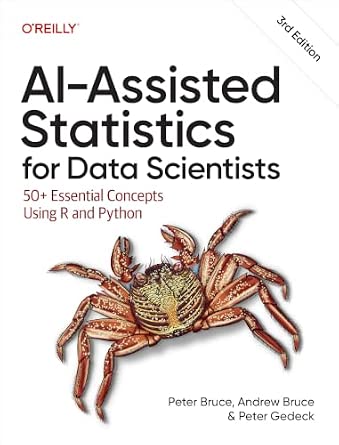
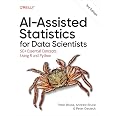
AI-Assisted Statistics for Data Scientists: 50+ Essential Concepts Using R and Python
Purchase options and add-ons
Statistical methods are a key part of data science, yet few data scientists have formal statistical training. Courses and books on basic statistics rarely cover the topic from a data science perspective. The third edition of this popular guide expands its practical foundations in R and Python into the modern AI toolkit, with new chapters on neural networks, deep learning, and large language models. Generative AI is integrated throughout, showing how tools such as ChatGPT, Claude, and Gemini work, and how they can support real-world statistical workflows.
This book highlights concepts that matter most when working with data, building predictive models, and deploying AI responsibly. If you're comfortable with R or Python and have had some exposure to basic statistics, this concise reference will boost your statistical literacy, your understanding of how AI works, and your confidence in real-world data science and AI projects.
- Conduct exploratory analysis of data to improve quality and model outcomes
- Apply sampling and experimental design to reduce bias and answer questions with clarity
- Use regression to understand data-generating processes and detect anomalies
- Build predictive models using classification, clustering, and unsupervised learning with unbalanced data
- ISBN-13979-8341666283
- Edition3rd
- PublisherO'Reilly Media
- Publication dateJuly 21, 2026
- LanguageEnglish
- Dimensions7 x 2 x 9.19 inches
- Print length505 pages
Discover the latest buzz-worthy books, from mysteries and romance to humor and nonfiction. Explore more
Frequently bought together
Customers who viewed this item also viewed
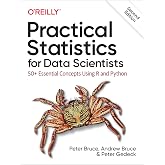
- Practical Statistics for Data Scientists: 50+ Essential Concepts Using R and PythonPaperbackFREE Shipping by AmazonGet it as soon as Tuesday, Sep 22Only 1 left in stock - order soon.
- AI Engineering: Building Applications with Foundation ModelsPaperbackFREE Shipping by AmazonGet it as soon as Saturday, Sep 19
- Essential Math for Data Science: Take Control of Your Data with Fundamental Linear Algebra, Probability, and StatisticsPaperbackFREE Shipping by AmazonGet it as soon as Saturday, Sep 19
- Hands-On Machine Learning with Scikit-Learn, Keras, and TensorFlow: Concepts, Tools, and Techniques to Build Intelligent SystemsPaperbackFREE Shipping by AmazonGet it as soon as Monday, Sep 21
- Data Science from Scratch: First Principles with PythonPaperbackFREE Shipping by AmazonGet it as soon as Saturday, Sep 19
- Designing Machine Learning Systems: An Iterative Process for Production-Ready ApplicationsPaperbackFREE Shipping by AmazonGet it as soon as Saturday, Sep 19
Customers also bought or read
- Essential Math for Data Science: Take Control of Your Data with Fundamental Linear Algebra, Probability, and Statistics
Paperback$36.22$36.22FREE delivery Sat, Sep 19 - Hands-On Machine Learning with Scikit-Learn, Keras, and TensorFlow: Concepts, Tools, and Techniques to Build Intelligent Systems
Paperback$49.50$49.50FREE delivery Mon, Sep 21 - R for Data Science: Import, Tidy, Transform, Visualize, and Model Data
Paperback$43.99$43.99FREE delivery Sat, Sep 19 - AI Engineering: Building Applications with Foundation Models#1 Best SellerEnterprise Applications
Paperback$52.40$52.40FREE delivery Sat, Sep 19 - Python Data Science Handbook: Essential Tools for Working with Data
Paperback$44.18$44.18FREE delivery Sat, Sep 19 - Practical Statistics for Data Scientists: 50+ Essential Concepts Using R and Python
Paperback$68.50$68.50FREE delivery Tue, Sep 22 - Mathematics of Machine Learning: Master linear algebra, calculus, and probability for machine learning
Paperback$44.30$44.30FREE delivery Mon, Sep 21 - Python for Data Analysis: Data Wrangling with pandas, NumPy, and Jupyter
Paperback$43.99$43.99FREE delivery Sep 30 - Oct 16 - Data Science from Scratch: First Principles with Python
Paperback$35.54$35.54FREE delivery Sat, Sep 19 - An Introduction to Statistical Learning: with Applications in Python (Springer Texts in Statistics)
Hardcover$56.21$56.21FREE delivery Thu, Oct 1 - Machine Learning for Trading: A disciplined workflow from research to live execution, with nine case studies and AI agents#1 New ReleaseComputer Neural Networks
Paperback$59.99$59.99FREE delivery Mon, Sep 21 - SQL for Data Analysis: Advanced Techniques for Transforming Data into Insights
Paperback$36.49$36.49FREE delivery Sat, Sep 19 - Fundamentals of Data Engineering: Plan and Build Robust Data Systems
Paperback$40.00$40.00FREE delivery Sep 27 - Oct 14 - Agentic Coding with Claude Code: The everyday developer's guide to agentic coding with Claude Code
Paperback$36.33$36.33FREE delivery Mon, Sep 21 - Hands-On Large Language Models: Language Understanding and Generation
Paperback$37.68$37.68FREE delivery Sat, Sep 19 - Machine Learning with PyTorch and Scikit-Learn: Develop machine learning and deep learning models with Python#1 Best SellerSpeech & Audio Processing
Paperback$36.05$36.05FREE delivery Sat, Sep 19 - Agentic Architectural Patterns for Building Multi-Agent Systems: Proven design patterns and practices for GenAI, agents, RAG, LLMOps, and enterprise-scale AI systems
Paperback$44.99$44.99FREE delivery Sat, Sep 19 - 30 Agents Every AI Engineer Must Build: Build production-ready agent systems using proven architectures and patterns
Paperback$41.79$41.79FREE delivery Mon, Sep 21 - Designing Machine Learning Systems: An Iterative Process for Production-Ready Applications
Paperback$40.00$40.00FREE delivery Sat, Sep 19 - Storytelling with Data: A Data Visualization Guide for Business Professionals#1 Best SellerBusiness Communication
Paperback$15.74$15.74Delivery Sat, Sep 19 - Graph Machine Learning: Learn about the latest advancements in graph data to build robust machine learning models
Paperback$38.54$38.54FREE delivery Mon, Sep 21 - AI Snake Oil: What Artificial Intelligence Can Do, What It Can’t, and How to Tell the Difference
Paperback$13.97$13.97Delivery Sat, Sep 19 - Software Engineering for Data Scientists: From Notebooks to Scalable Systems
Paperback$45.00$45.00FREE delivery Sat, Sep 19
From the brand
-
Explore more Data Science
-
Start learning with O'Reilly
-
More From O'Reilly
-
Sharing the knowledge of experts
O'Reilly's mission is to change the world by sharing the knowledge of innovators. For over 40 years, we've inspired companies and individuals to do new things (and do them better) by providing the skills and understanding that are necessary for success.
Our customers are hungry to build the innovations that propel the world forward. And we help them do just that.
From the Publisher
From the Preface
This book, which has been updated with extensive new chapters and material on AI (neural networks, deep learning, and generative AI), is aimed at the data scientist and the machine learning engineer who has some prior (perhaps spotty or ephemeral) exposure to statistics. Illustrations are provided using the R and/or Python programming languages. Some familiarity with those languages is useful, but, with the vibe coding capabilities of modern AI tools, even those with no programming background can benefit from this book.
Two of the authors came to the world of data science from the world of statistics, and have some appreciation of the contribution that statistics can make to the art of data science. At the same time, we are well aware of the limitations of traditional statistics instruction: statistics as a discipline is a century and a half old, and most statistics textbooks and courses are laden with the momentum and inertia of an ocean liner. The methods in the first portion of this book have some connection—historical or methodological—to the discipline of statistics. Neural nets—the underpinning of modern AI—evolved mainly out of computer science and are covered in the latter part of the book.
Data scientists, machine learning practitioners, and software engineers have come to know AI as a powerful coding tool. Vibe coding refers to the ability of AI models to produce code based on specifications (a prompt) written in English or some other natural language. A related concept, agentic coding, is broader, covering autonomous task execution by AI agents within a structured workflow that includes goal and task specification, testing, validation, and oversight. In this book, examples in R and Python are shown, and the initial chapters (the ones that focus on statistics) discuss the use of vibe coding, primarily at the conclusion of the chapters. The latter chapters discuss AI in more depth, and go into more detail on its use for coding.
Why learn about statistics, coding, and the models that underpin AI if large language models (LLMs) can do the work for you? If you can use AI as a quasi-magical tool to do your work, why do you really need to understand the underlying concepts?
- AI can make mistakes, mistakes which may not be readily apparent.
- If used properly in statistics and data science, AI will ask you questions and offer choices that require some knowledge of the underlying statistical concepts to answer.
- If you have some understanding of neural nets and how—based on a statistical and machine learning foundation—they enable deep learning and generative AI, you are in a better position to understand their strengths and weaknesses.
- While AI is very effective at providing “textbook” solutions to well-defined statistical problems, it does not yet have the ability to do the kind of critical thinking and problem solving that is required to work through an ambiguous data science project from end-to-end.
With respect to statistics, this book seeks to:
- Lay out, in digestible, navigable, and easily referenced form, key concepts from statistics that are relevant to data science.
- Explain which concepts are important and useful from a data science perspective, which are less so, and why.
With respect to AI, this book seeks to:
- Provide a conceptual overview, at a high level in nontechnical terms, the statistical and machine learning foundations and the current algorithms of neural networks, deep learning, and generative AI.
- Illustrate the use of generative AI for statistical analysis.
Note that this book is not intended as a practitioners guide to deep learning and generative AI.
Editorial Reviews
About the Author
Andrew Bruce has over 30 years of experience in statistics and data science in academia, government, and business. He has a PhD in statistics from the University of Washington and has published numerous papers in refereed journals. He has developed statistical-based solutions to a wide range of problems faced by a variety of industries, from established financial firms to internet startups, and offers a deep understanding of the practice of data science.
Peter Gedeck has over 30 years of experience in scientific computing and data science. After 20 years as a computational chemist at Novartis, he now works as a senior data scientist at Collaborative Drug Discovery. He specializes in the development of machine learning algorithms to predict biological and physicochemical properties of drug candidates. Coauthor of Machine Learning for Business Analytics, he earned a PhD in chemistry from the University of Erlangen-Nuernberg in Germany and studied mathematics at the Fernuniversitaet Hagen, Germany.
Product details
- ASIN : B0GK713BRM
- Publisher : O'Reilly Media
- Publication date : July 21, 2026
- Edition : 3rd
- Language : English
- Print length : 505 pages
- ISBN-13 : 979-8341666283
- Item Weight : 1.76 pounds
- Dimensions : 7 x 2 x 9.19 inches
- Best Sellers Rank: #154,909 in Books (See Top 100 in Books)
- #17 in Mathematical & Statistical Software
- #43 in Data Mining (Books)
- #47 in Data Processing
- Customer Reviews:
About the authors

Discover more of the author’s books, see similar authors, read book recommendations and more.

Dr. Peter Gedeck holds a Ph.D. in chemistry. He worked for twenty years as a computational chemist in drug discovery at Novartis in the United Kingdom, Switzerland, and Singapore. His research interests include the application of statistical and machine learning methods to problems in drug discovery. He is a scientist in the research informatics team at Collaborative Drug Discovery, which offers the pharmaceutical industry cloud-based software to manage the huge amount of data involved in the drug discovery process.
Peter’s specialty is the development of machine learning algorithms to predict biological and physicochemical properties of drug candidates. His scientific work is published in more than 50 peer reviewed articles and five books.
Peter is also a lecturer at the University of Virginia's School of Data Science teaching courses for the Master's program.