Refresh Your Home For Fall
To see product details, add this item to your cart. You can always remove it later.
Shipper / Seller
Amazon.com
Amazon.com
Shipper / Seller
Amazon.com
Returns
30-day refund / replacement
This item can be returned in its original condition for a full refund or replacement within 30 days of receipt.
Read full return policy
Payment
Secure transaction
Your transaction is secure
We work hard to protect your security and privacy. Our payment security system encrypts your information during transmission. We don’t share your credit card details with third-party sellers, and we don’t sell your information to others. Learn more
Gift options
Available at checkout
Available at checkout This item is a gift. Change
At checkout, you can add a custom message, a gift receipt for easy returns and have the item gift-wrapped
Added to

Sorry, there was a problem.

There was an error retrieving your Wish Lists. Please try again.

Sorry, there was a problem.

List unavailable.
Kindle app logo image

Download the free Kindle app and start reading Kindle books instantly on your smartphone, tablet, or computer - no Kindle device required.

Read instantly on your browser with Kindle for Web.

Using your mobile phone camera - scan the code below and download the Kindle app.

QR code to download the Kindle App

  • Designing Machine Learning Systems: An Iterative Process for Production-Ready Applications

Follow the author

Get new release updates & improved recommendations
Something went wrong. Please try your request again later.

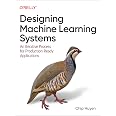
Designing Machine Learning Systems: An Iterative Process for Production-Ready Applications

4.6 out of 5 stars (1,000)

Purchase options and add-ons

Machine learning systems are both complex and unique. Complex because they consist of many different components and involve many different stakeholders. Unique because they're data dependent, with data varying wildly from one use case to the next. In this book, you'll learn a holistic approach to designing ML systems that are reliable, scalable, maintainable, and adaptive to changing environments and business requirements.

Author Chip Huyen, co-founder of Claypot AI, considers each design decision--such as how to process and create training data, which features to use, how often to retrain models, and what to monitor--in the context of how it can help your system as a whole achieve its objectives. The iterative framework in this book uses actual case studies backed by ample references.

This book will help you tackle scenarios such as:

  • Engineering data and choosing the right metrics to solve a business problem
  • Automating the process for continually developing, evaluating, deploying, and updating models
  • Developing a monitoring system to quickly detect and address issues your models might encounter in production
  • Architecting an ML platform that serves across use cases
  • Developing responsible ML systems

Frequently bought together

This item: Designing Machine Learning Systems: An Iterative Process for Production-Ready Applications
$40.00
Get it as soon as Saturday, Sep 19
In Stock
Ships from and sold by Amazon.com.
+
$52.40
Get it as soon as Saturday, Sep 19
In Stock
Ships from and sold by Amazon.com.
+
$56.86
Get it as soon as Saturday, Sep 19
In Stock
Ships from and sold by Amazon.com.
Total price: $00
To see our price, add these items to your cart.
Details
Added to Cart
Choose items to buy together.

Customers also bought or read

Loading...

From the brand


From the Publisher

Designing Machine Learning Systems

From the Preface

Who This Book Is For

This book is for anyone who wants to leverage ML to solve real-world problems. ML in this book refers to both deep learning and classical algorithms, with a leaning toward ML systems at scale, such as those seen at medium to large enterprises and fast-growing startups. Systems at a smaller scale tend to be less complex and might benefit less from the comprehensive approach laid out in this book.

Because my background is engineering, the language of this book is geared toward engineers, including ML engineers, data scientists, data engineers, ML platform engineers, and engineering managers.

You might be able to relate to one of the following scenarios:

  • You have been given a business problem and a lot of raw data. You want to engineer this data and choose the right metrics to solve this problem.
  • Your initial models perform well in offline experiments and you want to deploy them. You have little feedback on how your models are performing after your models are deployed, and you want to figure out a way to quickly detect, debug, and address any issue your models might run into in production.
  • The process of developing, evaluating, deploying, and updating models for your team has been mostly manual, slow, and error-prone. You want to automate and improve this process.
  • Each ML use case in your organization has been deployed using its own workflow, and you want to lay down the foundation (e.g., model store, feature store, monitoring tools) that can be shared and reused across use cases.
  • You’re worried that there might be biases in your ML systems and you want to make your systems responsible!

You can also benefit from the book if you belong to one of the following groups:

  • Tool developers who want to identify underserved areas in ML production and figure out how to position your tools in the ecosystem.
  • Individuals looking for ML-related roles in the industry.
  • Technical and business leaders who are considering adopting ML solutions to improve your products and/or business processes. Readers without strong technical backgrounds might benefit the most from Chapters 1, 2, and 11.

What This Book Is Not

This book is not an introduction to ML. There are many books, courses, and resources available for ML theories, and therefore, this book shies away from these concepts to focus on the practical aspects of ML. To be specific, the book assumes that readers have a basic understanding of the following topics:

  • ML models such as clustering, logistic regression, decision trees, collaborative filtering, and various neural network architectures including feed-forward, recurrent, convolutional, and transformer
  • ML techniques such as supervised versus unsupervised, gradient descent, objective/loss function, regularization, generalization, and hyperparameter tuning
  • Metrics such as accuracy, F1, precision, recall, ROC, mean squared error, and log-likelihood
  • Statistical concepts such as variance, probability, and normal/long-tail distribution
  • Common ML tasks such as language modeling, anomaly detection, object classification, and machine translation

You don’t have to know these topics inside out—for concepts whose exact definitions can take some effort to remember, e.g., F1 score, we include short notes as references—but you should have a rough sense of what they mean going in.

While this book mentions current tools to illustrate certain concepts and solutions, it’s not a tutorial book. Technologies evolve over time. Tools go in and out of style quickly, but fundamental approaches to problem solving should last a bit longer. This book provides a framework for you to evaluate the tool that works best for your use cases. When there’s a tool you want to use, it’s usually straightforward to find tutorials for it online. As a result, this book has few code snippets and instead focuses on providing a lot of discussion around trade-offs, pros and cons, and concrete examples.

Designing Machine Learning Systems: An Iterative Process for Production-Ready...
AI Engineering: Building Applications with Foundation Models
Customer Reviews
4.6 out of 5 stars 1,000
4.6 out of 5 stars 961
Books by Chip Huyen no data no data

Editorial Reviews

Review

"This is, simply, the very best book you can read about how to build, deploy, and scale machine learning models at a company for maximum impact. Chip is a masterful teacher, and the breadth and depth of her knowledge is unparalleled."

- Josh Wills, Software Engineer at WeaveGrid and former Director of Data Engineering, Slack

"
There is so much information one needs to know to be an effective machine learning engineer. It's hard to cut through the chaff to get the most relevant information, but Chip has done that admirably with this book. If you are serious about ML in production, and care about how to design and implement ML systems end to end, this book is essential."

- Laurence Moroney, AI and ML Lead, Google

"One of the best resources that focuses on the first principles behind designing ML systems for production. A must-read to navigate the ephemeral landscape of tooling and platform options."

- Goku Mohandas, Founder of Made With ML

"Chip's manual is the book we deserve and the one we need right now. In a blooming but chaotic ecosystem, this principled view on end-to-end ML is both your map and your compass: a must-read for practitioners inside and outside of Big Tech—especially those working at 'reasonable scale.' This book will also appeal to data leaders looking for best practices on how to deploy, manage, and monitor systems in the wild."

- Jacopo Tagliabue, Director of AI, Coveo; Adj. Professor of MLSys, NYU

"Chip is truly a world-class expert on machine learning systems, as well as a brilliant writer. Both are evident in this book, which is a fantastic resource for anyone looking to learn about this topic."

- Andrey Kurenkov, PhD Candidate at the Stanford AI Lab

From the Author

Ever since the first machine learning course I taught at Stanford in 2017, many people have asked me for advice on how to deploy ML models at their organizations. These questions can be generic, such as "What model should I use?" "How often should I retrain my model?" "How can I detect data distribution shifts?" "How do I ensure that the features used during training are consistent with the features used during inference?"
 
These questions can also be specific, such as "I'm convinced that switching from batch prediction to online prediction will give our model a performance boost, but how do I convince my manager to let me do so?" or "I'm the most senior data scientist at my company and I've recently been tasked with setting up our first machine learning platform; where do I start?"
 
My short answer to all these questions is always: "It depends." My long answers often involve hours of discussion to understand where the questioner comes from, what they're actually trying to achieve, and the pros and cons of different approaches for their specific use case.
 
ML systems are both complex and unique. They are complex because they consist of many different components (ML algorithms, data, business logics, evaluation metrics, underlying infrastructure, etc.) and involve many different stakeholders (data scientists, ML engineers, business leaders, users, even society at large). ML systems are unique because they are data dependent, and data varies wildly from one use case to the next.
 
For example, two companies might be in the same domain (ecommerce) and have the same problem that they want ML to solve (recommender system), but their resulting ML systems can have different model architecture, use different sets of features, be evaluated on different metrics, and bring different returns on investment.
 
Many blog posts and tutorials on ML production focus on answering one specific question. While the focus helps get the point across, they can create the impression that it's possible to consider each of these questions in isolation. In reality, changes in one component will likely affect other components. Therefore, it's necessary to consider the system as a whole while attempting to make any design decision.
 
This book takes a holistic approach to ML systems. It takes into account different components of the system and the objectives of different stakeholders involved. The content in this book is illustrated using actual case studies, many of which I've personally worked on, backed by ample references, and reviewed by ML practitioners in both academia and industry. Sections that require in-depth knowledge of a certain topic—e.g., batch processing versus stream processing, infrastructure for storage and compute, and responsible AI—are further reviewed by experts whose work focuses on that one topic. In other words, this book is an attempt to give nuanced answers to the questions mentioned above and more.
 
When I first wrote the lecture notes that laid the foundation for this book, I thought I wrote them for my students to prepare them for the demands of their future jobs as data scientists and ML engineers. However, I soon realized that I also learned tremendously through the process. The initial drafts I shared with early readers sparked many conversations that tested my assumptions, forced me to consider different perspectives, and introduced me to new problems and new approaches.

I hope that this learning process will continue for me now that the book is in your hand, as you have experiences and perspectives that are unique to you. Please feel free to share with me any feedback you might have for this book!

Product details

  • Publisher ‏ : ‎ O'Reilly Media
  • Publication date ‏ : ‎ June 21, 2022
  • Edition ‏ : ‎ 1st
  • Language ‏ : ‎ English
  • Print length ‏ : ‎ 386 pages
  • ISBN-10 ‏ : ‎ 1098107969
  • ISBN-13 ‏ : ‎ 978-1098107963
  • Item Weight ‏ : ‎ 1.4 pounds
  • Dimensions ‏ : ‎ 6.9 x 0.7 x 9.1 inches
  • Best Sellers Rank: #14,574 in Books (See Top 100 in Books)
  • Customer Reviews:
    4.6 out of 5 stars (1,000)

About the author

Follow authors to get new release updates, plus improved recommendations.
Chip Huyen
Brief content visible, double tap to read full content.
Full content visible, double tap to read brief content.

I’m Chip Huyen, a writer and computer scientist. I grew up chasing grasshoppers in a small rice-farming village in Vietnam.

I work in the intersection of AI, data, and storytelling. Previously, I built machine learning tools at NVIDIA, Snorkel AI, Netflix, and founded an AI infrastructure startup (acquired).

I also taught Machine Learning Systems Design at Stanford.

My last book, Designing Machine Learning Systems, is an Amazon bestseller in AI and has been translated into over 10 languages (very proud!).

In my free time, I like writing stories. I'm also the author of 4 Vietnamese story books.