Refresh Your Home For Fall
To see product details, add this item to your cart. You can always remove it later.
Shipper / Seller
Amazon.com
Amazon.com
Shipper / Seller
Amazon.com
Returns
30-day refund / replacement
This item can be returned in its original condition for a full refund or replacement within 30 days of receipt.
Read full return policy
Payment
Secure transaction
Your transaction is secure
We work hard to protect your security and privacy. Our payment security system encrypts your information during transmission. We don’t share your credit card details with third-party sellers, and we don’t sell your information to others. Learn more
Gift options
Available at checkout
Available at checkout This item is a gift. Change
At checkout, you can add a custom message, a gift receipt for easy returns and have the item gift-wrapped
Added to

Sorry, there was a problem.

There was an error retrieving your Wish Lists. Please try again.

Sorry, there was a problem.

List unavailable.
Kindle app logo image

Download the free Kindle app and start reading Kindle books instantly on your smartphone, tablet, or computer - no Kindle device required.

Read instantly on your browser with Kindle for Web.

Using your mobile phone camera - scan the code below and download the Kindle app.

QR code to download the Kindle App

  • AI Agents: The Definitive Guide: Design, Deployment, and Evaluation for Production

Follow the author

Get new release updates & improved recommendations
Something went wrong. Please try your request again later.

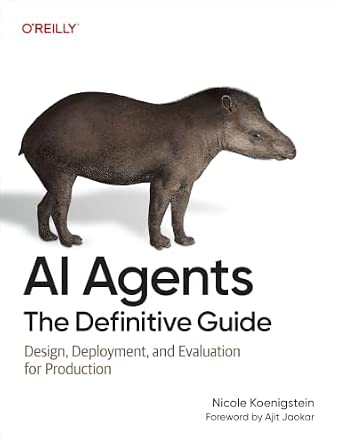
AI Agents: The Definitive Guide: Design, Deployment, and Evaluation for Production


Savings Pre-order Price Guarantee. Terms

Purchase options and add-ons

As AI agents move from research labs into production, engineering teams face mounting challenges—fragile tools, rising inference costs, erratic behavior, and unmet expectations. AI Agents: The Definitive Guide addresses what most books avoid: how to design, deploy, and maintain real AI agents that actually work in the real world, not just in demos. Written by Nicole Koenigstein, this book offers the practical, system-level foundations needed to build robust, scalable, and secure agentic systems.

Whether you're tasked with making agent prototypes production-ready or building mission-critical automation from the ground up, this book guides you through every layer of the stack, without being framework-dependent. It covers architectures, tool integration, performance optimization, safety strategies, and advanced evaluation, with a relentless focus on reliability and long-term value.

  • Design stateful, reasoning, and multi-agent systems
  • Apply reinforcement learning, search, and test-time compute
  • Build reliable tool integration and execution boundaries
  • Evaluate agents across development and production
  • Design memory, monitoring, fallbacks, and efficient infrastructure
  • Secure agents through isolation, governance, and threat modeling

Frequently bought together

This item: AI Agents: The Definitive Guide: Design, Deployment, and Evaluation for Production
$66.99
This title will be released on October 6, 2026.
Pre-order now.
Ships from and sold by Amazon.com.
+
$79.99
This title will be released on October 6, 2026.
Pre-order now.
Ships from and sold by Amazon.com.
+
$74.55
This title will be released on October 27, 2026.
Pre-order now.
Ships from and sold by Amazon.com.
Total price: $00
To see our price, add these items to your cart.
Details
Added to Cart
Some of these items ship sooner than the others.
Choose items to buy together.

Customers also bought or read

Loading...

From the brand


From the Publisher

AI Agents: The Definitive Guide: Design, Deployment, and Evaluation for Production

From the Preface

What This Book Is About

This book is a practical systems guide to designing, building, deploying, and evaluating AI agents for production.

It begins with the architectural foundations that make agentic behavior possible: state, control flow, planning, reasoning, reflection, and action. From there, it moves into increasingly complex systems, including human-in-the-loop workflows, hierarchical agents, swarms, search-based reasoning, reinforcement learning, and test-time compute.

The book also looks at the models behind the agents and the trade-offs involved in choosing between decoder-only, encoder-only, mixture-of-experts, reasoning, open-weight, and closed models. You’ll see how model choice, quantization, adapters, and inference constraints shape the behavior and feasibility of the larger system.

A substantial part of the book focuses on the transition from prototype to production. You’ll learn how to structure data contracts, validate outputs, integrate tools, use the Model Context Protocol, isolate execution, and govern programmatic tool calls. The later chapters address deployment, monitoring, fallbacks, inference backends, caching, evaluation, memory, infrastructure, cost, and threat modeling.

Evaluation is treated as part of the full agent lifecycle. This includes stress testing before deployment, observing behavior in production, turning traces into custom benchmarks, and assessing long-horizon reasoning, tool use, and system reliability.

Throughout the book, theory is paired with concrete implementations, architectural patterns, production considerations, and the trade-offs that become visible only when agentic systems are expected to operate under real conditions.

What This Book Is Not

This is not an introduction to large language models (LLMs). I assume that you already understand the basics of LLMs, embeddings, inference, and modern language models. Relevant concepts are explained where necessary, but the focus is on how those models become part of larger agentic systems.

This is also not a prompt engineering guide or a collection of API recipes. Prompts and instructions matter, but they’re only one part of an agent. This book provides the foundation for designing, evaluating, securing, and deploying production agents, including state, planning, tools, contracts, memory, execution boundaries, infrastructure, and governance.

Nor is this a framework manual. LangGraph, Pydantic, MCP, inference backends, and other tools appear throughout the book to make the examples concrete, but my goal is not to teach you one implementation stack. Frameworks and interfaces will change. My emphasis is on the architectural and engineering principles that allow you to evaluate new tools and apply them to your own systems.

Finally, this book is also not a collection of polished demonstrations that stop once an agent successfully calls a tool. It focuses on what happens or fails after your prototype works: reliability, observability, failure recovery, security, cost, deployment, and long-term maintainability.

Who This Book Is For

This book is written for intermediate to advanced software engineers, data scientists, machine learning engineers, MLOps engineers, AI and DevOps specialists, and AI infrastructure engineers who are responsible for designing, building, deploying, and maintaining LLM-powered agents in production. It’s for readers dealing with the realities that appear once an agent moves beyond a controlled prototype.

Specifically, I wrote this for:

  • The engineer who needs to turn an agent prototype into a reliable production system and troubleshoot what happens when state breaks, tools fail, latency increases, or costs begin to scale
  • The AI infrastructure engineers who are directly responsible for designing, developing, deploying, and maintaining AI agents powered by LLMs in production environments
  • The architect who needs to decide how models, tools, memory, control flow, evaluation, security, and infrastructure should work together across the full system
  • The technical leader who needs to assess feasibility, estimate cost, guide implementation teams, and understand the trade-offs between performance, reliability, security, and autonomy
  • The deep-tech founder or CTO who needs enough technical depth to evaluate solutions, set realistic expectations, and make decisions about how an agentic product can be built and operated sustainably

A working understanding of Python and large language models is assumed. Experience with cloud platforms can be helpful, but isn’t required. It’s also useful if you understand how transformers process sequences and have at least a basic sense of how embeddings work or vector stores support retrieval.

Throughout these chapters, I don’t shy away from the complexity that production agent systems demand. Technical depth, however, will always serve a practical purpose and I pair it with clear implementations and concrete examples. The book focuses on the details that emerge when agents are expected to operate under real conditions, because those are the details that determine whether a system merely works in a demo or can be maintained in production.

Editorial Reviews

About the Author

Nicole Koenigstein is an AI researcher and practitioner in agentic systems, working across research, consulting, teaching, and direct system implementation to build reliable, production-ready AI systems. Her work focuses on multi-agent architectures, evaluation, safety, and long-term system behavior.

She served as an external evaluator for a European Commission AI Grand Challenge and has advised IOSCO on generative AI in regulated environments. She also serves on advisory boards for leading AI and quantitative finance conferences. Nicole regularly delivers invited talks and technical workshops across academia, industry, and international events.

She is the author of
Math for Machine Learning and Transformers in Action with Manning Publications. Her forthcoming books, Transformers: The Definitive Guide--Applications Beyond NLP and AI Agents: The Definitive Guide, will be published by O'Reilly Media.

Product details

About the author

Follow authors to get new release updates, plus improved recommendations.
Nicole Koenigstein
Brief content visible, double tap to read full content.
Full content visible, double tap to read brief content.

Discover more of the author’s books, see similar authors, read book recommendations and more.