CELPIP Reading Score Chart

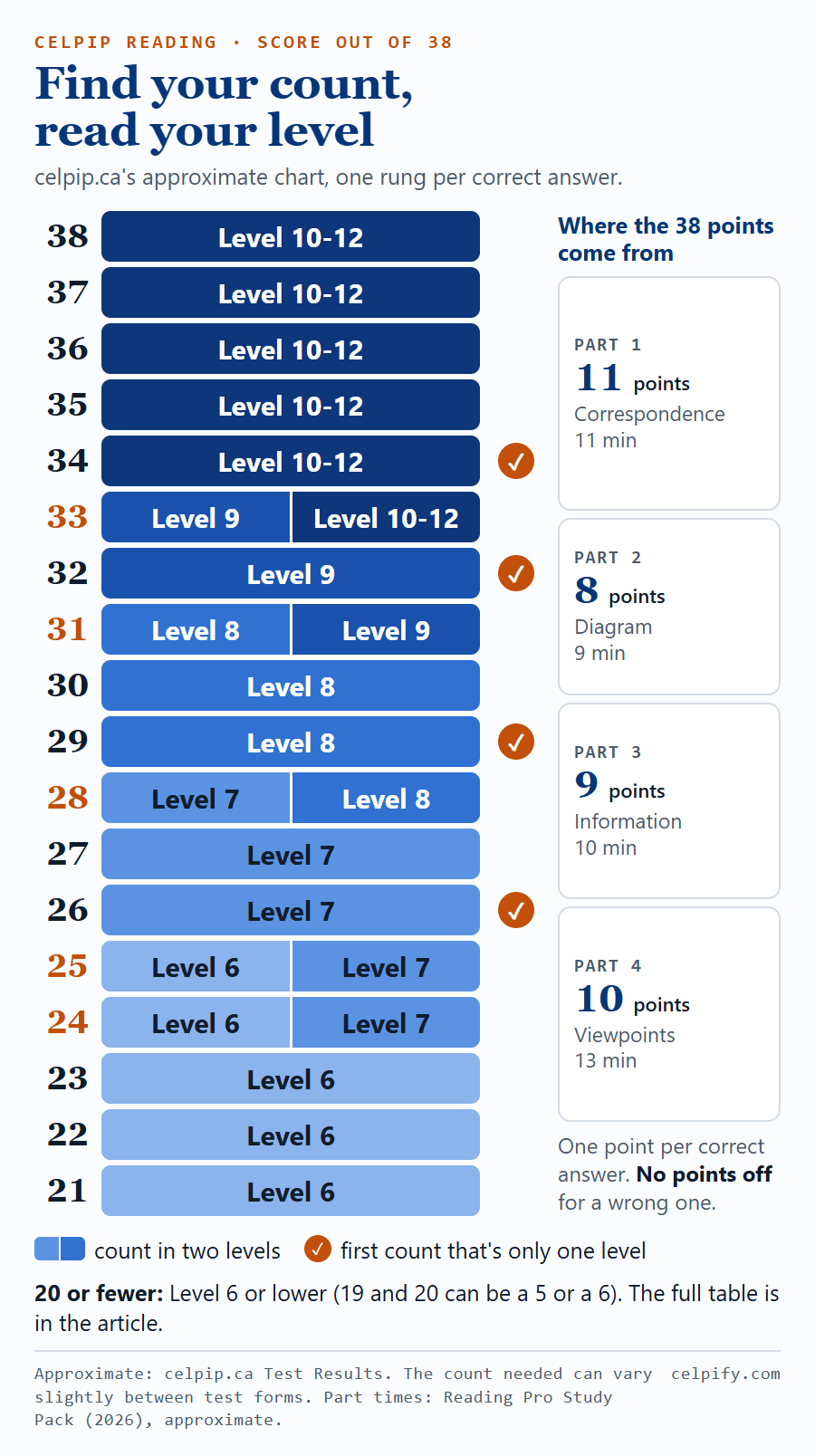
CELPIP Reading has 38 scored questions, and each right answer is worth one point. celpip.ca's approximate CELPIP score chart for Reading turns that count into a level: 24-28 correct is Level 7, 28-31 is Level 8, 31-33 is Level 9 and 33-38 is Levels 10-12. The top band starts at 33, two answers lower than in Listening.
Some counts sit in two levels, and 28 is one of them. It's also the median Test 1 Reading total on Celpify: the middle score of the 102 learners who did all four parts on a first try between August 1 and mid-October 2026 (practice data, not official results). So the typical first try lands on a count that could be a 7 or an 8. Six more right answers would make it a 34, and we know which six questions were missed most.
CELPIP Reading Score Chart Out of 38
The approximate number of correct answers for each Reading level, with the CLB level it equals and IRCC's IELTS Reading match.
This is the CELPIP Reading score table celpip.ca publishes. It covers CELPIP-General, the only version with a Reading test, so the CELPIP General reading score chart and this one are the same thing.
| CELPIP level | Correct out of 38 | CLB level | IELTS Reading (IRCC) |
|---|---|---|---|
| 10-12 | 33-38 | 10-12 | 8.0 or higher |
| 9 | 31-33 | 9 | 7.0 |
| 8 | 28-31 | 8 | 6.5 |
| 7 | 24-28 | 7 | 6.0 |
| 6 | 19-25 | 6 | 5.0 |
| 5 | 15-20 | 5 | 4.0 |
| 4 | 10-16 | 4 | 3.5 |
| 3 | 8-11 | 3 | Not in IRCC's table |
| M (levels 0 to 2) | 0-7 | 1-2 for a level 2, none for 0 or 1 | Not in IRCC's table |
celpip.ca calls it an example chart that shows how Reading scores "approximately correspond to CELPIP Levels", and warns that the raw score needed for a level "may vary slightly from one test to another". IRCC's IELTS General Training table stops at CLB 10, so an IELTS Reading score of 8.0 or higher counts as CLB 10 and above.
If you know IELTS, think of your CELPIP level as the Reading band score. It's a whole number, and from 3 up it's the same number as your CLB level.
What is 26 in CELPIP Reading?
Level 7. 26 sits only inside the 24-28 band, so it's the first count that can't be a 6. At 24 or 25 you could still get a 6, because Level 6 runs up to 25.
What is 28 out of 38 in CELPIP Reading?
Level 7 or 8. 28 is the top of Level 7 and the bottom of Level 8, the one count the two share. 29 is only Level 8.
What is 31 out of 38 in CELPIP Reading?
Level 8 or 9. You need 32 to be sure of a 9.
What is 33 out of 38 in CELPIP Reading?
Level 9 or 10-12. 33 closes the Level 9 band and opens 10-12, and 34 is the first count that's only 10-12. Our CELPIP reading practice test covers 34 in its FAQ and has all 38 Test 1 questions, so you can work out your own count.
On a shared count, which level should you plan around? The lower one. The cut moves a little from form to form and isn't published, so a 31 in practice is a safe 8, not a safe 9. Listening reads the same way, but the CELPIP Listening score chart needs two more answers at the top: there, 10-12 starts at 35.
How Is CELPIP Reading Graded?
Five steps take you from the answers you click to the level on your score report.
How CELPIP Reading is graded, step by step
From 38 points to the level on your score report, in five slides.
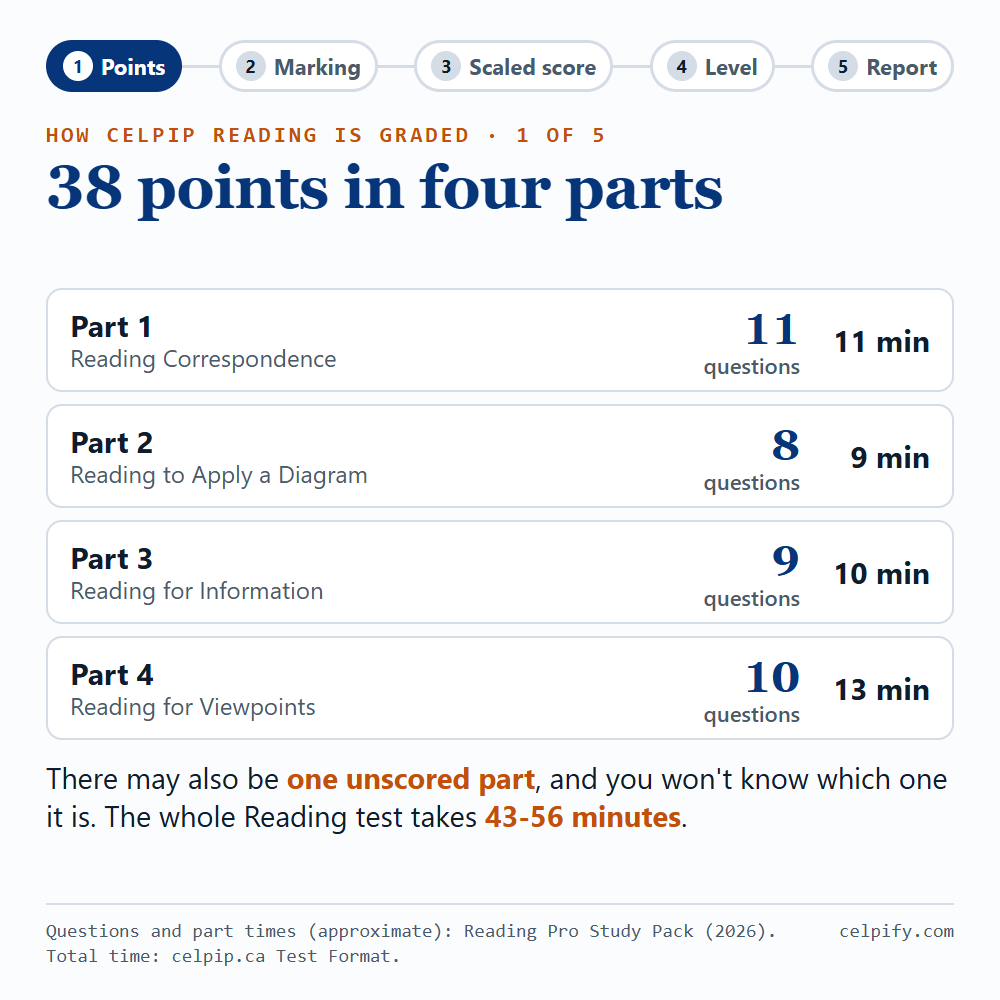
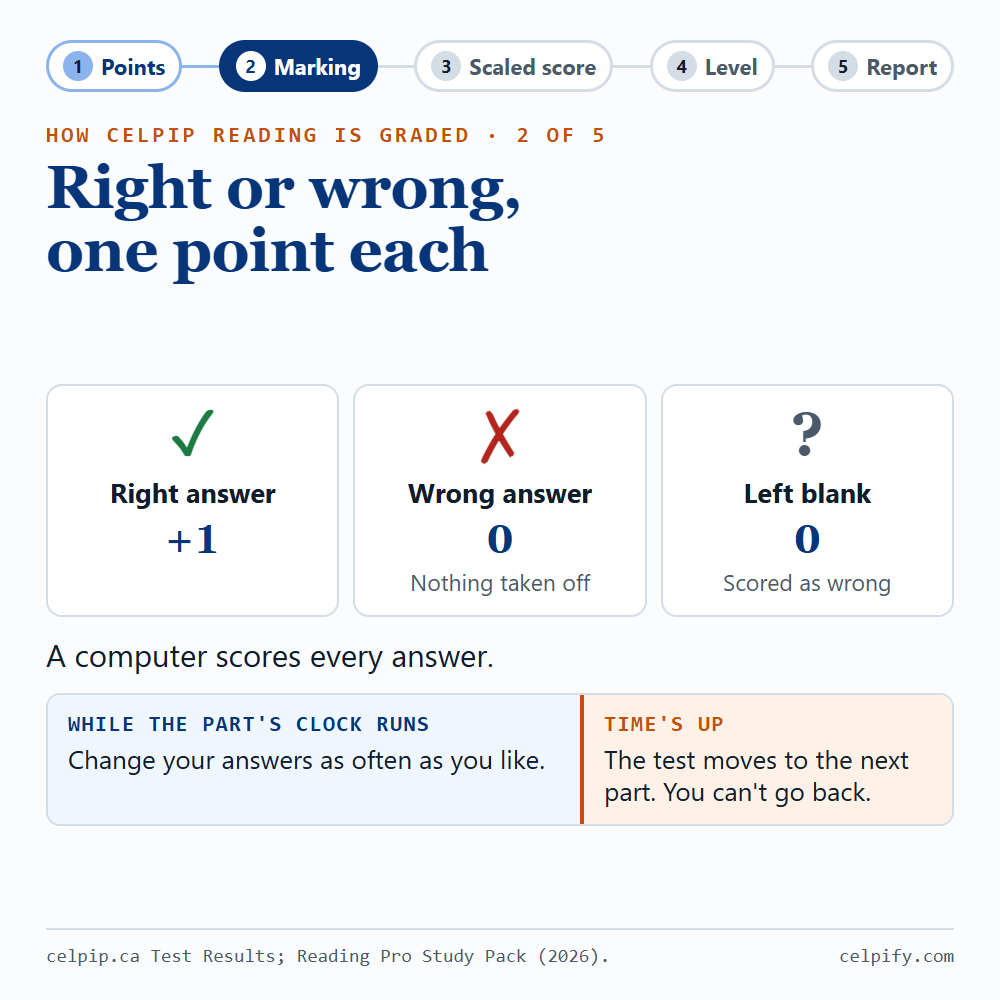
The 38 points come from four parts: 11 questions on correspondence, 8 on a diagram and a short email about it, 9 on an informational text and 10 on an article with a reader's comment. A computer marks every answer right or wrong. In celpip.ca's words, answers are "scored dichotomously", and "questions that are left blank are scored as incorrect". Nothing comes off for a wrong answer, so a guess can only help.
The count on your screen isn't quite your score, though. The 2026 Reading Pro Study Pack says "there may be one unscored part", and you won't know which one. Those unscored questions look like all the others, so you may answer more than 38. Within each part, you can change your answers as often as you like until that part's clock runs out. Then the test moves on by itself, and you can't go back to an earlier part.
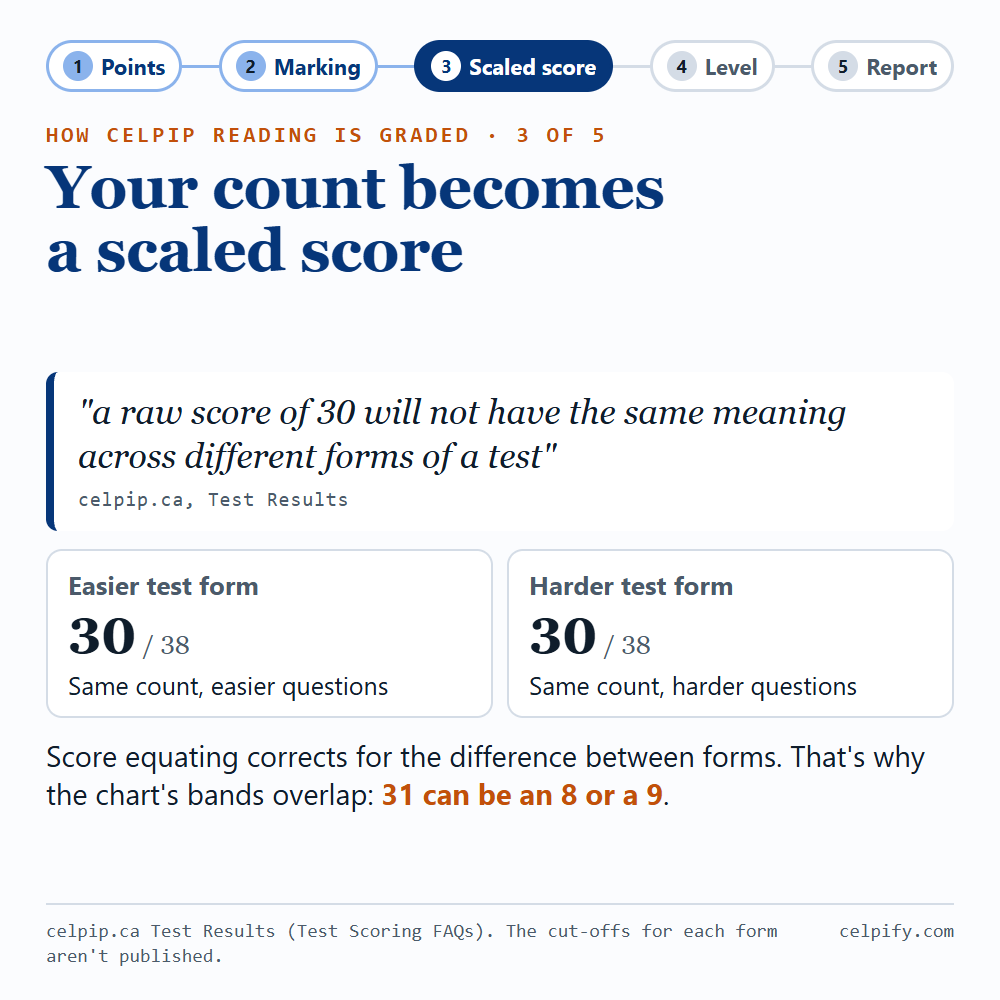
Next, your count becomes a scaled score. Different people get different test forms, and some forms are a little harder than others. Score equating corrects for that, which is why celpip.ca warns that "a raw score of 30 will not have the same meaning across different forms of a test". You'll read online that harder questions are worth more points. The pack says each correct answer receives 1 point; what equating looks at is how hard the questions on your form were.
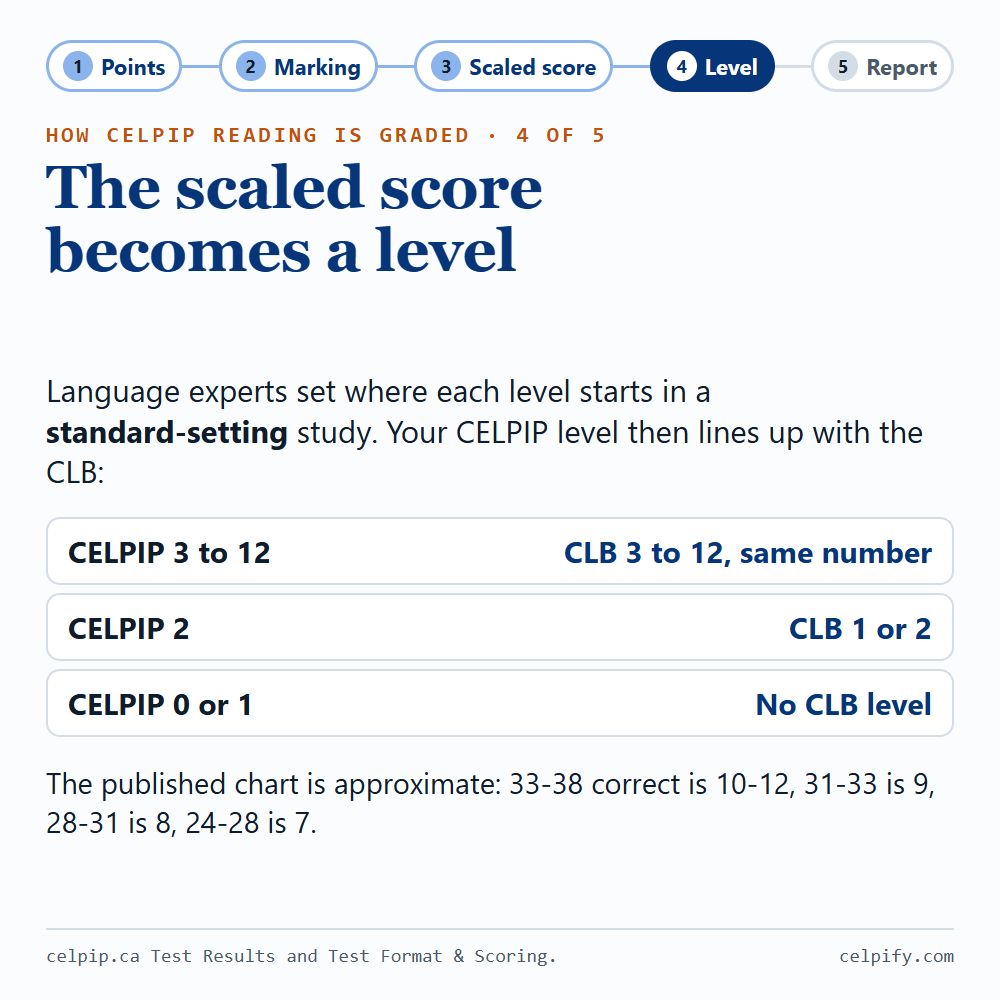
Then the scaled score becomes a level. English language experts set where each level starts in what celpip.ca calls a "standard setting exercise". From 3 up, your CELPIP level is the same number as your CLB level. Level 2 equals CLB 1 or 2, and 0 or 1 has no CLB.
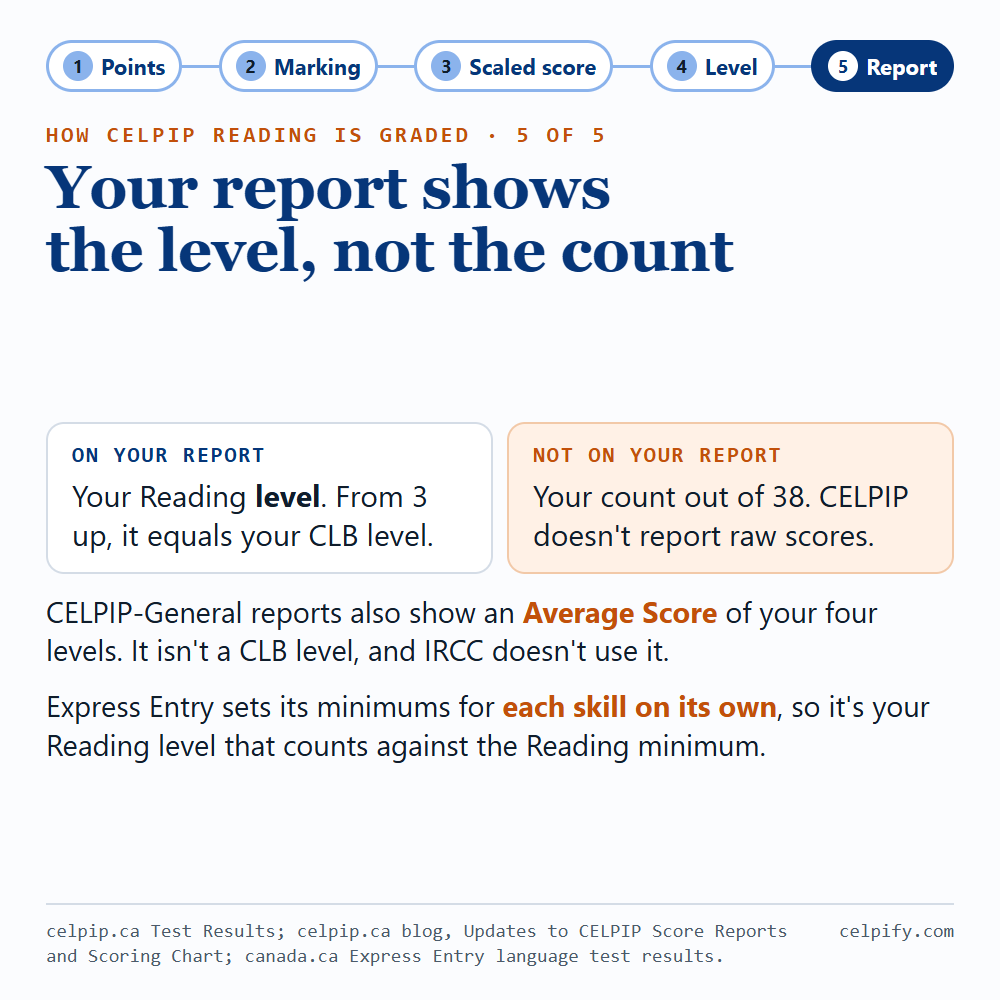
Your score report shows that level, never the count. CELPIP-General reports also carry an Average Score of your four levels, but celpip.ca says it "is not equivalent to any Canadian Language Benchmark (CLB) level" and isn't relevant for IRCC. Our guide to the CELPIP maximum score explains how the average and overall scores work. Reading only appears on CELPIP-General, because the LS test assesses Listening and Speaking only.
How to calculate your CELPIP Reading score
On a practice test, add up your right answers across the four parts and find that total in the chart above. You'll land on one level or two. Nobody outside CELPIP can tell you the exact cut on your real form, because it isn't published.
Where Learners Lose Reading Points on Test 1
Celpify's first tries on the free Test 1 Reading, turned into points on the chart.
Between August 1 and mid-October 2026, 102 Celpify learners did all four parts of Test 1 Reading on a first try. Their median total was 28 out of 38, a 7 or an 8. The middle half scored between 23 and 31. 27% reached 31 or more, and 12% reached 34. These are practice first tries, not official results, and Test 1 is often the first test a new learner opens.
Where did the missing points go? On average, learners left 3.5 points behind in Part 1, 1.6 in Part 2, 4.0 in Part 3 and 4.3 in Part 4 (first tries per part: 165, 143, 137 and 120 learners). That's 13.4 points in all, and Parts 3 and 4 hold 8.3 of them. We added up each part's own first tries, so read the split as a rough guide.
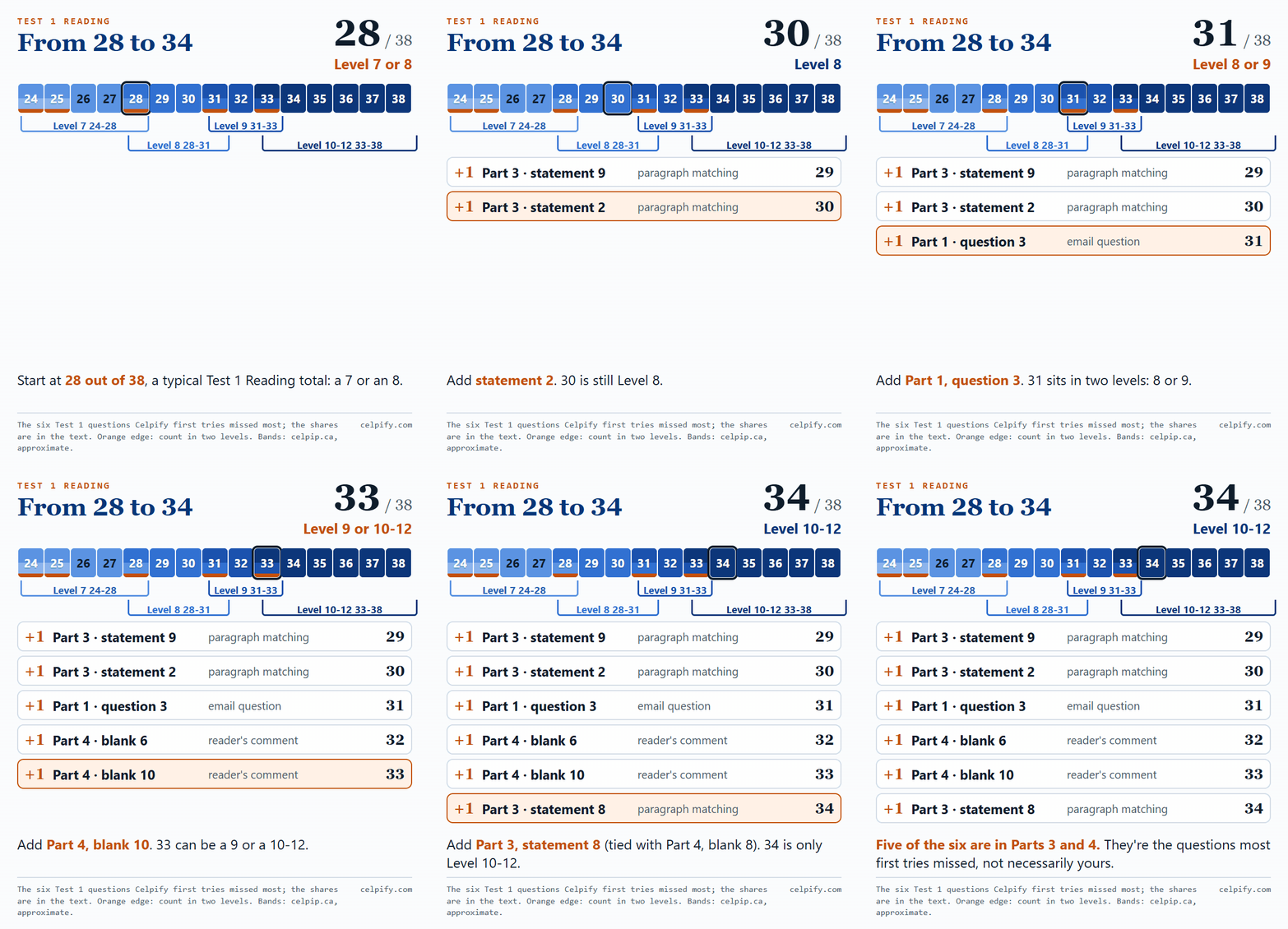
The GIF adds the six questions most first tries missed. Part 3 statement 9 was right for only 19% of 137 learners, and 66% picked paragraph D instead. Then come Part 3 statement 2 (31%), Part 1 question 3 (35% of 165), Part 4 blank 6 (36% of 120), Part 4 blank 10 (43%) and Part 3 statement 8 (47%, tied with Part 4 blank 8). Five of the six are in Parts 3 and 4, and together they're six points: the whole gap between the median 28 and a clean 34.
You can try all 38 Test 1 questions, with a reason for every option, in our CELPIP reading practice test with answers. Our look at why statement 9 trips most people goes through the "not given" trap, and the Reading Part 3 guide and Reading Part 4 guide cover the two parts where most points went.
The other Celpify tests point the same way. 109 learners finished a first complete 38-question Reading section on any test: 63% reached Level 7 or higher and 23% reached Level 9 or higher, counting a shared count at the lower level (August 1 to mid-October 2026). And 31% of 285 complete Reading sections landed on a count that sits in two levels, against 43% of 218 Listening sections. Reading's 7/8 overlap is a single count, 28. In Listening it's two, 30 and 31.
What a CELPIP Reading Level Is Worth
From 3 up, your Reading level is your CLB level for reading, and each program sets its own bar.
Express Entry checks each skill on its own. The Federal Skilled Worker Program needs CLB 7 in all four abilities. The Canadian Experience Class needs CLB 7 for TEER 0 or 1 jobs and CLB 5 for TEER 2 or 3 jobs. The Federal Skilled Trades Program sets a lower bar for Reading than for Listening: CLB 4 in reading and writing, CLB 5 in speaking and listening.
Then there are points. Under Express Entry's CRS, a single applicant gets 17 points per ability at CLB 7, 23 at CLB 8, 31 at CLB 9 and 34 at CLB 10 or higher. Moving your Reading from 8 to 9 is worth 8 points on its own, before any skill transferability points. Our guide to CLB 7, 8 and 9 in CELPIP shows what each level is worth across all four skills, and CELPIP score requirements for Express Entry covers the program rules.
Australia accepts CELPIP too. Its Proficient English level needs Reading 8, with Listening 9, Writing 10 and Speaking 8, so Reading and Speaking share the lowest bar. Superior English needs Reading 10. The CELPIP for Australia immigration guide has every level.
How to Raise Your Reading Count
Habits that follow from how Reading is scored and timed.
- Give each part its own clock. The pack plans about 11 minutes for Part 1, 9 for Part 2, 10 for Part 3 and 13 for Part 4. When a part's time runs out the test moves on, so you can't save minutes in Part 1 and spend them in Part 4.
- Answer every question. A blank scores the same as a wrong answer. On Test 1, 38% of the 102 learners who did all four parts left at least one question blank on their first try (August 1 to mid-October 2026).
- Change your mind if you need to. Within a part you can change answers as often as you like until time's up, so pick something, move on, and come back if there's time.
- Take notes on paper. You get paper and a pen at the test centre. You can't highlight or make notes on the screen.
- Use E in Part 3. E means the information isn't in the text. Before you pick a paragraph, find the words that prove the whole statement, not just its topic.
- Track who thinks what in Part 4. The article gives two or more opinions, and a reader's comment follows it. Note each person's view and their reason before you answer.
Our CELPIP Reading tips go further, part by part.
CELPIP Reading Score Chart: Common Questions
Short answers to what people ask about Reading counts and grading.
Sources & further reading
The official pages behind the chart, the grading steps and the program minimums on this page.
- CELPIP Test ResultsThe approximate Reading scores out of 38 and the disclaimer, right-or-wrong scoring, score equating, scaled scores, standard setting, unscored items and the Australia DHA levelsOfficial CELPIPcelpip.ca
- CELPIP Test Format & Scoring43-56 minutes for Reading, the four part names, the CELPIP to CLB chart and the LS test with no ReadingOfficial CELPIPcelpip.ca
- CELPIP Reading Pro Study Pack (October 2026)38 scored questions at 1 point each, a possible unscored part, questions and minutes per part, changing answers within a part, no going back, notes on paperOfficial CELPIPcelpip.ca
- Updates to CELPIP Score Reports and Scoring ChartThe Average Score isn't a CLB level and isn't relevant for IRCC; 0-2 replaced M on score chartsOfficial CELPIPcelpip.ca
- Express Entry: Language test resultsCLB 7 for the Federal Skilled Worker Program, CLB 7 or 5 for the Canadian Experience Class by TEER, CLB 4 in reading and writing for the Federal Skilled Trades ProgramIRCC · Government of Canadacanada.ca
- Express Entry: CRS criteria17, 23, 31 and 34 points per ability at CLB 7, 8, 9 and 10 or more for a single applicantIRCC · Government of Canadacanada.ca
- How to find your language level based on your test resultsIRCC's IELTS General Training Reading to CLB tableIRCC · Government of Canadacanada.ca
Keep exploring:CELPIP score calculator · CLB converter