CELPIP Writing Task 1 Samples with Answers: Level 7 vs 10

CELPIP Writing Task 1 gives you 27 minutes to write one email of 150 to 200 words. It's the first of the two writing tasks on CELPIP-General. The prompt sets up a situation, tells you who you're writing to, and lists the things your email has to do. Start at the greeting. CELPIP's own instructor says to skip From, To and Subject lines and go straight to "Dear..." or "Hi...".
This page answers the Maple Tech complaint from Celpify's free Test 1 twice, at Level 7 and at Level 10, with a note on every change between the two. After that come 14 practice questions and more model answers in formal, semi-formal and informal tones. If you're working toward the CLB 7 or 9 you need, the two-level comparison is the part to study.
One pattern from Celpify practice: on 270 Task 1 first tries by 131 learners (August 1 to mid-October 2026, Celpify AI estimates), Readability was the lowest criterion, or tied for lowest, 96% of the time. So grammar, paragraph breaks and linking words are the first things to check.
CELPIP Writing Format for Task 1: Time, Words and Tools
The screen gives you a timer, a word counter and a spelling checker. The prompt gives you a reader and a list of jobs.
Task 1 quick facts
- Time: 27 minutes. Task 2, the survey response, follows with 26 minutes of its own.
- Length: 150 to 200 words. A word counter sits under the response box.
- Spelling: the test has an automatic spelling checker. It offers suggestions and you choose one. Like any spelling checker, it won't notice "their" where you meant "there".
- Tone: formal, semi-formal or informal, set by the person you're writing to.
- Bullets: Celpify's Test 1 prompt has three. The rated prompt in CELPIP's official Writing Pro pack has four, so be ready for either.
Your CELPIP writing score comes from both responses together. CELPIP doesn't publish a split between the two tasks, so give the email your full effort.
What the prompt looks like
Every prompt has the same anatomy:
Situation: what has happened, in two or three sentences.
Recipient: who you're writing to. This decides your tone.
"In your email:" the things you must do, as bullet points. Cover them in the order they're given.
Two things AI answers get wrong about Task 1
Subject lines. Some AI answers tell you to open with a subject line of 5 to 10 words. In CELPIP's official Task 1 webinar, a viewer asked about From, To and Subject lines, and the instructor said not to spend time or words on them: start with the greeting and finish with your name. None of the rated emails in the official Writing Pro pack has a subject line.
Spell-check. The same answers often say there's no spelling checker. celpip.ca says the Writing test "does include an automatic spelling checker", and the July 2026 guidebook for test takers lists spell-check as a feature. The skill is picking the right suggestion, since "sensor" and "censor" are both real words.
Official CELPIP webinar: Writing an Email for Task 1 (S6E11). It starts at the From, To and Subject question.
Address every bullet
The official Writing Pro pack's advice is to "write at least one sentence for each task (most will need more!)". A skipped or rushed bullet costs you under Task Fulfillment, which covers completeness. On the Test 1 prompt, Celpify first tries that touched all three bullets averaged Level 7.81, and the rest averaged 6.96 (126 first tries by 126 learners, August 1 to mid-October 2026, checked by keywords, AI estimates).
CELPIP Writing Task 1 Questions: 14 Practice Prompts
Every prompt below follows the official shape: a situation, then "In your email:" and three things to do. They're Celpify's own, grouped by the tone each one needs.
Formal email prompts
Writing to a company, a landlord or an office you don't know.
1. Construction noise
Construction work in your apartment building has started at 6 a.m. every day for the past two weeks. Write an email to the building manager. In your email:
- Describe the problem
- Explain how it is affecting you
- Ask for a specific solution
2. A job application with no reply
Two weeks ago, you applied for a job at a local company, but you haven't heard back. Write an email to the hiring manager. In your email:
- Remind them of your application
- Explain why you are still interested in the position
- Ask about the next steps and when you might hear back
3. A sofa that arrived damaged
A sofa you ordered from a furniture store was delivered yesterday with a torn cushion and a broken leg. Write an email to the store's customer service department. In your email:
- Describe the damage
- Explain how the delivery went
- Say what you want the store to do
4. Enrolling your child
Your family has just moved, and you want to enrol your eight-year-old in the local elementary school. Write an email to the school office. In your email:
- Introduce your family and your child
- Ask what documents you need to bring
- Ask about programs or activities your child could join
5. Broken streetlights
Three streetlights on your street have been out for a month. Write an email to your city's public works department. In your email:
- Describe where the problem is and how long it has lasted
- Explain why it is a safety concern
- Ask what the city will do and when
Semi-formal email prompts
Writing to a manager, a colleague or a neighbour you know a little.
6. Time off for a family emergency
You need two weeks off work next month because of a family emergency. Write an email to your supervisor. In your email:
- Explain why you need the time off
- Suggest how your work will be covered
- Offer to help before you leave
7. Asking to work from home
You'd like to work from home two days a week. Write an email to your manager. In your email:
- Explain your reasons
- Propose a schedule
- Address one concern your manager might have
8. Thanking a neighbour
Your neighbour looked after your cat while you were away for ten days. Write an email to thank them. In your email:
- Say thank you and explain how it helped
- Mention one thing they did that you noticed
- Offer to return the favour
Informal email prompts
Writing to a friend or a family member.
9. A surprise party
You're planning a surprise birthday party for a friend. Write an email to another friend. In your email:
- Explain the occasion and why it's a surprise
- Give the date, time and place
- Ask them to help with one thing
10. Catching up
You haven't seen a close friend in months. Write an email to them. In your email:
- Say why you've been out of touch
- Suggest a plan to meet
- Ask about something happening in their life
11. Borrowing a car
You need to borrow a friend's car for a weekend trip. Write an email to your friend. In your email:
- Explain why you need it
- Say when you'd pick it up and return it
- Offer something in return
12. An apology
You missed a friend's important event last weekend. Write an email to your friend. In your email:
- Apologize and explain what happened
- Say how you feel about missing it
- Suggest how to make it up to them
13. Moving to your city
A friend is moving to your city and has asked for advice about where to live. Write an email to your friend. In your email:
- Recommend a neighbourhood and explain why
- Give tips for finding an apartment
- Offer to help when they arrive
14. Advice about a job
A friend works at a company where you'd like to apply. Write an email to your friend. In your email:
- Explain why you're interested in the company
- Ask what it's like to work there
- Ask for one tip for your application
Give each one 27 minutes and aim for 170 to 190 words. Then compare your draft with the Task 1 writing samples below. The Test 1 email below is free to write on Celpify, with a timer and feedback.
CELPIP Writing Task 1 Samples with Answers: One Prompt, Two Levels
Same prompt, same writer, two levels. The Level 7 email isn't bad; the Level 10 one just does more with every paragraph.
Test 1, Task 1: the Maple Tech laptop
Three weeks ago, you ordered a new laptop from Maple Tech, an online electronics store, for $1,200. When the package arrived, the screen was cracked and three keys were missing from the keyboard. You have called customer service twice and sent two follow-up emails, but no one has offered a replacement or a refund, and the laptop is still unusable.
Write an email to Maple Tech's customer service department. In your email:
- Describe the problems with the laptop when it arrived
- Explain what you have already done to try to resolve the issue
- State exactly what you would like the company to do now
Want to try it first? It's the free Task 1 prompt from Celpify's Test 1. Write the Maple Tech email yourself with the 27-minute timer, then come back and compare.
Both emails below are Celpify's own. We wrote them to the wording of CELPIP's Level 7 and Level 10 descriptors (May 2026), and CELPIP didn't rate them. The notes name the official criterion that each change feeds.
Real first tries on this prompt averaged Level 7.47 on Celpify's AI estimate (126 first tries by 126 learners, August 1 to mid-October 2026), and 23.8% came in below Level 7.
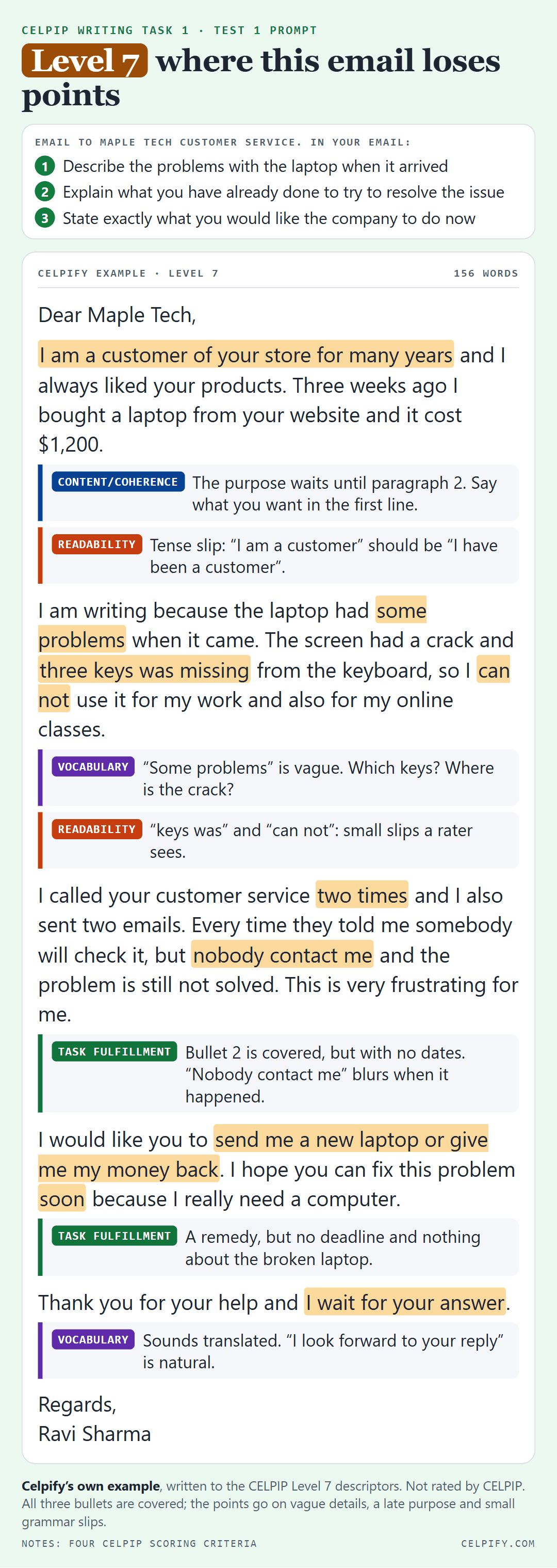
Level 7 · Celpify example · 156 words
Dear Maple Tech,
I am a customer of your store for many years and I always liked your products. Three weeks ago I bought a laptop from your website and it cost $1,200.
I am writing because the laptop had some problems when it came. The screen had a crack and three keys was missing from the keyboard, so I can not use it for my work and also for my online classes.
I called your customer service two times and I also sent two emails. Every time they told me somebody will check it, but nobody contact me and the problem is still not solved. This is very frustrating for me.
I would like you to send me a new laptop or give me my money back. I hope you can fix this problem soon because I really need a computer.
Thank you for your help and I wait for your answer.
Regards,
Ravi Sharma
Why it sits at Level 7
- Content/Coherence: it covers all three bullets, so the email does its job. But the purpose only arrives in paragraph two, after a line about being a loyal customer.
- Vocabulary: "some problems", "fix this problem" and "a computer" are everyday words. The Level 7 descriptor talks about "common and some context-specific words", and that's where this sits. "I wait for your answer" sounds translated.
- Readability: it has paragraphs, which Level 7 asks for ("organize related ideas into paragraphs"). But "three keys was", "can not" and "nobody contact me" are slips, and the last one blurs when things happened.
- Task Fulfillment: the tone is polite and right for a company. The request has no deadline and says nothing about the broken laptop, so the reader still has to ask what happens next.
The Level 7 email in CELPIP's official Writing Pro pack loses points in much the same way: a late purpose, vague details and grammar errors that get in the way of the meaning.
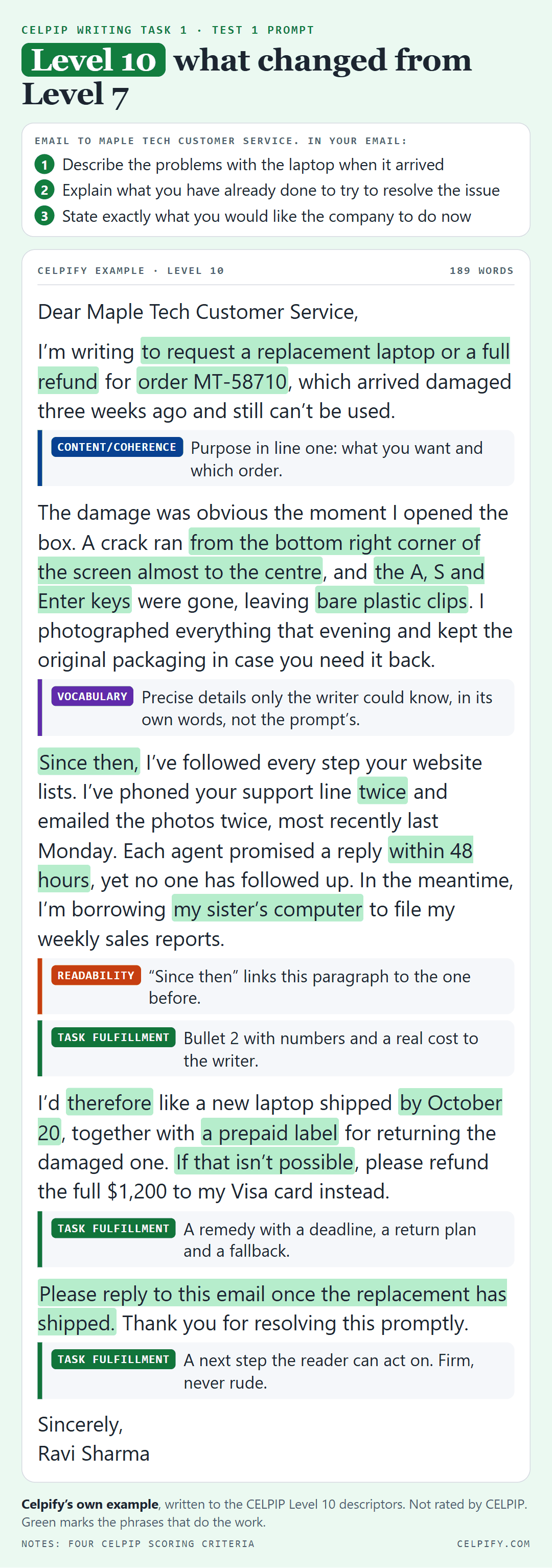
Level 10 · Celpify example · 189 words
Dear Maple Tech Customer Service,
I'm writing to request a replacement laptop or a full refund for order MT-58710, which arrived damaged three weeks ago and still can't be used.
The damage was obvious the moment I opened the box. A crack ran from the bottom right corner of the screen almost to the centre, and the A, S and Enter keys were gone, leaving bare plastic clips. I photographed everything that evening and kept the original packaging in case you need it back.
Since then, I've followed every step your website lists. I've phoned your support line twice and emailed the photos twice, most recently last Monday. Each agent promised a reply within 48 hours, yet no one has followed up. In the meantime, I'm borrowing my sister's computer to file my weekly sales reports.
I'd therefore like a new laptop shipped by October 20, together with a prepaid label for returning the damaged one. If that isn't possible, please refund the full $1,200 to my Visa card instead.
Please reply to this email once the replacement has shipped. Thank you for resolving this promptly.
Sincerely,
Ravi Sharma
What changed from Level 7 to Level 10
- The purpose is in line one. The reader knows what Ravi wants, and for which order, before the first sentence ends.
- One paragraph per bullet, in the prompt's order. The damage, then what he's tried, then what he wants.
- Details only the writer could know. The order number, which keys, where the crack runs, how many calls and emails, whose computer he's borrowing. The Level 10 descriptor asks you to "support key ideas with a range of facts, descriptions, details".
- A remedy with a deadline. A date, a prepaid return label and a refund if the first option fails.
- Links between paragraphs. "Since then", "In the meantime" and "therefore" carry the reader along. The descriptor calls it connecting ideas "within and between paragraphs".
- Nothing above the greeting. No subject line, no From or To. Greeting first, name last.
Deadlines are rare in practice. Of the 126 Test 1 first tries, only 14 learners (11%) gave a date or a time frame for the fix, and they averaged Level 8.21 against 7.38 for everyone else (Celpify AI estimates). Nearly everyone asked for a refund or a replacement (91%). The 11 learners who didn't averaged 5.73. A deadline won't lift an email on its own, but it tends to come with the precise, complete answers that score higher.
The plan behind this email is on our CELPIP writing templates page, which works through the same prompt step by step with a different email.
More CELPIP Email Samples with Answers: Formal and Informal
These CELPIP email writing examples cover three more prompts, at Level 9 or above and at Level 7. Read each pair side by side and look for what the higher one adds.
Formal email sample: complaint to building management
Prompt: You live in an apartment building and there has been excessive noise from construction work starting at 6 AM every day for the past two weeks. Write an email to the building manager describing the problem, explaining how it affects you, and requesting a solution.
Level 9+ · Celpify example · 164 words
Dear Mr. Thompson,
I am writing to bring to your attention a significant issue that has been affecting residents in Building C over the past two weeks. The construction crew has been starting work at approximately 6 AM daily, generating substantial noise that penetrates through the walls and windows.
This situation has severely impacted my daily routine and well-being. As someone who works from home, I rely on a quiet environment for productivity. The early morning noise has disrupted my sleep schedule and made it nearly impossible to conduct virtual meetings with clients during morning hours.
I would respectfully request that the construction schedule be modified to begin no earlier than 8 AM, when most residents are already up for the day. Alternatively, perhaps the noisiest activities could be scheduled for later in the day.
I appreciate your prompt attention to this matter and look forward to hearing about the steps that can be taken to address this concern.
Sincerely,
Jennifer Chen
Unit 405
Why this reaches Level 9+
- Professional salutation and closing
- Precise vocabulary (substantial, impacted, respectfully)
- Clear paragraph structure addressing all three points
- Specific invented details (Building C, Unit 405, 8 AM)
- Diplomatic, solution-oriented request
- A checkable detail (an 8 AM start) instead of a general complaint
Informal email sample: invitation to a friend
Prompt: You are planning a surprise birthday party for a mutual friend named Sarah. Write an email to another friend inviting them, explaining the occasion, providing party details, and asking them to help.
Level 9+ · Celpify example · 180 words
Hey Mike!
I hope you're doing well! I'm reaching out because I'm putting together a surprise birthday bash for Sarah, and I'd absolutely love for you to be there. She's turning 30 this year (can you believe it?), and I think she deserves something special after the tough year she's had.
Here are the details: I've booked a private room at The Maple Leaf Pub on Queen Street for Saturday, January 15th at 7 PM. Sarah thinks we're just having a casual dinner, so please don't let anything slip! Her brother is bringing her over at 7:15, so try to get there a few minutes early and hide with the rest of us.
I was wondering if you could help me out with something. Would you mind picking up the birthday cake from Sweet Delights on Bloor Street on your way over? I'll transfer you the money beforehand, of course.
Let me know by Wednesday if you can make it, so I can give the pub a final headcount. It really wouldn't be the same without you there!
Cheers,
Emma
Its level comes from the voice. It reads like a real person inviting a real friend: idioms land naturally ("let anything slip", "help me out"), and every detail is specific, from Queen Street to the cake shop. All three bullet points get full coverage without the email ever sounding like a checklist.
Level 7 · Celpify example · 154 words
Hi Mike,
How are you? I am writing to tell you about a surprise party for Sarah. Her birthday is coming and I want to make it special for her because she had a hard year. She does not know about the party, so please keep it a secret.
The party will be on Saturday, January 15th at 7 PM. It will be at a restaurant called The Maple Leaf Pub. Sarah thinks we will just have dinner together. About fifteen people are coming.
Can you help me with something? I need someone to bring the birthday cake. Can you pick it up on your way to the restaurant? I will pay you back for it. The cake shop is on Bloor Street and the cake will be ready at 5 PM.
Please tell me if you can come before Wednesday. I hope to see you there! It will be really fun.
Thanks,
Emma
Same structure, same three points covered, and it would pass. But notice "I am writing to tell you" addressed to a close friend. That's formal-letter phrasing in a casual email, and it's exactly the kind of register slip that keeps a response at Level 7. The vocabulary stays generic ("make it special", "help me with something"), and no sentence takes a risk.
Semi-formal email sample: a request to your supervisor
Prompt: You need to take two weeks off work next month for a family emergency. Write an email to your supervisor explaining the situation, proposing coverage, and offering to help.
Level 9 · Celpify example · 168 words
Dear Ms. Patterson,
I am writing to request two weeks of leave from February 10th to 24th due to an unexpected family emergency. My father has been hospitalized in Vancouver and requires surgery, and I need to be there to support my family during his recovery.
I understand this request comes at short notice, and I want to assure you that I have considered how my responsibilities can be covered. I have already spoken with David Chen, who has kindly agreed to handle my ongoing projects, including the monthly client report. I will also prepare thorough handover notes for any pending tasks and share them with you before I leave.
Additionally, I am happy to complete any urgent work before my departure and remain available via email for critical questions during my absence, ideally between 9 and 10 each morning.
I truly appreciate your understanding during this difficult time and am committed to ensuring minimal disruption to our team's operations.
Thank you for your consideration.
Sincerely,
Robert Kim
The Email Plan Behind Every Sample
Every sample on this page follows the same five-part plan.
- A greeting that fits the reader the prompt names.
- The purpose, in one or two sentences: why you're writing.
- One paragraph per bullet, in the prompt's order, each with at least one specific detail.
- A close with a next step: a request, a date, something the reader can act on.
- A sign-off that matches the greeting, then your name.
That's a plan, not a script. Our CELPIP writing templates page draws it as a one-page sheet and explains why memorised sentences are a risk. CELPIP says test takers who include memorised or copied content "are subject to invalidation of their test results."
The 27-Minute Plan for Task 1
Watch one semi-formal email get built: notes first, then a paragraph per bullet, with the word counter running.
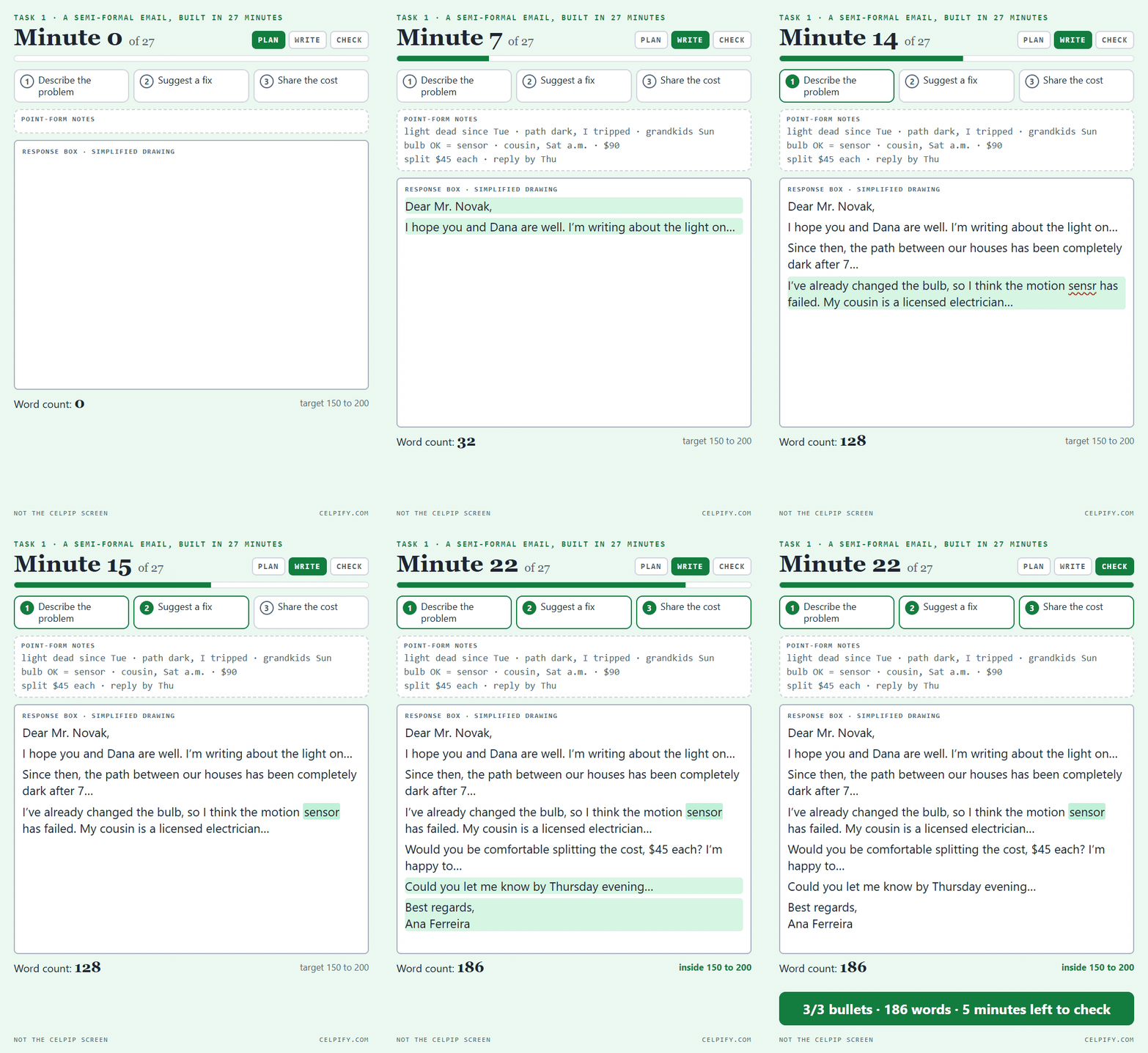
CELPIP gives two versions of the time split. Its Tips page says to use the first 5 minutes to plan and leave 5 to 7 minutes at the end to revise. The Writing Pro pack suggests 4 to 5 minutes of planning and about 3 minutes of checking (3 to 4 in its Task 1 strategy list). A plan that fits both: 5 minutes to plan, about 17 to write and 5 to check.
The planning minutes
The pack spells out the steps:
- Brainstorm in point form for 2 to 3 minutes. Spelling doesn't matter yet.
- Choose your main ideas.
- Put them in order.
- Think of supporting details.
- Write a strong, clear purpose statement.
The semi-formal email from the animation
Practice prompt: the fence light
You and your next-door neighbour, Mr. Novak, share a fence between your backyards. The motion-sensor light on the fence stopped working last week, and the path between your houses is now dark at night. Write an email to Mr. Novak. In your email:
- Describe the problem and why it matters to you
- Suggest a way to fix it
- Propose how you could share the cost
Semi-formal · Celpify example · 186 words
Dear Mr. Novak,
I hope you and Dana are well. I'm writing about the light on our shared fence, which stopped working last Tuesday, and I'd like to sort it out together.
Since then, the path between our houses has been completely dark after 7 p.m. Last night I tripped over a recycling bin on my way home from a late shift, and I'm worried your grandchildren could do the same when they visit on Sundays.
I've already changed the bulb, so I think the motion sensor has failed. My cousin is a licensed electrician, and he could replace the whole unit on Saturday morning if that suits you. He's quoted $90 for a new sensor light and about an hour of work, which seems fair to me.
Would you be comfortable splitting the cost, $45 each? I'm happy to pay him on the day, and you could pay me back whenever it's convenient. If you'd rather use your own electrician, that's fine with me too.
Could you let me know by Thursday evening so I can confirm the time with him?
Best regards,
Ana Ferreira
Why semi-formal? Mr. Novak is a neighbour, not a close friend and not a company. "Dear Mr. Novak", a few contractions, a polite question ("Would you be comfortable...?") and "Best regards" sit between the two.
How long do learners actually take? On 235 Task 1 first tries with a recorded time (128 learners, August 1 to mid-October 2026), the median was 20.7 minutes, and one in five (20.4%) submitted before the 15-minute mark. The first tries that used 22 minutes or more averaged Level 8.13 on Celpify's AI estimate, the highest of any group. So plan to use all 27 minutes, check included.
CELPIP Writing Task 1 Word Limit: 150 to 200, With Some Room
The range is a guide with a little give, not a wall.
The instructions say 150 to 200 words, and the counter under the box keeps track for you. celpip.ca puts it like this: "You do have a little bit of room to be under or over the suggested word count limits", but "your final score may suffer if you are significantly over or under". In the official Task 1 webinar, the instructor puts that room at about 10%, which tops out around 220 words. Going 10% under gives a floor of about 135.
Aim for 170 to 190. That's enough to give every bullet a real detail without padding.
In Celpify practice, 79% of Task 1 first tries landed inside 150 to 200 (214 of 270 first tries, 131 learners, August 1 to mid-October 2026). Only 14 came in under 150, and 13 went over 220. The over-220 group didn't score lower on our AI estimate (Level 8.15, 11 learners), but that's a small group, it's our scorer rather than a CELPIP rater, and CELPIP's warning about going well over still applies. Extra words also eat into your checking time.
Where the words should go
A balanced 180-word email with three bullets breaks down roughly like this: about 20 words to open (greeting and purpose), 45 to 55 words for each of the first two bullets, 35 to 45 for the third, and about 20 to close and sign off.
Word-count mistakes we keep seeing
- Padding with filler like "I am writing this email to tell you that..."
- Restating the prompt instead of answering it
- Uneven development, where one bullet gets a paragraph and another gets a clause
Formal, Semi-Formal or Informal: One Email, Three Readers
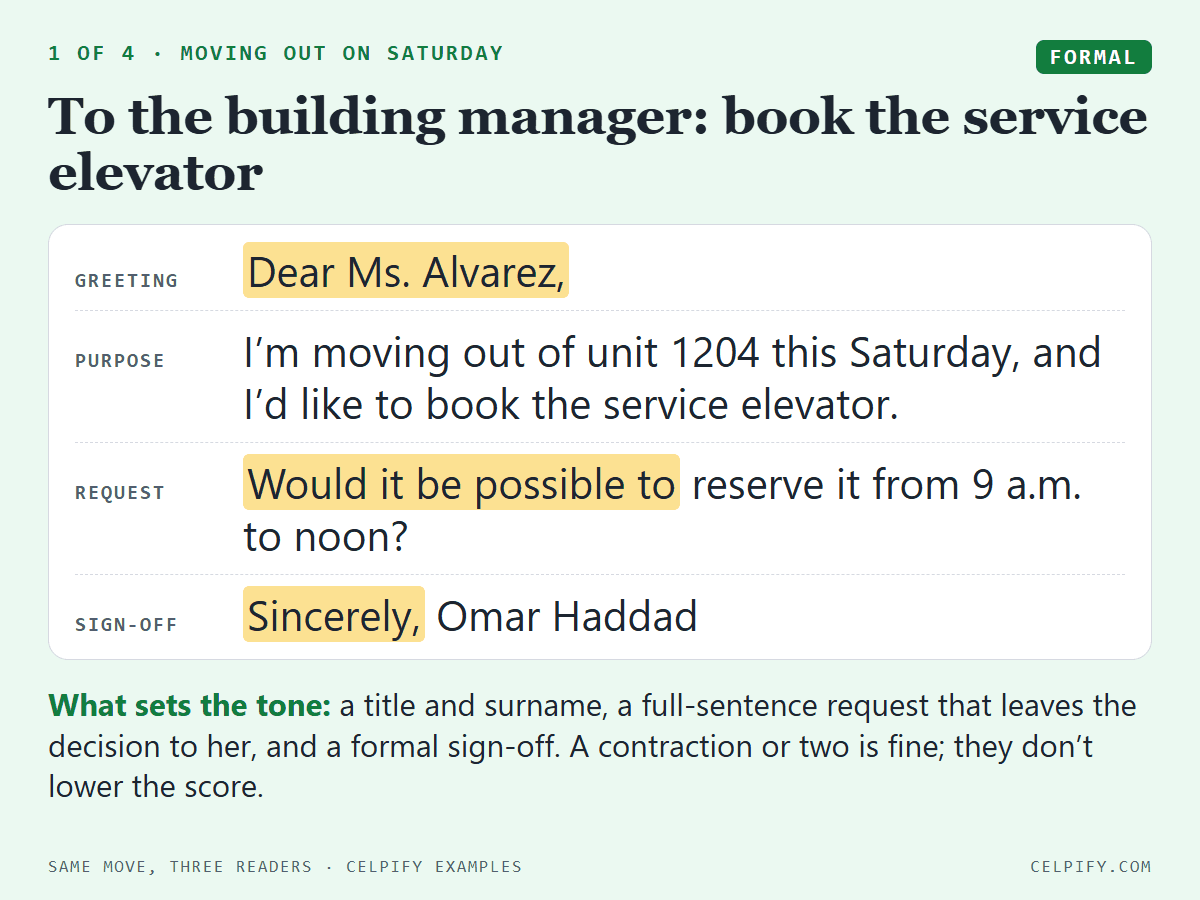
The prompt always tells you who's reading. Step through the same moving-day request written for three readers.
One request, three readers
Celpify examples. Yellow marks what changes with the reader.
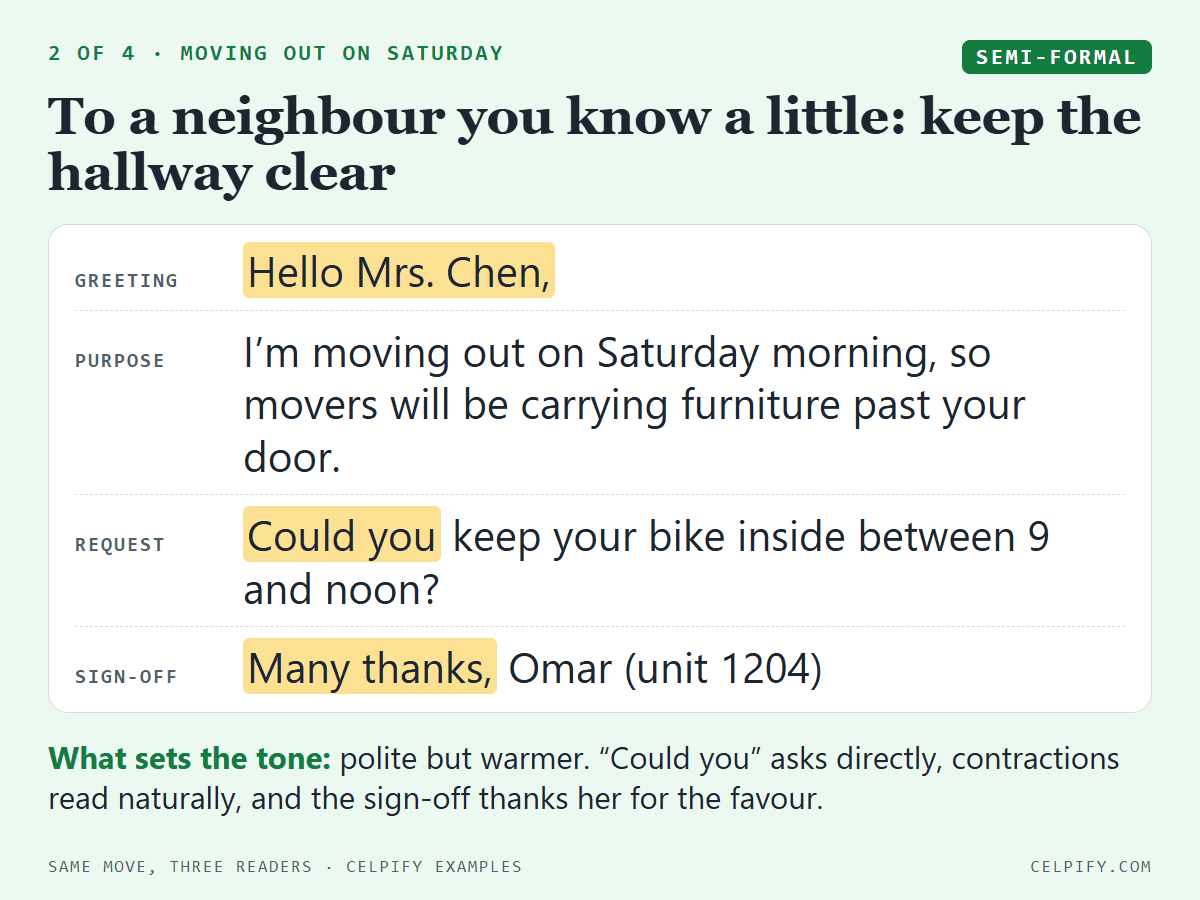
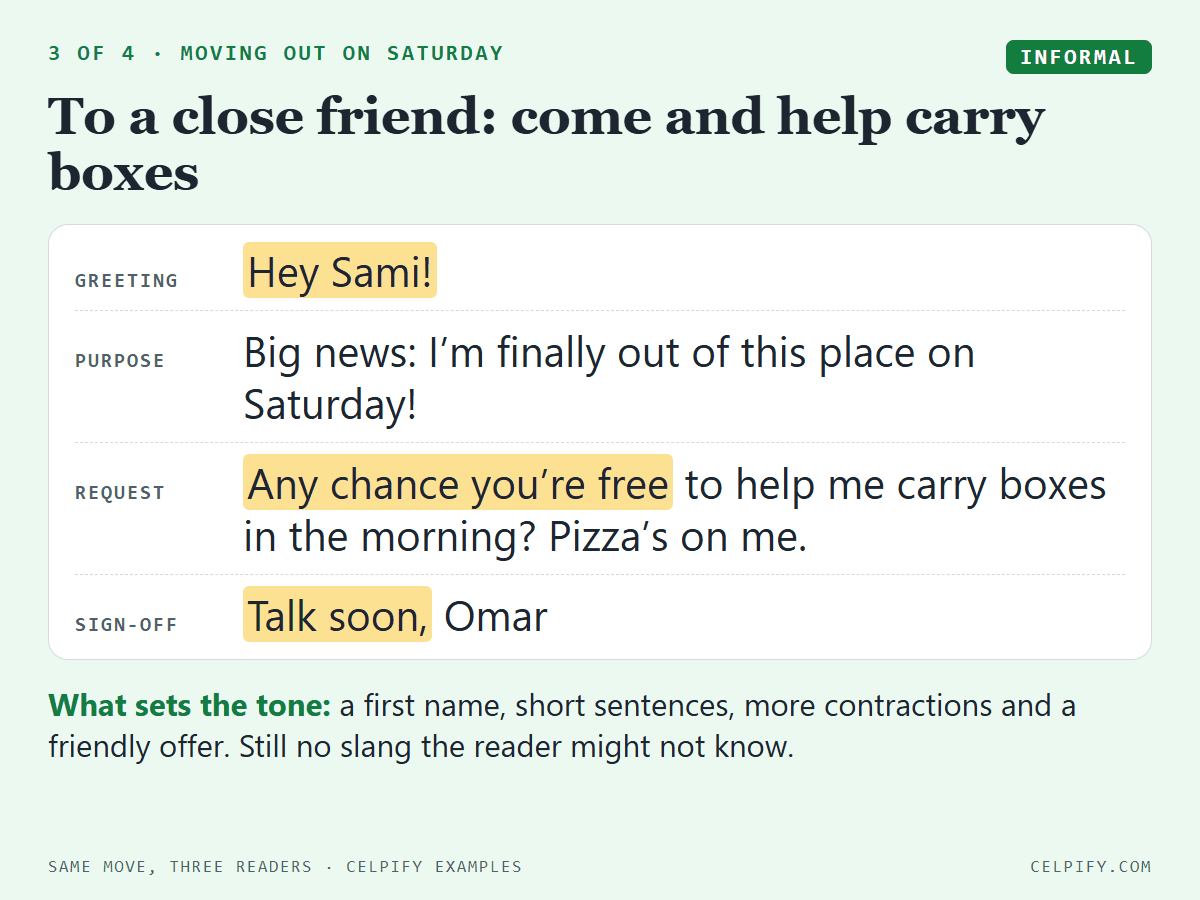
| Reader | Greeting and sign-off | Tone |
|---|---|---|
| Formal: a company, landlord, school or office | Dear Ms. Alvarez, / Dear Customer Service, Sincerely, / Best regards, | Polite and direct. Firm if you're complaining, never rude. |
| Semi-formal: a manager, colleague or neighbour | Dear Mr. Novak, / Hello Mrs. Chen, Best regards, / Many thanks, | Warm but polite. Questions like "Could you...?" |
| Informal: a friend or family member | Hi Sami, / Hey Sami! Talk soon, / Cheers, | Relaxed and friendly. No slang the reader might not know. |
Contractions don't lower your score. In CELPIP's Task 2 webinar, the instructor says writing "I'm" or "I am" doesn't affect your score; it's a style choice, and using lots of contractions makes a message a little less formal. celpip.ca's own example of a professional email opens with "I'm writing to ask about the status of my package". So in a formal email, use them lightly rather than not at all.
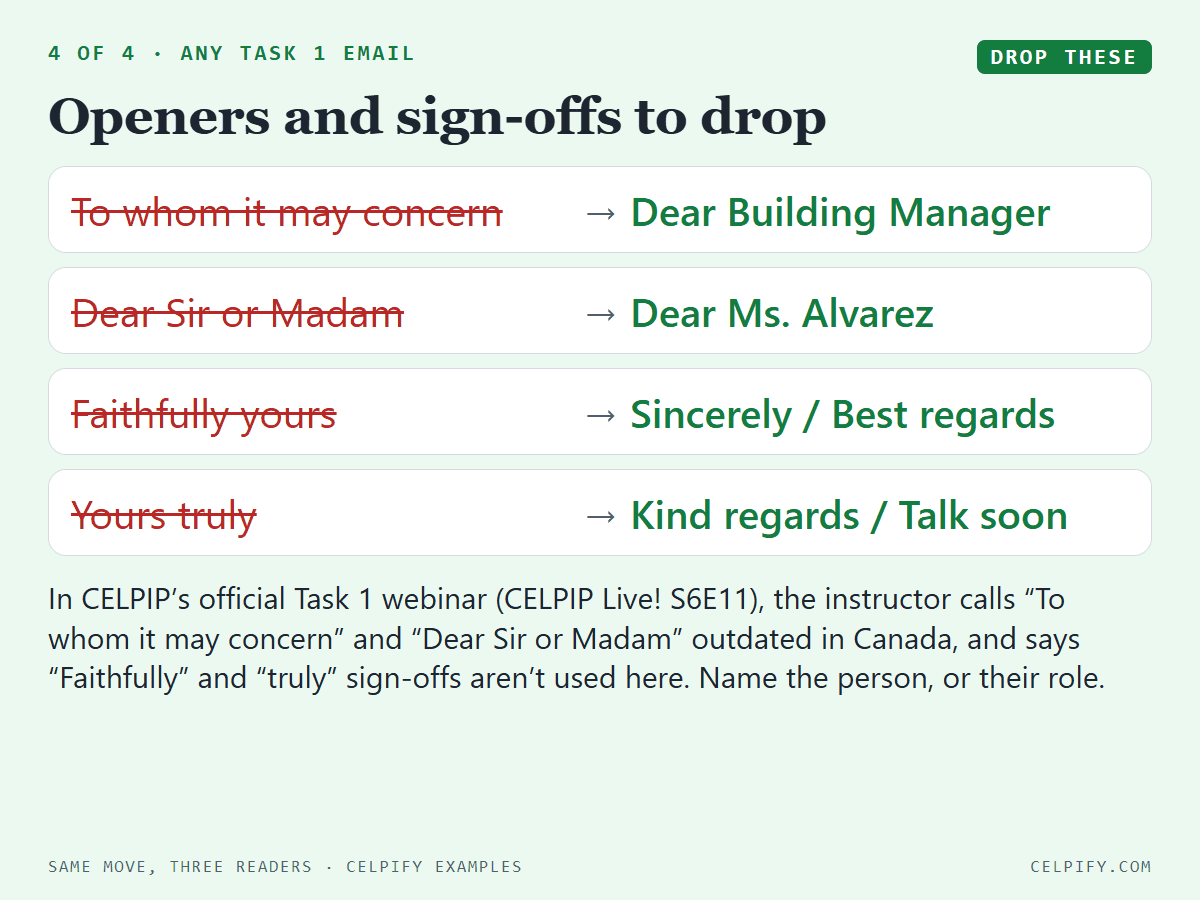
Drop "To whom it may concern" and "Dear Sir or Madam". CELPIP's Task 1 instructor calls both outdated and old-fashioned in Canada, and says "Faithfully yours" isn't used here either. Name the person if the prompt gives a name, or their role if it doesn't: "Dear Building Manager".
Top Mistakes That Lower Task 1 Scores
The same handful of errors shows up again and again in emails that land below Level 9.
Tone and format errors
Wrong tone for the reader
"Dear Sir" to a friend, "Hey!" to a manager. Check who you're writing to before you type the greeting, not after.
Lines above the greeting
A Subject:, From: or To: line costs words and adds nothing. CELPIP's instructor says to start with the greeting only. In Celpify practice, only 6 of 270 first tries (2.2%) opened with a subject line, so most learners already get this right.
No greeting at all
On 11 Task 1 first tries (4.1%, 11 learners) we found no greeting in the opening. They averaged Level 6.00 against 7.92 for everyone else, and Task Fulfillment fell to 6.09 (Celpify AI estimates, August 1 to mid-October 2026).
"Dear Sir or Madam" and "Faithfully yours"
Both are outdated in Canada, according to CELPIP's own instructor. In our data, 31 first tries (11.5%, 25 learners) opened with "Dear Sir or Madam" or "To whom it may concern". Their overall level was about the same as everyone else's (7.94 against 7.83), but Task Fulfillment, which covers tone, was a little lower (8.19 against 8.39).
No sign-off
Ending without "Sincerely," or "Cheers," plus a name makes the email feel cut off mid-thought.
Content errors
Skipping a bullet point is the big one, and it's usually the last bullet that gets sacrificed to the clock. Vague details are the quieter version of the same problem. "The noise happens sometimes" gives a rater nothing to reward, while "the drilling starts at 6 AM daily" shows control of detail. Then there's tone drift: a formal opening that slides into "anyway, gotta go!" by the last paragraph reads worse than either register used consistently.
Language errors
- One block of text. Emails written with no paragraph breaks (1 to 4 lines including the greeting and sign-off; 16 first tries, 10 learners) averaged Level 6.25 and Readability 5.44. The usual 7 to 8 lines averaged 8.02.
- Stiff informal emails: "I am writing to inform you" sounds wrong to a friend.
- A formal email full of contractions. They don't cost marks on their own, but a stream of them makes a complaint sound casual.
- Paragraphs that don't connect, so the rater has to guess the link between ideas.
- The same adjective five times. Vary "good" with "excellent", "positive" or "helpful".
How to Get CLB 10 in CELPIP Writing Task 1
Moving from a solid 7 to a 10 is mostly about precision: a purpose that lands first, details only you could know, and sentences that link up.
First lines that set the level
The first line tells the rater whether you know why you're writing. Compare the two Maple Tech openings:
Level 7
"I am a customer of your store for many years and I always liked your products."
Level 10
"I'm writing to request a replacement laptop or a full refund for order MT-58710, which arrived damaged three weeks ago and still can't be used."
CELPIP's own rated Level 7 email trips on the same thing: its purpose waits until the second paragraph.
Vocabulary upgrades
Precise words beat fancy ones, as long as they suit the reader. "Very big problem" becomes "significant concern" in a formal email or "huge issue" to a friend. "I want to ask" becomes "I would like to request" or "I was wondering if". "Thank you" grows into "I really appreciate it" or "thanks so much", depending on who's reading.
We built a full phrase bank for this, sorted by tone and by part of the email, in the Task 1 vocabulary guide.
Details that sound real
Do your details have to be Canadian? No. In CELPIP's Task 2 webinar, a viewer asked exactly that, and the instructor said references don't have to be to Canadian places at all; the easiest details come from your own life. What matters is that they're specific: a date, an amount, a name, something you saw. The official sample emails use Canadian spelling (neighbour, honour), so that's a sensible default.
Sentence variety
Mix your structures:
- Simple: "The construction starts at 6 AM."
- Compound: "The noise is disruptive, and it has affected my work."
- Complex: "Although I understand renovations are necessary, the early start has cut into my sleep."
An email written entirely in simple sentences holds itself back, no matter how correct it is.
Rewrite, then compare
Second drafts help more than you'd think. When learners wrote the same Task 1 prompt a second time (64 retries by 42 learners, August 1 to mid-October 2026), the average Celpify AI estimate rose from Level 7.59 to 8.69, and Readability rose the most (+1.34). The second emails weren't longer, about one word shorter on average. They were cleaner.
Task 1 Readiness Check
Test your understanding of email writing requirements
You're writing an email to your apartment building manager about a broken elevator. Which greeting and closing combination is correct?
How Task 1 Is Scored: The Four Official Dimensions
CELPIP raters assess writing on four dimensions, published in the official Writing Pro study pack. Knowing them changes how you practise.
Content/Coherence
How many ideas you present, how good they are, how logically they're organized, and whether you support them with examples and details.
Vocabulary
Word choice, range, precision, and whether your phrasing sounds natural for the situation.
Readability
Format and paragraphing, connectors and transitions, grammar, spelling, and punctuation. In short: how easy your email is to read.
Task Fulfillment
Relevance, completeness, tone, and word count. Did you follow the instructions and write to the right person in the right register?
Notice where tone and word count sit: inside Task Fulfillment, not as separate scores. That's why a flawless email in the wrong register can score lower than a slightly imperfect one written by someone who clearly understood the situation.
In Celpify practice, Readability is the criterion that drops first. On 270 Task 1 first tries by 131 learners (August 1 to mid-October 2026, AI estimates), it was the single lowest score on 75% of first tries, and tied for lowest on most of the rest. It averaged 7.00, against 7.93 for Content/Coherence, 7.83 for Vocabulary and 8.37 for Task Fulfillment.
If you have an immigration target, check how CELPIP writing levels map to CLB to see what your program requires.
Keep exploring:CELPIP writing templates · Task 1 vocabulary · Task 2 samples with answers · CELPIP writing tips
Sources & further reading
The official CELPIP sources behind the format facts, timings, word-count room and scoring criteria on this page.
- CELPIP Test Format & ScoringThe Writing test's 53 minutes and the names of its two tasksOfficial CELPIPcelpip.ca
- CELPIP Writing Pro: Target 9+ Study Pack (2026)27 and 26 minutes, planning and checking minutes, the Task 1 key skills, the four scoring dimensions and the rated sample emailsOfficial CELPIPcelpip.ca
- CELPIP Tips & ResourcesThe word counter, the spelling checker, the room around the word count, and plan 5 / revise 5 to 7 minutesOfficial CELPIPcelpip.ca
- CELPIP Guidebook for Test Takers (July 2026)The personal timer, word counter and spell-check on the computer-delivered testOfficial CELPIPcelpip.ca
- CELPIP Level Descriptors (May 2026)The Level 7 and Level 10 Writing wording our two Maple Tech emails were written toOfficial CELPIPcelpip.ca
- Essential Vocabulary and Tone Strategies for the CELPIP Writing TestProfessional tone in Task 1, including the "I'm writing to ask" exampleOfficial CELPIPcelpip.ca
- CELPIP Live! Writing an Email for CELPIP Writing Task 1 (S6E11)Start with the greeting, no From, To or Subject lines; about 10% word-count room; outdated openers and sign-offsOfficial CELPIP · YouTubeyoutube.com
- CELPIP Live! Writing Task 2: Responding to Survey Questions (S4E11)Contractions are a style choice; details don't have to be CanadianOfficial CELPIP · YouTubeyoutube.com
- Using CELPIP Sample Responses in the ClassroomCELPIP's statement that memorised or copied content can lead to invalidated resultsOfficial CELPIPcelpip.ca
Common Questions About CELPIP Writing Task 1
Short answers to the questions people ask most about the email task