#1
An open-source personal AI assistant that runs on your own hardware and talks to you through chat apps such as Slack, Telegram and WhatsApp.
- GitHub stars
- 395k
- Last commit
- today
- Latest release
- v2026.11.6
- Self-hosted
- Yes
openclaw.ai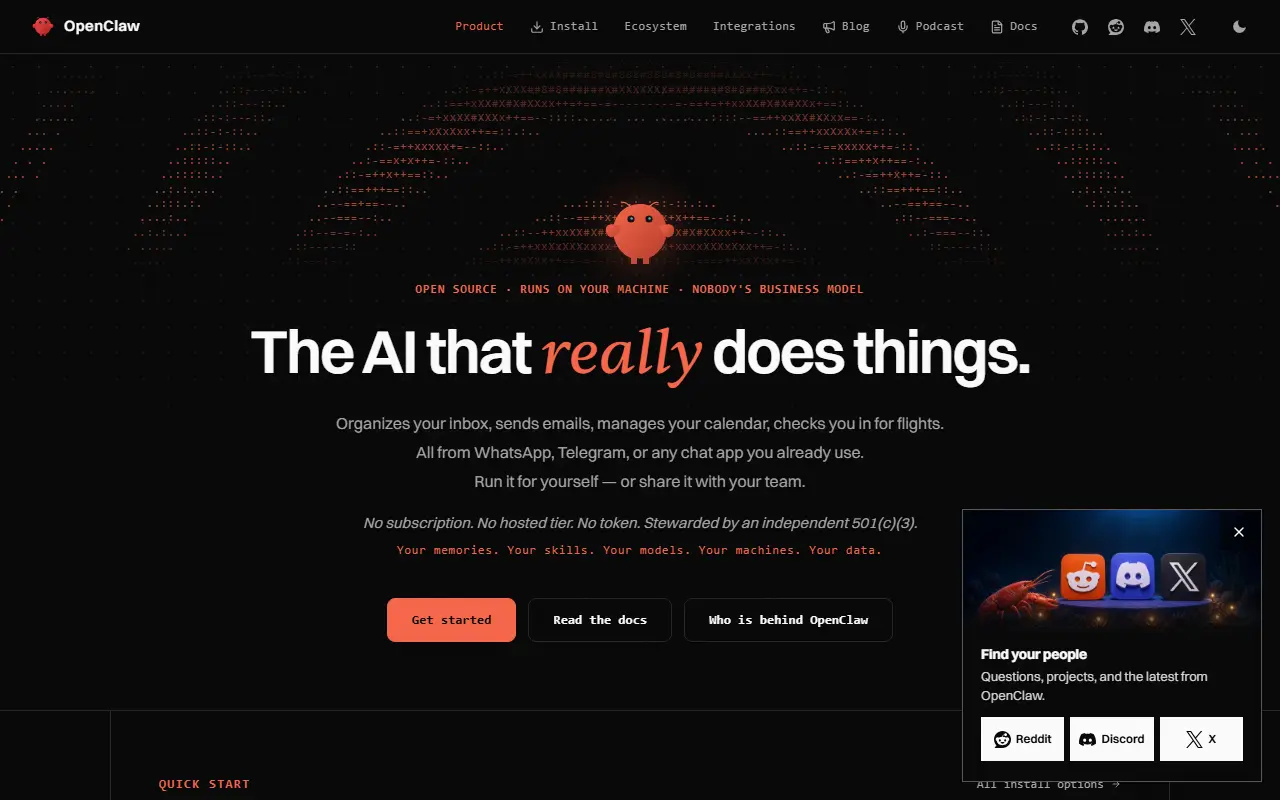
OpenClaw is an AI assistant, open source, that you run on your own computer. Instead of living inside a single website, it connects to the messaging channels you already use, including Discord, iMessage, Slack, Teams, Telegram and WhatsApp, with more than twenty others supported according to the project. Native desktop and mobile apps cover macOS, iOS, Android, Windows and Linux.
A single Gateway process runs the assistant, either as a personal setup on one laptop or as a deployment shared across a team, with configuration being the main difference between the two. State, memory and credentials stay on your hardware, and the model or agent harness is a swappable plugin, so you can use hosted models such as Claude or Codex, or local models, without changing the rest of the setup.
OpenClaw is stewarded by an independent nonprofit foundation, and the project says it offers no paid plan, no hosted service and no token. By default it only contacts its servers for a daily version check, and anonymous statistics are opt-in. GitHub lists the license as 'Other', so check the repository for the exact terms. It suits people who want a private assistant they control themselves.
Key features
- Connects to Discord, Slack, Telegram, WhatsApp and more
- Native apps across desktop and mobile platforms
- Swappable model providers and agent harnesses as plugins
- Memory and credentials stored on your own hardware
- Single gateway for personal or shared team use
- Opt-in anonymous usage statistics
Pricing: Free and open source; the project says it has no paid plan, hosted offering or token.
#2
A tool for downloading and running open large language models locally through a command line and REST API, with Docker support and many integrations.
- GitHub stars
- 188k
- Last commit
- 2 days ago
- Latest release
- v0.40.16
- Licence
- MIT
- Self-hosted
- Yes
ollama.com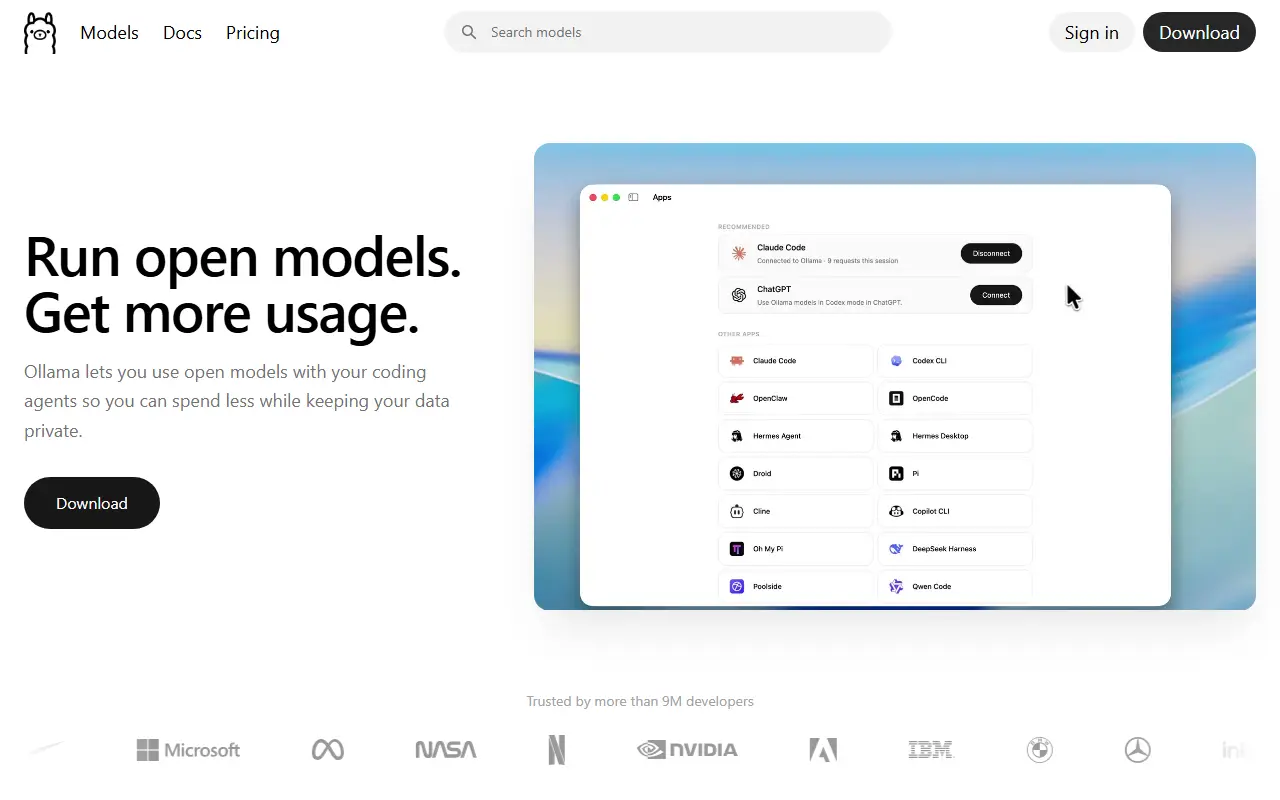
Ollama makes it straightforward to run open large language models on your own machine. You install it on macOS, Windows or Linux, or use the official Docker image, then pull a model and chat with it from the command line. It is written in Go and released under the MIT license, and it builds on the llama.cpp project for inference.
Besides the CLI, Ollama provides a REST API for managing and running models, with official Python and JavaScript client libraries. Models can be imported and customized through a Modelfile, and an online library lists what is available. It can be connected to coding agents and assistants such as Claude Code, OpenCode, Codex and OpenClaw, and many community chat interfaces, including Open WebUI and LibreChat, work with it.
Because models run on your own hardware, Ollama can serve as a self-hosted alternative to cloud assistants such as ChatGPT and Perplexity when privacy, offline use or cost control matter. It is aimed at developers and hobbyists experimenting with open models, and at teams that want to wire local models into their own applications.
Key features
- Run open language models locally from the CLI
- REST API for managing and running models
- Official Python and JavaScript libraries
- Modelfile for customizing and importing models
- Official Docker image
- Integrations with coding agents and chat interfaces
Pricing: Running models locally is free, and the Free plan includes starter cloud credits. Pro costs $20, Max $100 and Team $500 per month with included usage credits; Enterprise is custom.
#3
A self-hosted chat interface for local and cloud language models, supporting Ollama and OpenAI-compatible APIs, with RAG, user roles and a plugin system.
- GitHub stars
- 159k
- Last commit
- 3 days ago
- Latest release
- v0.13.4
- Self-hosted
- Yes
openwebui.com
Open WebUI is a self-hosted web interface for working with large language models. It connects to Ollama for local models and to any OpenAI-compatible endpoint, so one deployment can front LM Studio, Groq, Mistral, OpenRouter, vLLM and similar backends side by side. It is designed to keep working fully offline when you rely only on local models.
Administrators get role-based access control with user groups and per-group permissions, which suits shared team or household installs. Beyond chat there is retrieval-augmented generation over your documents, custom models that bundle instructions, tools and knowledge into agents, and an extension system made of filters, actions, pipes, tools and skills. External services attach through MCP, MCPO and OpenAPI tool servers, and an optional Open Terminal feature gives agents a filesystem to work in.
You can install it with pip, uv or Docker, or deploy it to Kubernetes using kubectl, kustomize or Helm, and container images are tagged for bundled Ollama and for CUDA. The project lists an enterprise plan for organizations that want vendor support. Its license is listed as custom rather than a standard one, so review the terms before reselling or rebranding it.
Key features
- Connects to Ollama and OpenAI-compatible APIs
- Role-based access control with user groups
- Retrieval-augmented generation over your own documents
- Plugin system with filters, tools and pipes
- MCP and OpenAPI tool server support
- Custom agents combining models, tools and knowledge
- Install via pip, Docker or Kubernetes
Pricing: Free to self-host; an enterprise plan is available through the vendor's sales team.
#4
An open-source platform that organizes AI agents into continuous operations, with options to self-host through Docker or major cloud platforms.
- GitHub stars
- 86k
- Last commit
- 2 days ago
- Latest release
- v2.3.4
- Self-hosted
- Yes
lobehub.com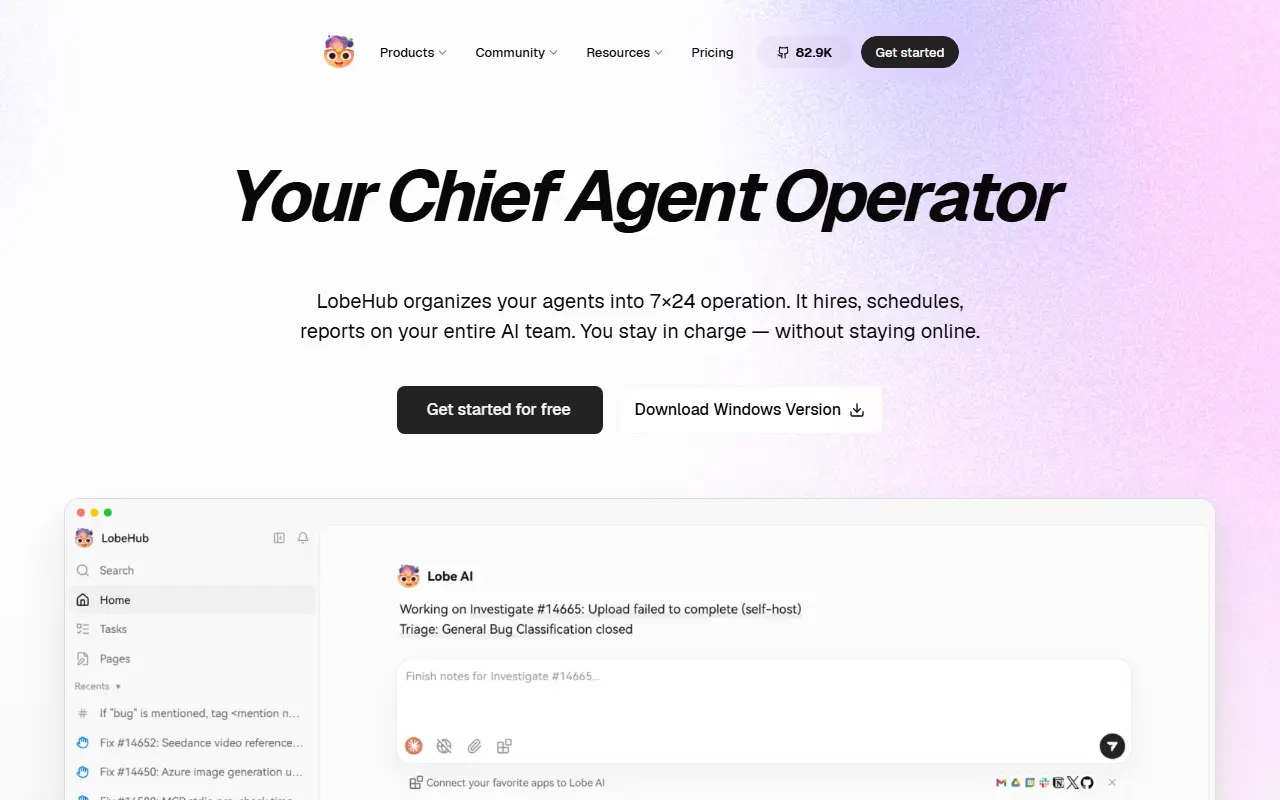
LobeHub describes itself as a Chief Agent Operator that organizes your AI agents into around-the-clock operation. It is designed to take on the hiring, scheduling and reporting for a whole team of agents so that you stay in charge without having to stay online. The project is written in TypeScript, and its GitHub topics point to chat, agent, knowledge base and MCP functionality.
The README groups its features around four ideas: Operator, Create, Collaborate and Evolve, which cover treating agents as the unit of work, scaling new kinds of collaboration networks, and the co-evolution of humans and agents. A plugin ecosystem extends the platform, and the project's topics reference model providers such as OpenAI, Claude, Gemini and DeepSeek.
LobeHub can be self-hosted: the README documents deployment on Vercel, Zeabur, Sealos and Alibaba Cloud, as well as Docker, and describes the environment variables used for configuration. GitHub lists the license as 'Other', so check the repository for the exact terms. It suits individuals and teams who want to run a shared workspace of AI agents on infrastructure they choose.
Key features
- Agents organized into continuous operations
- Scheduling and reporting for agent teams
- Knowledge base, skills and MCP support
- Plugin ecosystem for extending agents
- Docker and cloud platform deployment
- Support for major model providers
Pricing: Free plan with 500,000 monthly credits. Starter costs $12.90, Premium $24.90 and Ultimate $49.90 per month billed monthly, or about $9.90, $19.90 and $39.90 billed yearly; Enterprise Edition is by contact.
#5
A self-hostable, open-source ChatGPT-style chat interface that works with many AI providers and includes agents, MCP support, artifacts and multi-user auth.
- GitHub stars
- 47k
- Last commit
- today
- Licence
- MIT
- Self-hosted
- Yes
librechat.ai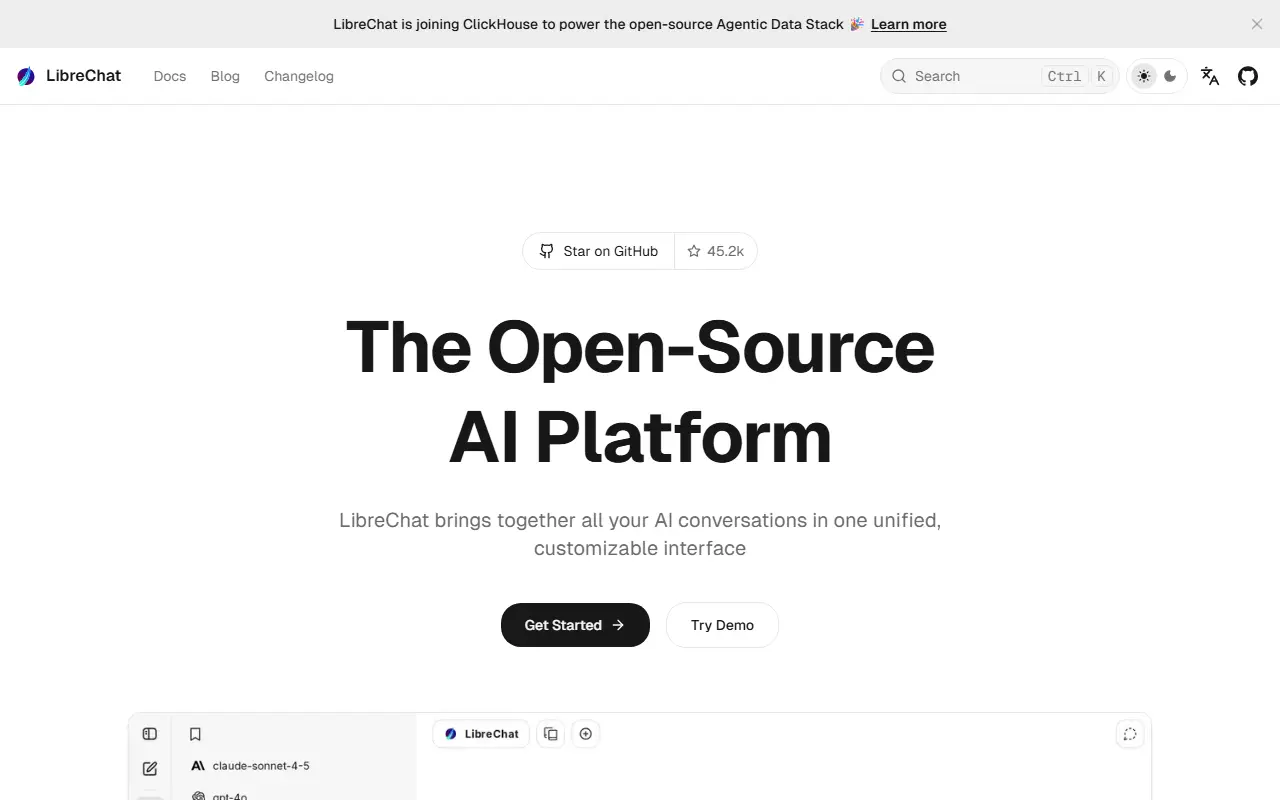
LibreChat is an open-source chat interface modeled on ChatGPT that you can self-host. It is written in TypeScript and released under the MIT license. Rather than being tied to one vendor, it connects to many providers, including OpenAI, Anthropic, Azure, AWS, Google Vertex AI and Gemini, Mistral, Groq, DeepSeek and OpenRouter, and lets you switch between models within a conversation.
Its feature set includes agents, MCP and skills, artifacts, a code interpreter, image generation, OpenAPI actions and functions, presets, message search and secure multi-user authentication. The recent README highlights an agent management API in beta, optional attached workspaces for code workers that are described as highly experimental, code approval controls, manual context compaction and unified file attachments.
Administrators can set role-based grants and approval modes for sensitive actions such as file writes and command execution. LibreChat suits individuals and organizations that want a private alternative to ChatGPT with a choice of models, and teams that need multi-user access control on infrastructure they manage.
Key features
- Chat with many AI providers in one interface
- Switch models within a conversation
- Agents, skills and MCP support
- Artifacts and code interpreter
- Message search and presets
- Secure multi-user authentication
- Agent management API in beta
Pricing: Free and open source under the MIT license.
#6
An all-in-one AI application for chatting with your documents and running AI agents locally, with multi-user support and desktop and Docker versions.
- GitHub stars
- 69k
- Last commit
- yesterday
- Latest release
- v1.20.0
- Licence
- MIT
- Self-hosted
- Yes
- Hosted version
- Available
anythingllm.com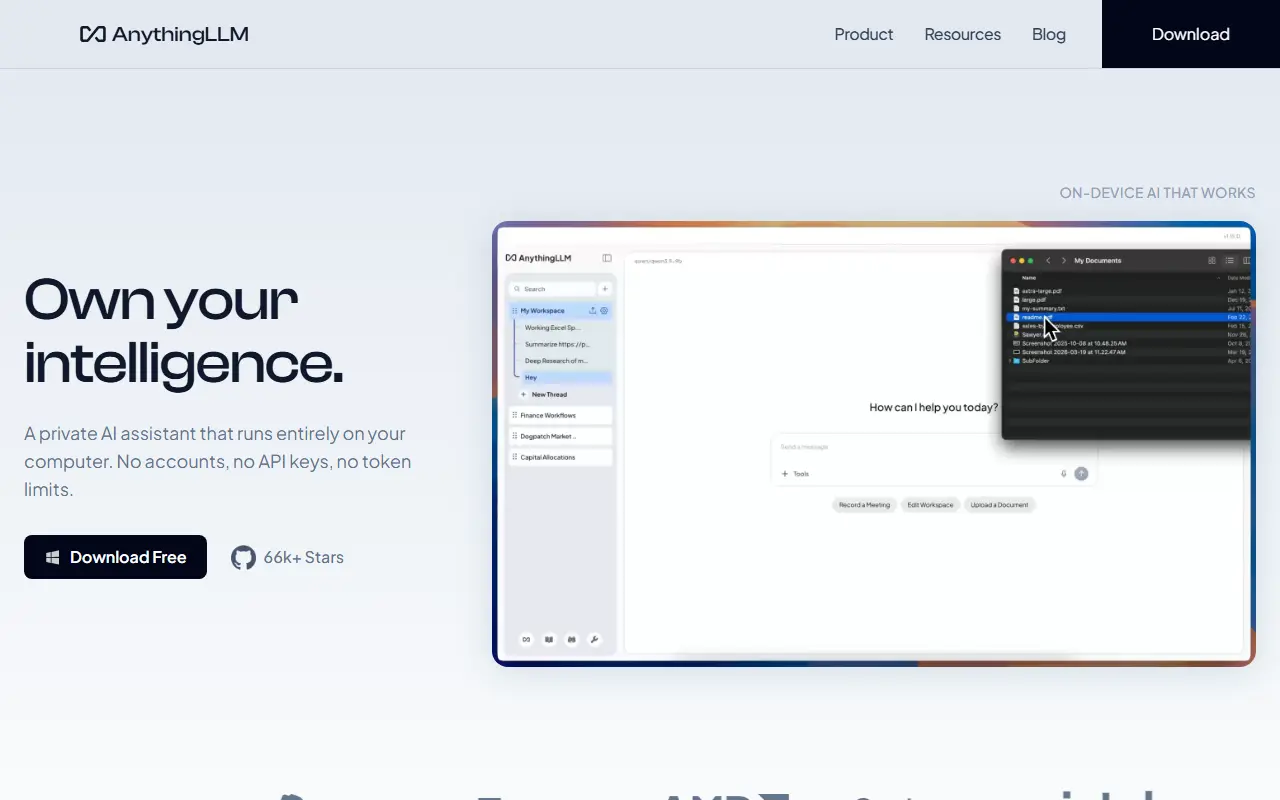
AnythingLLM is an all-in-one AI application for chatting with your own documents and automating work with AI agents. It runs locally by default, lets you connect local or cloud language models, and is written in JavaScript under the MIT license. The README describes it as a way to build a private, fully featured assistant in the style of ChatGPT.
Vector databases, document processing pipelines, multi-user support and agents all come included. Newer features listed include dynamic model routing based on rules you define, automatic and user-managed memories, scheduled tasks with agent capabilities, skill selection, a no-code agent builder, MCP compatibility and multi-modal support for both closed and open-source models.
It is available as a desktop app for Mac, Windows and Linux, as a Docker version that adds multi-user access control, and as a hosted instance, and there is an open-source Android app. Administrators can control access and experience per user. It suits individuals and teams who want a private document-chat and agent workspace without much setup.
Key features
- Chat with your documents using RAG
- Built-in AI agents and no-code agent builder
- Multi-user access control in Docker version
- Connects to local or cloud LLMs
- Vector database and document pipeline support
- MCP compatibility and scheduled tasks
- Desktop apps for Mac, Windows and Linux
Pricing: Self-hosting with Docker is free. Hosted Cloud costs $50 per month (Basic) or $99 per month (Pro); Enterprise with on-premise deployment is quoted on request.
#7
A cross-platform desktop AI client that supports many LLM providers and local models, with prebuilt assistants, document handling and MCP support.
- GitHub stars
- 54k
- Last commit
- 2 days ago
- Latest release
- v2.2.3
- Licence
- AGPL-3.0
cherryai.com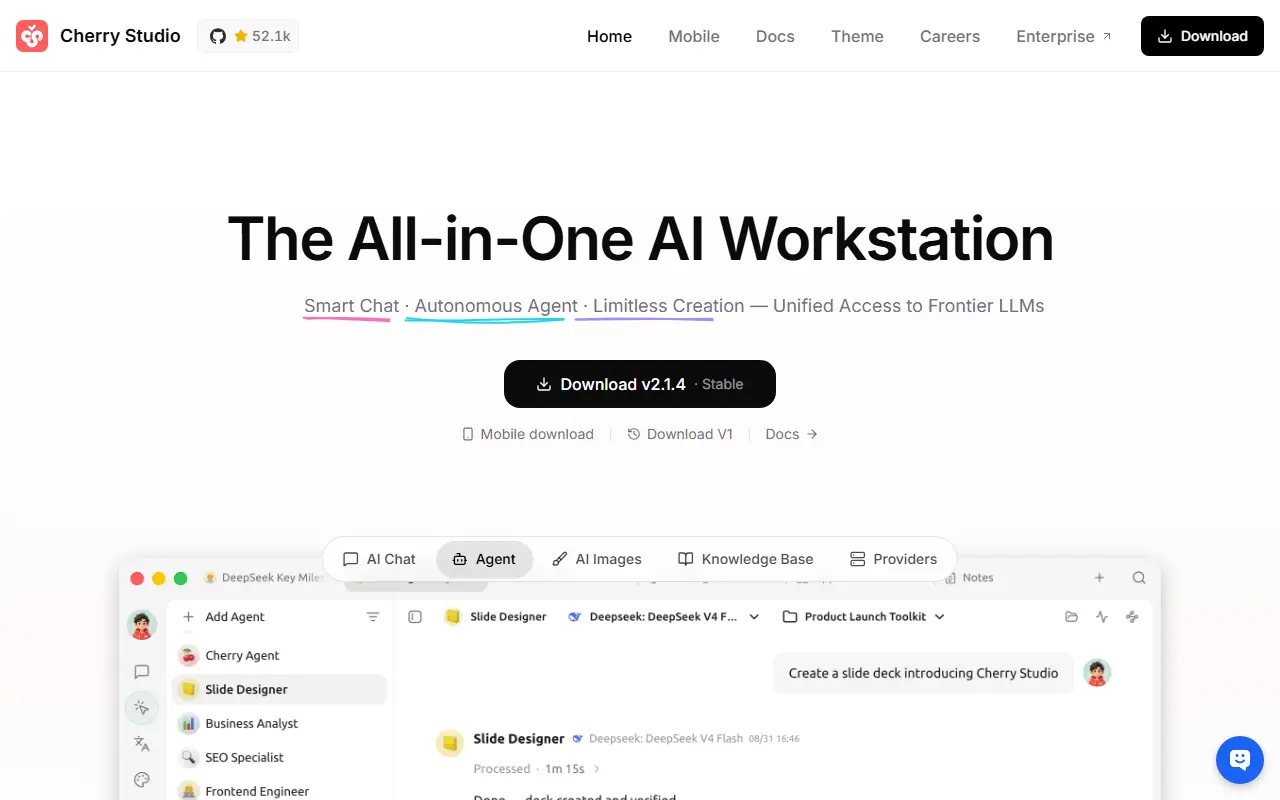
Cherry Studio is a desktop client for working with multiple large language model providers, available for Windows, Mac and Linux. It is written in TypeScript and licensed under AGPL-3.0, and it is described as an AI productivity studio offering chat, autonomous agents and a large library of ready-made assistants.
It can connect to major cloud LLM services such as OpenAI, Gemini and Anthropic, to AI web services like Claude, Perplexity and Poe, and to local models through Ollama and LM Studio. Conversations can involve several models at once, and users can pick from more than 300 preconfigured assistants or create their own.
Other tools include handling of text, images, Office files and PDFs, WebDAV backup, Mermaid chart rendering, code highlighting, global search, topic management, AI translation, mini programs and an MCP server. Themes and complete Markdown rendering are included, and no environment setup is needed. It suits individuals who want one desktop app for many models.
Key features
- Support for many cloud and local LLM providers
- Over 300 preconfigured AI assistants
- Multi-model simultaneous conversations
- Text, image, Office and PDF handling
- WebDAV backup and Mermaid chart rendering
- MCP server and mini programs
- Light and dark themes
Pricing: Free and open source under the AGPL-3.0 license.
#8
An open-source AI platform for enterprise search and chat that indexes knowledge from 50+ apps and works with any LLM, deployable on your own infrastructure.
- GitHub stars
- 33k
- Last commit
- 2 days ago
- Latest release
- v5.1.3
- Self-hosted
- Yes
onyx.app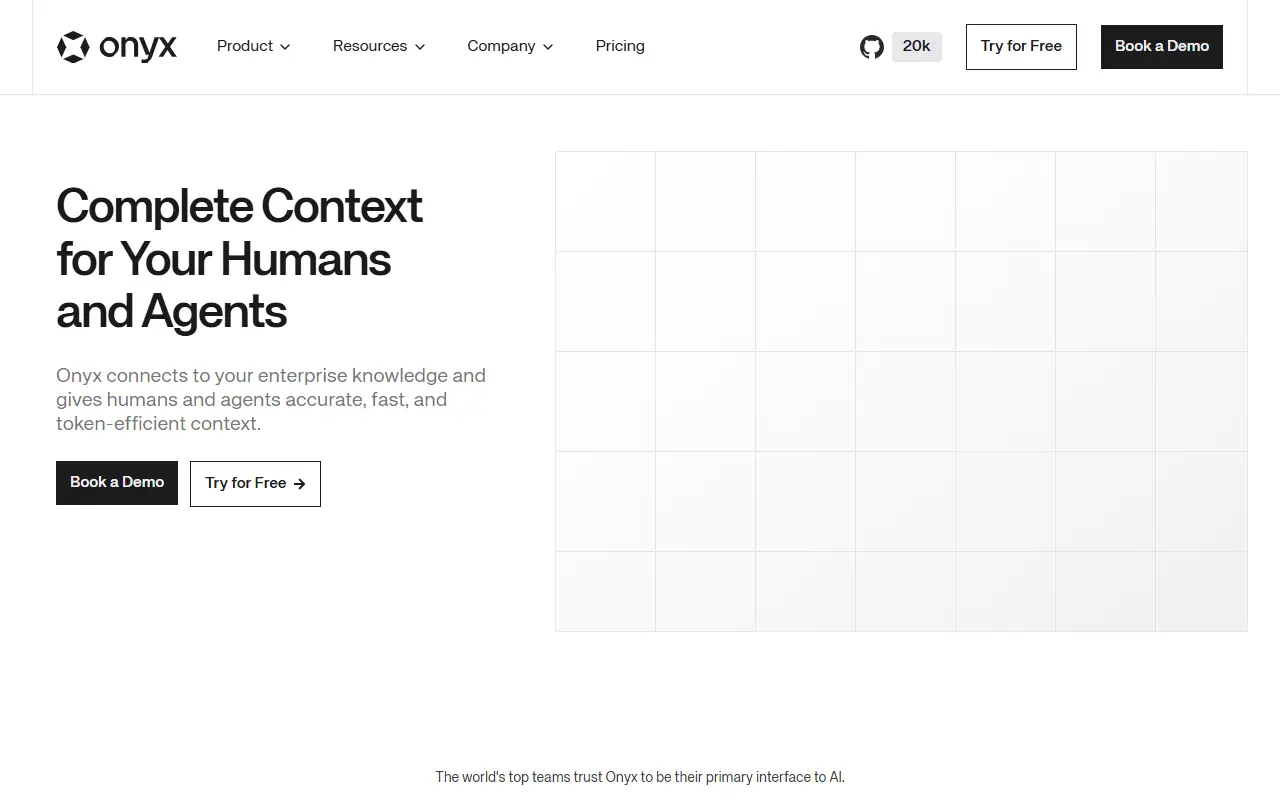
Onyx is an open-source AI platform that acts as a knowledge and context layer for teams and their AI agents. It connects to more than 50 applications, pulls in documents along with their metadata and permissions, and builds an internal representation so that LLMs can answer questions grounded in what your company actually knows.
The project argues that this indexed approach gives more reliable, lower-latency and cheaper context than approaches that have an agent search many tools iteratively through MCP. Features include agentic RAG on a hybrid index, a Deep Research mode for multi-step reports, custom agents with their own knowledge, instructions and actions, and live web search through providers such as Serper, Google PSE, Brave and SearXNG. Sandboxes and skills extend what models can do, and the chat interface works with every major LLM.
Onyx emphasizes data sovereignty through flexible self-hosted deployments, with a single-command deploy option. The code is written in Python and Next.js, and the license is listed as 'Other' on GitHub, so check the terms for the enterprise features. It suits organizations that want a private, ChatGPT-style assistant connected to internal documents.
Key features
- Connectors to 50+ workplace applications
- Hybrid index with agentic RAG
- Deep Research multi-step reports
- Custom agents with their own knowledge
- Web search via Serper, Brave and others
- Works with any LLM
- Indexing that respects source permissions
Pricing: Business costs $25 per user per month on monthly billing, or $20 per user per month billed annually, with a free trial. Enterprise pricing and deployment options are by contact.
#9
An open-source desktop app that acts as a ChatGPT replacement, running local language models offline or connecting to cloud providers, with an OpenAI-compatible local server.
- GitHub stars
- 46k
- Last commit
- 4 days ago
- Latest release
- v0.8.8
- Self-hosted
- Yes
jan.ai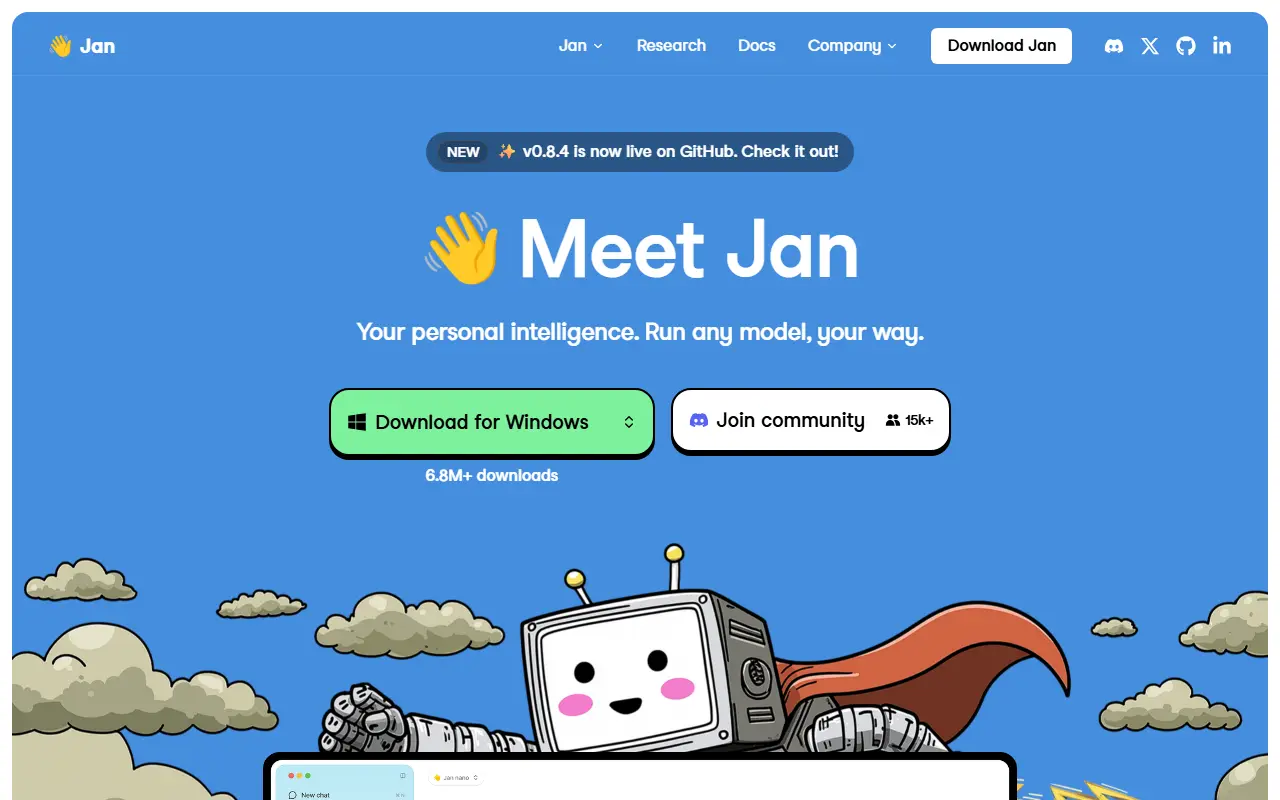
Jan is an open-source desktop application that serves as a ChatGPT alternative you control. It can download and run language models such as Llama, Gemma, Qwen and GPT-oss from Hugging Face entirely on your own computer, so conversations stay private and work without an internet connection.
When you want more capability than local hardware allows, Jan can connect to cloud models from OpenAI, Anthropic, Mistral, Groq, MiniMax and others from the same interface. You can create custom assistants for specific tasks, and Model Context Protocol support adds agentic abilities. A built-in local server on localhost port 1337 exposes an OpenAI-compatible API, so other applications can use your local models as a drop-in backend.
Jan is built with Rust and Tauri and ships installers for Windows, macOS and Linux in deb and AppImage form. Its license is listed as 'Other' on GitHub, so check the repository terms before redistributing it. It is meant for people who want local AI with a polished interface rather than a command line.
Key features
- Download and run local LLMs from Hugging Face
- Connect to OpenAI, Anthropic, Mistral and Groq
- Custom assistants for specific tasks
- OpenAI-compatible local server
- Model Context Protocol integration
- Installers for Windows, macOS and Linux
Pricing: Free and open source; running local models costs nothing beyond your own hardware, and cloud providers bill you separately.
#10
An open-source AI engine that runs LLMs, vision, voice, image and video models on your own hardware behind OpenAI-compatible APIs, with no GPU required.
- GitHub stars
- 50k
- Last commit
- today
- Latest release
- v5.0.1
- Licence
- MIT
- Self-hosted
- Yes
localai.io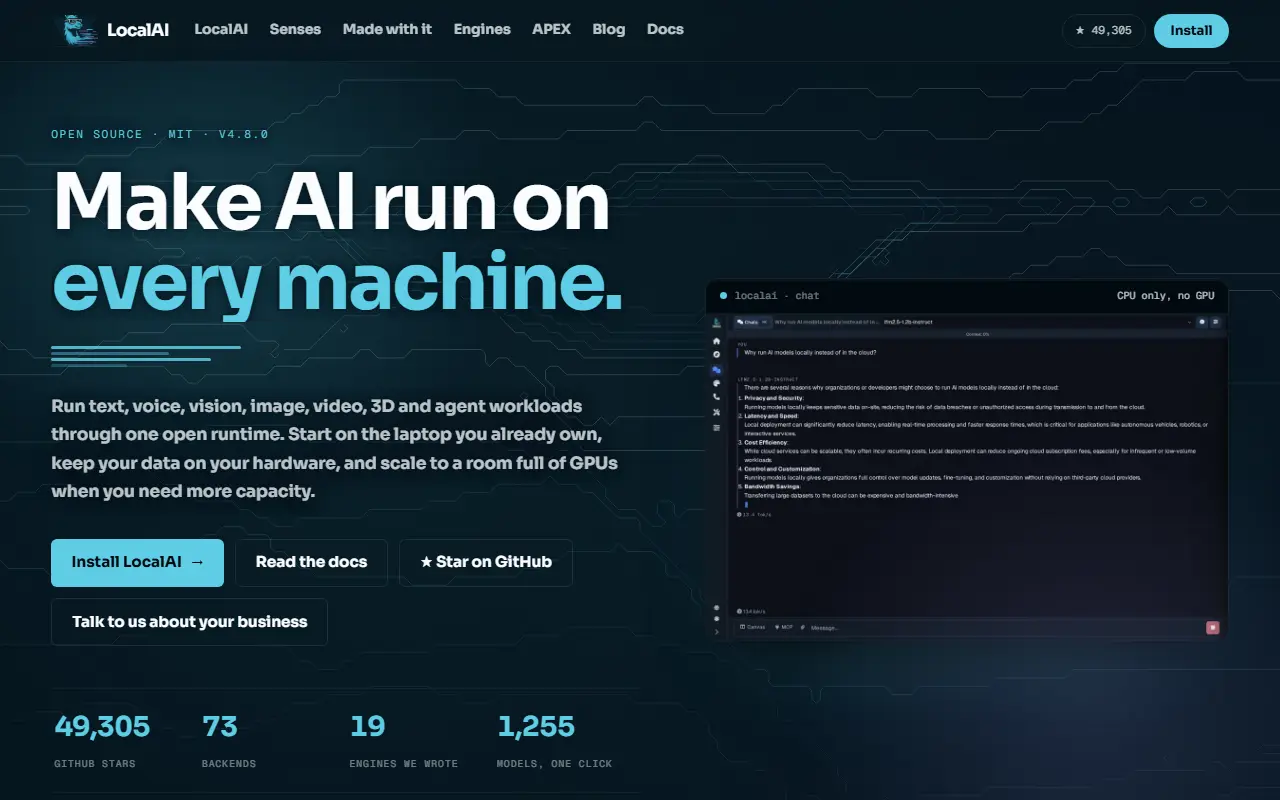
LocalAI is an open-source AI engine for running models of many kinds, including language, vision, voice, image and video models, on your own hardware. A GPU is not required. It is written in Go and released under the MIT license, was started by Ettore Di Giacinto and is looked after by the LocalAI team.
Its design is a small core with separate backends that are pulled on demand, so nothing unused gets installed. Backends wrap engines such as llama.cpp, vLLM, whisper.cpp, stable-diffusion and MLX, and you can write your own in any language against an open interface. It can run on CPU alone, through Vulkan, or on NVIDIA, AMD, Intel and Apple Silicon hardware.
APIs are drop-in compatible with OpenAI, Anthropic and ElevenLabs across every backend. Multi-user features include API key authentication, user quotas and role-based access, and built-in agents support tool use, RAG, MCP and skills. The project stresses that data stays on your infrastructure. It suits developers and teams who want a private, self-hosted replacement for cloud AI APIs.
Key features
- Runs LLM, vision, voice, image and video models
- Composable backends pulled on demand
- OpenAI, Anthropic and ElevenLabs API compatibility
- Runs on CPU, NVIDIA, AMD, Intel and Apple Silicon
- API key authentication, quotas and role-based access
- Built-in agents with tools, RAG and MCP
Pricing: Free and open source under the MIT license.
31 more ChatGPT alternatives
- View tool
Powerful AI Client
GPL-3.0vs ChatGPT★ 42k
- View tool

PrivateGPT
AI Infrastructure
Complete API layer for private AI applications on local models: RAG, skills, tools, MCP, t
Apache-2.0vs ChatGPT★ 58k
- View tool
The open-source AI Management System
OSSvs Manus★ 21k
- View tool
BrowserOS neo, formerly BrowserClaw, is a local, open-source browser your AI agents (Claud
AGPL-3.0vs Perplexity★ 14k
- View tool
🏆 Self Hosted Gen AI desktop app. Free alternative to Higgsfield, OpenArt, Freepik....
OSSvs ChatGPT★ 3.4k
- View tool
Ekko Studio brings multiple AI agents into one workspace across desktop, mobile, and web —
OSSvs ChatGPT★ 12k
- View tool

llamafile
AI Infrastructure
Distribute and run LLMs with a single file.
OSSvs ChatGPT★ 27k
- View tool
✨ Zero-config AI chat assistant. No API key needed — sign up and instantly chat with GPT-5
MITvs ChatGPT★ 89k
- View tool
Native iOS and Android client for Open WebUI, direct OpenAI-compatible, Ollama, and Hermes
GPL-3.0vs ChatGPT★ 2.5k
- View tool

Hugging Face Chat UI
AI Tools
The open source codebase powering HuggingChat
Apache-2.0vs ChatGPT★ 11k
- View tool
Use your locally running AI models to assist you in your web browsing
MITvs ChatGPT★ 8.4k
- View tool
Khoj is an applied artificial intelligence company building safe, useful AI software for h
AGPL-3.0vs ChatGPT★ 38k
- View tool
AI suite powered by state-of-the-art models and providing advanced AI/AGI functions. Inclu
MITvs ChatGPT★ 7.2k
- View tool
Chat with AI large language models running natively in your browser. Enjoy private, server
Apache-2.0vs ChatGPT★ 1.2k
- View tool
ChatMCP is an AI chat client implementing the Model Context Protocol (MCP).
Apache-2.0vs ChatGPT★ 2.2k
- View tool
Formerly Better Chatbot. Navigator is an open-source AI workspace for agents, MCP and work
MITvs ChatGPT★ 1.2k
- View tool
Chat Chat, your own unified chat and search to AI platform, with a simple and easy to use
AGPL-3.0vs Poe★ 1.3k
- View tool
GPT4All: Run Local LLMs on Any Device. Open-source and available for commercial use.
MITvs ChatGPT★ 77k
- View tool
🌊 AChat - An open-source/self-hosted/local-first AI platform, designed for enterprises an
OSSvs ChatGPT★ 3.3k
- View tool
Browser Operator - The AI browser with built in Multi-Agent platform! Open source alternat
BSD-3-Clausevs ChatGPT★ 514
- View tool
💬 SpeechGPT is a web application that enables you to converse with ChatGPT.
MITvs ChatGPT★ 2.7k
- View tool
Open chat interface for all your models.
Apache-2.0vs ChatGPT★ 1.5k
- View tool
Lemon AI is the first Full-stack Open-source Self-Evolving General AI Agent, offering a fu
OSSvs ChatGPT★ 1.6k
- View tool
All-in-one native macOS AI chat application for virtually any AI provider
Apache-2.0vs ChatGPT★ 941
- View tool
A self-hosted, offline, ChatGPT-like chatbot. Powered by Llama 2. 100% private, with no da
MITvs ChatGPT★ 11k
- View tool

InternVL
AI Infrastructure
[CVPR 2024 Oral] InternVL Family: A Pioneering Open-Source Alternative to GPT-4o. 接近GPT-4
MITvs ChatGPT★ 10k
- View tool
Open-source alternative to Claude Agent SDK, ChatGPT Agents, and Manus.
Apache-2.0vs ChatGPT★ 1.1k
- View tool
An open-source ChatGPT app with a voice
MITvs ChatGPT★ 2.3k
- View tool
A commercially-viable ChatGpt web application built with React. 使用React搭建的一款可商业化的ChatGpt W
MITvs ChatGPT★ 1.4k
- View tool

Open Deep Research
AI Tools
An open-source alternative to OpenAI and Gemini's deep research.
MITvs Perplexity★ 879
- View tool
Chat with your documents using local AI
MITvs ChatGPT★ 1.1k
Commercial ChatGPT alternatives
Hosted, closed-source products that compete with ChatGPT. Showing 12 of 58.
- View tool
Meta's AI assistant for chat and image generation, also built into its apps
SaaS
- View tool

Microsoft Copilot
AI Tools
Microsoft's AI chat assistant with web search, image creation and Office integration
SaaS
- View tool
AI assistant from Anthropic for writing, analysis, coding and document work
SaaS
- View tool
xAI's chat assistant with live web and X post search, image generation and reasoning
SaaS
- View tool
Perplexity is an AI answer engine that responds to questions with summarized answers and cited web sources.
SaaS
- View tool
One chat app to talk to many AI models and build custom bots
SaaS
- View tool
Google AI assistant for chat, writing, coding, research and image generation
SaaS
- View tool
AI chat assistant and API built on DeepSeek reasoning and language models
SaaS
- View tool
AI assistant from Mistral AI with web search, document analysis and image generation
SaaS
- View tool
AI assistant from Alibaba built on its Qwen models, with image and document features
SaaS
- View tool

Apple Intelligence
AI Tools
Personal AI features built into iPhone, iPad and Mac
SaaS
- View tool
iOS AI chat assistant for fast, natural conversations
SaaS
See every ChatGPT alternative on its tool page
ChatGPT alternatives: questions
- What is the best open-source alternative to ChatGPT?
- OpenClaw is the top-ranked open-source alternative to ChatGPT on Enlisted: An open-source personal AI assistant that runs on your own hardware and talks to you through chat apps such as Slack, Telegram and WhatsApp. Other strong options are Ollama, Open WebUI, LobeHub and LibreChat.
- What are the best commercial alternatives to ChatGPT?
- Meta AI, Microsoft Copilot, Claude, Grok and Perplexity are among the hosted, closed-source alternatives to ChatGPT listed on Enlisted, which lists 58 in total. Compare their pricing and features on each tool page.
- Are these ChatGPT alternatives free?
- All 41 are open source, so the code is free to use under its licence, and all of them can be self-hosted on your own server or computer. 12 also offer a paid or managed cloud version if you'd rather not host it yourself.
- How is this list of ChatGPT alternatives ranked?
- By a score built from GitHub stars, star growth over the last 30 days and how recently the code changed. 25 of these projects shipped code in the last 30 days. Data is refreshed daily, and nobody can pay to move up.
 TrackMedia
 TrackRev


