Build the internal tool without the queue.
Fabricate is an AI app builder for enterprise teams: describe the workflow your team runs, and it builds a working web app with sign-in and shared records, to replace a spreadsheet or to show IT precisely what you need before it enters the backlog. The Free plan includes 60 credits a month and needs no credit card.
Review it with your security team before real data arrives.
- Free plan: 60 credits a month
- No card needed
- Live link included
From one message to an internal tool
Then try it yourself and ask for changes in the same chat until it fits.
You write: An approval app for my department's purchase requests. Team members join with an invite code I give them and submit a request with the item, the supplier, the cost, a cost centre and a reason. Approvers see the requests waiting for them and approve or reject each one with a comment. Everyone sees the status of their own requests, and I see all of them, filtered by status and cost centre.
 Fabricate
I built your purchase approval app: team members join with your invite code and submit requests with the item, supplier, cost, cost centre and reason, approvers approve or reject with a comment, everyone follows their own requests and you see them all with filters. Submit and approve a test request.
Then ask for changes, such as
- Add a second approval step
- Add a monthly spend summary
- Use our brand colours
A whole new app usually takes about 20 to 35 credits.
Dispatch desk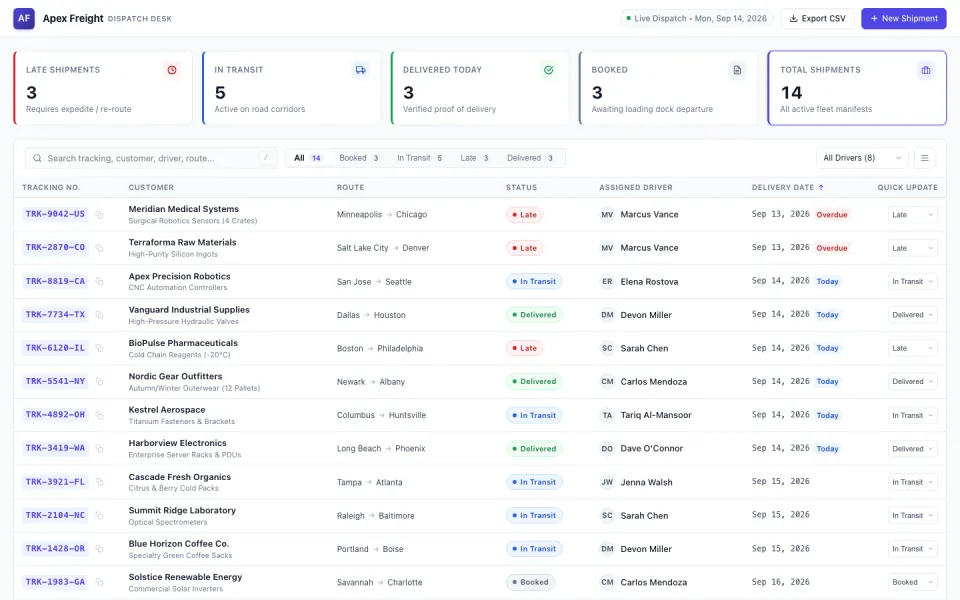
Why the spreadsheet is still there
Enterprise work does not wait for capacity. It moves somewhere nobody reviewed.
The backlog outlasts the requirement
A request queues for two quarters. By the time it is scheduled, the process it was meant to support has already changed.
Spreadsheets fill the gap
When the tool does not arrive, the work still happens. It happens in a shared workbook nobody has reviewed and everybody depends on.
Specifying is harder than wanting
A written requirements document is an argument about interpretation. Teams struggle to specify a workflow they have only ever performed.
Procurement is slower than the problem
Enterprise software means evaluation, contracts and migration, which is a long process for a workflow used by nine people in one department.
What one enterprise team can build on its own
Enough to replace a workbook, or to specify the requirement precisely before it reaches the backlog.
Days instead of quarters
Generate a working application for one departmental workflow without waiting for development capacity to free up.
Shared records
Ask for the records your process depends on and get server routes with a Durable Object SQLite database behind them.
Sign-in and restricted access
Request authentication and describe which people should reach which workflows. Have your security team review the result before real data enters it.
Deployed on Cloudflare
Applications run on Cloudflare's global network, so a departmental tool does not need a server request to go live.
No vendor lock-in
Standard React and TypeScript. On a paid plan, download the code or push it to GitHub so enterprise IT can take ownership on their own timeline.
A specification that runs
A working tool is an unambiguous requirements document. Hand IT something they can click instead of a document they have to interpret.
In short
- Best suited to enterprise departmental tools and pilots, not to systems of record for regulated data
- SSO, larger user counts and custom terms are a sales conversation, not self-serve features
- Have your own security and compliance teams review anything before real data enters it
Scoping an enterprise internal tool your IT team will accept
In most enterprises the gap between a business team's need and IT's capacity is filled by a spreadsheet. That spreadsheet becomes load-bearing, has no access control and no history, and is discovered during an audit. The realistic goal is not to bypass IT, which creates the same problem with better styling. It is to replace an unreviewed workbook with something scoped, reviewable and explicit about what it does and does not handle.
Start where the stakes are proportionate: A tracker, an intake form, an approval queue or a reporting view for one department is a good fit. A system of record for financial, health or personal data is not, until your security and compliance teams have reviewed it and agreed.
Use it to specify, not only to ship: A working application is a far better requirements document than a written one. Even where IT will ultimately build or own the tool, arriving with something clickable removes most of the interpretation from the conversation.
Be explicit about the boundary: There is no self-hosted deployment, no central policy console and no compliance certification you can inherit by using the platform. SSO, larger seat counts and custom terms are discussed directly at sales@fabricate.build. Knowing the boundary is what makes the tool safe to adopt inside it.
Where this fits in an enterprise
Choose one and the builder opens with its description filled in. Change any word before you build.
- Approval workflowRequests, reviewers and decisions in one shared record.
- Intake and triageA form, an owner, a priority and a status instead of a shared inbox.
- Asset registerAssets, owners and locations instead of a workbook on a drive.
- Weekly reportThe report a team compiles by hand, built from records.
How to build an internal tool
Four steps, all in one chat.
- 1Describe the workflow your team runs
Who submits, who reviews, what each record holds and who can see it.
- 2Run it with made-up records
Use test data in the preview, and have your security team review it before real data arrives.
- 3Ask for changes
Add a page, a field or a colour by asking in the same chat.
- 4Publish it
The live app starts with a fresh database, so your test entries stay behind.
Chat

Your app

- Free60 credits a monthBuild, preview and publish. No card needed.
- A new app20 to 35 creditsA small change is about 3 to 10 credits.
- Pro350 credits a monthA live link and your own domain. Prices are on the pricing page.
Enterprise IT and security questions
- Does Fabricate offer SSO, audit logging or compliance certifications?
- Not as self-serve features today. SSO, higher user counts, custom credit volumes and dedicated support are handled case by case, so contact sales@fabricate.build to discuss what your organization requires. Do not assume a control exists because a workflow appears to work.
- Can we run this on our own infrastructure?
- Applications are deployed on Cloudflare. There is no self-hosted or on-premise deployment option today. On a paid plan you can download the code or push it to GitHub, and your own engineers can then host it wherever your policies require.
- Can it connect to our internal systems?
- A generated application can call APIs that are reachable from the internet with credentials you supply. It does not connect to systems behind your corporate network, and it is not a data-warehouse integration tool. Treat any connection to internal systems as work requiring your own security review.
- Is this approved for regulated or confidential data?
- That is your organization's determination, not ours. Review data residency, retention, access control and your own regulatory obligations with your security and compliance teams before putting confidential or regulated data into any application you build here.
- How does IT keep governance over what teams build?
- There is no central administrative console for policy enforcement today. Governance is organizational: decide which categories of tool and which classes of data are acceptable, and route anything beyond that through your normal review. Code download and GitHub export give IT a path to take ownership.
- What support is available?
- Paid plans include priority support, and dedicated support comes with Max. For anything beyond that, including onboarding assistance for a larger team, contact sales@fabricate.build.
Keep reading
Every page by trade and role- Build an internal tool for your teamForms, lists, approvals and dashboards behind a staff sign-in.Build it
- Build a custom admin panel without codeSign-in, roles, searchable tables and edit forms.Build it
- Build a custom CRM without codeContacts, companies, a deal pipeline and follow-ups.Build it
- Build an analytics dashboard without codeKPIs and charts from data you enter, import or fetch.Feature
- Security holes AI writes into backendsWhat to check in generated server code before real data arrives.Blog
Start with one workflow
Describe the process your team runs and get a working application with shared records and sign-in. Review it with your security team before real data arrives.
Build free. No card needed.