
A single <11MB binary with a modern Web UI, CLI, and API for KVM.
No XML. No bloat. Just VMs.

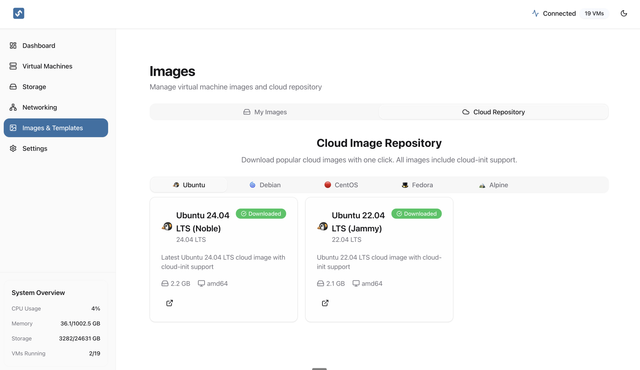
Flint is a modern, self-contained KVM management tool built for developers, sysadmins, and home labs who want zero bloat and maximum efficiency. It was built in a few hours out of a sudden urge for something better.
System Requirements:
- Linux host (Debian, Ubuntu, Fedora, RHEL, Arch, etc.)
- libvirt >= 6.10.0 (check with
libvirtd --version) - QEMU/KVM virtualization support
Required Packages:
Debian/Ubuntu
sudo apt update
sudo apt install -y qemu-kvm libvirt-daemon-system libvirt-daemon libvirt-clients bridge-utils
sudo systemctl enable --now libvirtd
RHEL/Fedora/CentOS
sudo dnf install -y qemu-kvm libvirt libvirt-client virt-install
sudo systemctl enable --now libvirtd
Arch Linux
sudo pacman -S qemu-full libvirt virt-install virt-manager
sudo systemctl enable --now libvirtd
Note: If you encounter libvirt-lxc.so.0: cannot open shared object file, install the LXC library:
# Debian/Ubuntu
sudo apt install -y libvirt-daemon-driver-lxc

# RHEL/Fedora
sudo dnf install -y libvirt-daemon-lxc

# Arch
sudo pacman -S libvirt-lxc
Platform Compatibility:
Flint is built with CGO (libvirt-go bindings). We provide binaries for both glibc and musl (Alpine Linux):
- glibc binaries:
flint-linux-amd64,flint-linux-arm64(for Debian, Ubuntu, Fedora, RHEL, Arch, etc.) - musl binaries:
flint-linux-amd64-musl,flint-linux-arm64-musl(for Alpine Linux)
Running Flint on Alpine Linux
Native musl support is now available! Download the musl-specific binary for your architecture:
# For Alpine Linux (amd64)
wget https://github.com/volantvm/flint/releases/latest/download/flint-linux-amd64-musl.zip
unzip flint-linux-amd64-musl.zip
chmod +x flint
./flint serve

# For Alpine Linux (arm64)
wget https://github.com/volantvm/flint/releases/latest/download/flint-linux-arm64-musl.zip
unzip flint-linux-arm64-musl.zip
chmod +x flint
./flint serve
Prerequisites for Alpine:
# Install required Alpine packages
apk add libvirt-daemon libvirt-qemu qemu-system-x86_64
rc-update add libvirtd
rc-service libvirtd start
Alternative: Use gcompat compatibility layer
If you prefer to use the standard glibc binary on Alpine:
apk add gcompat libstdc++
wget https://github.com/volantvm/flint/releases/latest/download/flint-linux-amd64.zip
unzip flint-linux-amd64.zip
chmod +x flint
./flint servecurl -fsSL https://raw.githubusercontent.com/volantvm/flint/main/install.sh | bashAuto-detects OS/arch, installs to /usr/local/bin, and prompts for web UI passphrase setup.
Flint implements a multi-layered security approach:
Web UI Security:
- Passphrase Authentication: Web interface requires a passphrase login
- Session-Based: Secure HTTP-only cookies with 1-hour expiry
- No API Key Exposure: Web UI never exposes API keys to browsers
API Security:
- Bearer Token Authentication: CLI and external tools use API keys
- Protected Endpoints: All API endpoints require authentication
- Flexible Access: Support for both session cookies and API keys
Authentication Flow:
# First run - set passphrase
flint serve
# 🔐 No web UI passphrase set. Let's set one up for security.
# Enter passphrase: ********

# Web UI access
# Visit http://your-server:5550 → Enter passphrase → Full access

# CLI access (uses API key)
flint vm list --all

# External API access
curl -H "Authorization: Bearer YOUR_API_KEY" http://localhost:5550/api/vms- 🖥️ Modern UI — A beautiful, responsive Next.js + Tailwind interface, fully embedded.
- ⚡ Single Binary — No containers, no XML hell. A sub-8MB binary is all you need.
- 🛠️ Powerful CLI & API — Automate everything. If you can do it in the UI, you can do it from the command line or API.
- 📦 Frictionless Provisioning — Native Cloud-Init support and a simple, snapshot-based template system.
- 🔐 Secure by Default — Multi-layered authentication with passphrase protection.
- 💪 Non-Intrusive — Flint is a tool that serves you. It's not a platform that locks you in.
- 🌐 Remote Management — Connect to remote KVM/libvirt servers via SSH from a single Flint instance.
1. Start the Server
# Interactive setup (recommended for first run)
flint serve --set-passphrase

# Or set passphrase directly
flint serve --passphrase "your-secure-password"

# Or use environment variable
export FLINT_PASSPHRASE="your-secure-password"
flint serve
On first run, you'll be prompted to set a web UI passphrase for security.
- Web UI:
http://localhost:5550(requires passphrase login) - API:
http://localhost:5550/api(requires authentication)
2. Web UI Access
- Visit
http://localhost:5550 - Enter your passphrase to access the management interface
- All API calls are automatically authenticated via session
3. CLI Usage
# VM Management
flint vm list                    # List all VMs
flint vm launch my-server        # Create and start a VM
flint vm ssh my-server          # SSH into a VM

# Cloud Images
flint image list                 # Browse cloud images
flint image download ubuntu-24.04 # Download an image

# Networks & Storage
flint network list               # List networks
flint storage volume list default # List storage volumes
4. API Access (for external tools)
# Get your API key (requires authentication)
curl -H "Authorization: Bearer YOUR_API_KEY" http://localhost:5550/api/vmsFlint can connect to remote KVM/libvirt servers via SSH, allowing you to manage distributed virtualization infrastructure from a single instance.
Setup Requirements:
- SSH key-based authentication configured between Flint host and remote server
- Remote server must have libvirt >= 6.10.0 installed
- User on remote server must have permissions to access libvirt
Configuration Methods:
Option 1: Web UI (Recommended)
- Navigate to Settings in the Flint web interface
- Enable "SSH Connection" toggle
- Fill in SSH connection details:
- Username (e.g.,
rootor user with libvirt permissions) - Host (IP address or hostname)
- Port (default: 22)
- SSH Key Path (auto-detected from ~/.ssh/)
- Username (e.g.,
- Click "Test Connection" to verify
- Click "Save Configuration" and restart Flint
Option 2: Configuration File
Edit ~/.flint/config.json:
{
  "libvirt": {
    "uri": "qemu:///system",
    "ssh": {
      "enabled": true,
      "username": "root",
      "host": "192.168.1.100",
      "port": 22,
      "key_path": "~/.ssh/id_rsa",
      "known_hosts_path": "~/.ssh/known_hosts"
    }
  }
}
Option 3: Environment Variables
export FLINT_LIBVIRT_SSH_ENABLED=true
export FLINT_LIBVIRT_SSH_USERNAME=root
export FLINT_LIBVIRT_SSH_HOST=192.168.1.100
export FLINT_LIBVIRT_SSH_PORT=22
export FLINT_LIBVIRT_SSH_KEY_PATH=~/.ssh/id_rsa
flint serve
SSH Key Setup:
# On Flint host, generate SSH key if needed
ssh-keygen -t rsa -b 4096 -f ~/.ssh/id_rsa

# Copy public key to remote server
ssh-copy-id [email protected]

# Verify connection
ssh [email protected] virsh list --all
Security Notes:
- SSH keys must have secure permissions (600 or 400)
- Password authentication is not supported (key-based only)
- Flint uses the standard libvirt SSH transport (qemu+ssh://)
- All libvirt operations are encrypted via SSH tunnel
Complete CLI commands, API reference, and advanced usage:
➡️ docs.md - Complete CLI & API Documentation
- Backend: Go 1.25+
- Web UI: Next.js + Tailwind + Bun
- KVM Integration: libvirt-go
- Binary Size: ~11MB (stripped)
🚀 Flint is young, fast-moving, and designed for builders.
Try it. Break it. Star it. Contribute.