Buy New
-
To see product details, add this item to your cart.
Ships from: Amazon.com Sold by: Amazon.com
Used - Good
-
To see product details, add this item to your cart.
Ships from: textbooks_source Sold by: textbooks_source
Download the free Kindle app and start reading Kindle books instantly on your smartphone, tablet, or computer - no Kindle device required.
Read instantly on your browser with Kindle for Web.
Using your mobile phone camera - scan the code below and download the Kindle app.
Follow the authors
OK
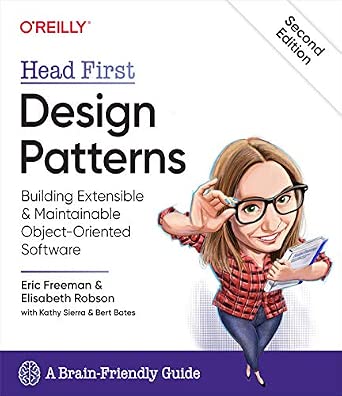
Head First Design Patterns: Building Extensible and Maintainable Object-Oriented Software 2nd Edition
Purchase options and add-ons
What will you learn from this book?
You know you don't want to reinvent the wheel, so you look to Design Patterns: the lessons learned by those who've faced the same software design problems. With Design Patterns, you get to take advantage of the best practices and experience of others so you can spend your time on something more challenging. Something more fun. This book shows you the patterns that matter, when to use them and why, how to apply them to your own designs, and the object-oriented design principles on which they're based. Join hundreds of thousands of developers who've improved their object-oriented design skills through Head First Design Patterns.
What's so special about this book?
If you've read a Head First book, you know what to expect: a visually rich format designed for the way your brain works. With Head First Design Patterns, 2E you'll learn design principles and patterns in a way that won't put you to sleep, so you can get out there to solve software design problems and speak the language of patterns with others on your team.
- ISBN-10149207800X
- ISBN-13978-1492078005
- Edition2nd
- PublisherO'Reilly Media
- Publication dateJanuary 12, 2021
- LanguageEnglish
- Dimensions7.75 x 1.5 x 9 inches
- Print length669 pages
Frequently bought together

Customers who viewed this item also viewed
- Design Patterns: Elements of Reusable Object-Oriented SoftwareHardcoverFREE Shipping on orders over $35 shipped by AmazonGet it as soon as Monday, Sep 21
- Designing Data-Intensive Applications: The Big Ideas Behind Reliable, Scalable, and Maintainable SystemsPaperbackFREE Shipping by AmazonGet it as soon as Sunday, Sep 20
- A Philosophy of Software Design, 2nd EditionPaperbackFREE Shipping on orders over $35 shipped by AmazonGet it as soon as Sunday, Sep 20
- Head First Design Patterns: A Brain-Friendly GuidePaperbackFREE ShippingGet it Sep 21 - 23Only 1 left in stock - order soon.
- Head First Software Architecture: A Learner's Guide to Architectural ThinkingPaperbackFREE Shipping by AmazonGet it as soon as Sunday, Sep 20
- Fundamentals of Software Architecture: A Modern Engineering ApproachPaperbackFREE Shipping by AmazonGet it as soon as Sunday, Sep 20
Customers also bought or read
- Head First Software Architecture: A Learner's Guide to Architectural Thinking
Paperback$53.35$53.35FREE delivery Sun, Sep 20 - Design Patterns: Elements of Reusable Object-Oriented Software
Hardcover$24.35$24.35Delivery Mon, Sep 21 - Clean Architecture: A Craftsman's Guide to Software Structure and Design (Robert C. Martin Series)
Paperback$30.29$30.29Delivery Sun, Sep 20 - Refactoring: Improving the Design of Existing Code (2nd Edition) (Addison-Wesley Signature Series (Fowler))
Hardcover$45.15$45.15FREE delivery Sun, Sep 20 - The Pragmatic Programmer: Your Journey To Mastery, 20th Anniversary Edition (2nd Edition)
Hardcover$45.97$45.97FREE delivery Sun, Sep 20 - Clean Code: A Handbook of Agile Software Craftsmanship (Robert C. Martin Series)
Paperback$58.14$58.14FREE delivery Sun, Sep 20 - Domain-Driven Design: Tackling Complexity in the Heart of Software
Hardcover$51.75$51.75FREE delivery Sun, Sep 20 - A Philosophy of Software Design, 2nd Edition#1 Best SellerSoftware Testing
Paperback$19.87$19.87Delivery Sun, Sep 20 - Fundamentals of Software Architecture: A Modern Engineering Approach#1 Best SellerComputer Programming Logic
Paperback$52.40$52.40FREE delivery Sun, Sep 20 - Clean Code: A Handbook of Agile Software Craftsmanship
Paperback$22.88$22.88$5.99 delivery Sep 28 - 30 - Architecture Patterns with Python: Enabling Test-Driven Development, Domain-Driven Design, and Event-Driven Microservices
Paperback$37.10$37.10FREE delivery Sun, Sep 20 - Grokking Algorithms, Second Edition: An illustrated guide for programmers and other curious people
Paperback$49.99$49.99FREE delivery Mon, Sep 21 - Unit Testing Principles, Practices, and Patterns: Effective testing styles, patterns, and reliable automation for unit testing, mocking, and integration testing with examples in C#
Paperback$40.00$40.00FREE delivery Sep 22 - 28 - Software Architecture: The Hard Parts: Modern Trade-Off Analyses for Distributed Architectures
Paperback$43.99$43.99FREE delivery Mon, Sep 21 - UML Distilled: A Brief Guide to the Standard Object Modeling Language (Addison-Wesley Object Technology Series)
Paperback$23.48$23.48Delivery Sep 23 - 29 - Learning Domain-Driven Design: Aligning Software Architecture and Business Strategy
Paperback$37.49$37.49FREE delivery Mon, Sep 21 - Head First C#: A Learner's Guide to Real-World Programming with C# and .NET
Paperback$53.35$53.35FREE delivery Sun, Sep 20 - Software Engineering at Google: Lessons Learned from Programming Over Time
Paperback$32.15$32.15Delivery Sun, Sep 20 - Fluent Python: Clear, Concise, and Effective Programming
Paperback$43.99$43.99FREE delivery Sun, Sep 20 - C++ Software Design: Design Principles and Patterns for High-Quality Software
Paperback$51.24$51.24FREE delivery Mon, Sep 21 - AI Engineering: Building Applications with Foundation Models#1 Best SellerEnterprise Applications
Paperback$52.40$52.40FREE delivery Sun, Sep 20 - Operating Systems: Three Easy Pieces#1 Best SellerComputer Operating Systems Theory
Paperback$28.27$28.27Delivery Mon, Sep 21
From the brand
-
Explore the full series
-
Brain-Friendly Guides
-
Brain-Friendly Guides
-
Explore the full series
-
Learning isn't something that just happens to you. It's something you do. Learning means building more mental pathways, bridging connections between new and pre-existing knowledge, recognizing patterns, and turning facts and information into knowledge (and ultimately, wisdom).
Based on the latest research in cognitive science, neuro-biology, and educational psychology, Head First books get your brain into learning mode.
From the Publisher
About 'Head First' Books
We think of a Head First Reader as a Learner
Learning isn't something that just happens to you. It's something you do. You can't learn without pumping some neurons. Learning means building more mental pathways, bridging connections between new and pre-existing knowledge, recognizing patterns, and turning facts and information into knowledge (and ultimately, wisdom). Based on the latest research in cognitive science, neuro-biology, and educational psychology, Head First books get your brain into learning mode.
Here's how we help you do that:
We tell stories using casual language, instead of lecturing. We don't take ourselves too seriously. Which would you pay more attention to: a stimulating dinner party companion, or a lecture?
We make it visual. Images are far more memorable than words alone, and make learning much more effective. They also make things more fun.
We use attention-grabbing tactics. Learning a new, tough, technical topic doesn't have to be boring. The graphics are often surprising, oversized, humorous, sarcastic, or edgy. The page layout is dynamic: no two pages are the same, and each one has a mix of text and images.
Metacognition: thinking about thinking
If you really want to learn, and you want to learn more quickly and more deeply, pay attention to how you pay attention. Think about how you think. The trick is to get your brain to see the new material you're learning as Really Important. Crucial to your well-being. Otherwise, you're in for a constant battle, with your brain doing its best to keep the new content from sticking.
Here's what we do:
We use pictures, because your brain is tuned for visuals, not text. As far as your brain's concerned, a picture really is worth a thousand words. And when text and pictures work together, we embedded the text in the pictures because your brain works more effectively when the text is within the thing the text refers to, as opposed to in a caption or buried in the text somewhere.
We use redundancy, saying the same thing in different ways and with different media types, and multiple senses, to increase the chance that the content gets coded into more than one area of your brain.
We use concepts and pictures in unexpected ways because your brain is tuned for novelty, and we use pictures and ideas with at least some emotional content, because your brain is more likely to remember when you feel something.
We use a personalized, conversational style, because your brain is tuned to pay more attention when it believes you're in a conversation than if it thinks you're passively listening to a presentation.
We include many activities, because your brain is tuned to learn and remember more when you do things than when you read about things. And we make the exercises challenging-yet-do-able, because that's what most people prefer.
We use multiple learning styles, because you might prefer step-by-step procedures, while someone else wants to understand the big picture first, and someone else just wants to see an example. But regardless of your own learning preference, everyone benefits from seeing the same content represented in multiple ways.
We include content for both sides of your brain, because the more of your brain you engage, the more likely you are to learn and remember, and the longer you can stay focused. Since working one side of the brain often means giving the other side a chance to rest, you can be more productive at learning for a longer period of time.
We include challenges by asking questions that don't always have a straight answer, because your brain is tuned to learn and remember when it has to work at something.
Finally, we use people in our stories, examples, and pictures, because, well, you're a person. Your brain pays more attention to people than to things.
Generative AI Design Patterns
|
Machine Learning Design Patterns
|
Data Engineering Design Patterns
|
Cloud Application Architecture Patterns
|
Design Patterns for Cloud Native Applications
|
Learning JavaScript Design Patterns
|
|
|---|---|---|---|---|---|---|
| Customer Reviews |
4.6 out of 5 stars 26
|
4.6 out of 5 stars 417
|
4.0 out of 5 stars 20
|
4.4 out of 5 stars 34
|
4.2 out of 5 stars 52
|
4.1 out of 5 stars 48
|
| Design Patterns from O'Reilly Media | no data | no data | no data | no data | no data | no data |
Editorial Reviews
Review
About the Author
Elisabeth Robson is the co-author of several Head First books, including Head First Design Patterns, and is a principal at WickedlySmart, an online learning company for software developers.
Product details
- Publisher : O'Reilly Media
- Publication date : January 12, 2021
- Edition : 2nd
- Language : English
- Print length : 669 pages
- ISBN-10 : 149207800X
- ISBN-13 : 978-1492078005
- Item Weight : 2.65 pounds
- Dimensions : 7.75 x 1.5 x 9 inches
- Part of series : Head First
- Best Sellers Rank: #53,222 in Books (See Top 100 in Books)
- #1 in Java Programming
- #5 in Object-Oriented Software Design
- #6 in Object-Oriented Design
- Customer Reviews:
About the authors

Elisabeth Robson is currently co-founder of Wickedly Smart (wickedlysmart.com) where she is creating new brain-friendly learning products.

Eric is described by Head First series co-creator Kathy Sierra as “one of those rare individuals fluent in the language, practice, and culture of multiple domains from hipster hacker, corporate VP, engineer, think tank.” Professionally, Eric recently ended nearly a decade as a media company executive—having held the position of CTO of Disney Online at The Walt Disney Company. Eric is now devoting his time to WickedlySmart, a startup he co-created with Elisabeth Robson.
By training, Eric is a computer scientist, having studied with industry luminary David Gelernter during his Ph.D. work at Yale University. His dissertation is credited as the seminal work in alternatives to the desktop metaphor, and also as the first implementation of activity streams, a concept he and Dr. Gelernter developed.
In his spare time, Eric is deeply involved with music; you’ll find Eric’s latest project, a collaboration with ambient music pioneer Steve Roach, available on the iPhone app store under the name Immersion Station.
Eric lives with his wife and young daughter on Bainbridge Island. His daughter is a frequent vistor to Eric’s studio, where she loves to turn the knobs of his synths and audio effects. Eric’s also passionate about kids education and nutrition, and looking for ways to improve them.