
High-Level Data Link Control (HDLC) is a bit-oriented data link layer protocol used for reliable data transmission between network nodes using structured frames.
- Operates at the data link layer
- Uses frames as the basic unit of transmission
- Supports point-to-point and multipoint communication
- Provides flow control and error control
- Widely used in WAN and synchronous communication
Purpose of an HDLC Frame
An HDLC frame enables the receiver to:
- Identify the start and end of a frame
- Recognize the intended destination
- Control communication flow
- Detect transmission errors
- Ensure reliable data delivery
HDLC Frame Format
Each HDLC frame consists of the following fields:
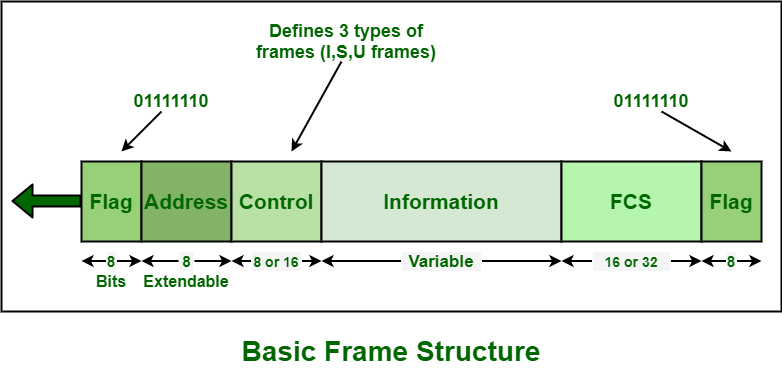
Size of Different Fields :
| Field Name | Size (bits) |
|---|---|
| Flag Field | 8 bits |
| Address Field | 8 bits |
| Control Field | 8 or 16 bits |
| Information Field | Variable (not used in some type of HDLC frames) |
| FCS (Frame Check Sequence) Field | 16 or 32 bits |
| Closing Flag Field | 8 bits |
Let us understand these fields in details :
1. Flag Field
- Marks the beginning and end of a frame
- Uses an 8-bit pattern
01111110 (0x7E) - Provides synchronization
2. Address Field
- Identifies the secondary station
- Supports individual, group, and broadcast addressing
- Length may vary based on network requirements
3. Control Field
- Controls communication and frame type
- Supports three frame types: Information (I-Frame): Data transfer, Supervisory (S-Frame): Flow and error control, Unnumbered (U-Frame): Link management
4. Information Field
- Contains user data or management information
- Optional and variable in length
5. Frame Check Sequence (FCS)
- Used for error detection
- Uses CRC-16 or CRC-32
- Ensures frame integrity
6. Ending Flag Field
- Indicates the end of the frame
- May serve as the starting flag for the next frame

Key Advantages of HDLC
- Reliable and efficient data transmission
- Strong error detection using CRC
- Flexible addressing and frame control
- Supports continuous frame transmission
HDLC provides a robust framing structure and has influenced many modern data link protocols through its efficient error handling and communication control mechanisms.