
VoIP means a Voice Over Internet Protocol. It uses the internet to send voice from one place to a another. When we use the VoIP voice is turned into a digital data and sent over the Wi-Fi or a wired internet connection. We can make the VoIP calls using special phones or apps on the your computer. PSTN is means a Public Switched Telephone Network. It is the old fashioned way of making the phone calls. PSTN uses the special wires and systems just for the phone calls.
These wires connect phones all over the world. When we use the regular home phone and sometimes a cell phone we are using PSTN. Unlike a VoIP the PSTN dont use the internet to send voice. Instead it uses its own separate network of wires and towers.
What is Voice Over Internet Protocol (VoIP)?
VoIP is means a Voice Over Internet Protocol also called as a IP telephony and Internet telephony and Broadband telephony. In simple it refers to the Phone service over the Internet. This technology allows to make the voice call using the broadband internet connection instead of regular phone line. It is used for the delivery of high range voice communications as well as the multimedia sessions over a Internet Protocol (IP) networks that is why it is called as the Voice over IP. Now it is one of the most effective way of delivering the voice between people.
In a VoIP Internet is used as transmission medium for the telephone calls by sending a voice data in the form of a packets using Internet Protocol IP. It transmits the real time voice signal from a source IP address to the target IP address. In the current days Voice Over Internet Protocol VoIP is one of the reliable and cost effective alternative to early and traditional phone service.
-660.jpg)
Advantages of VoIP
- These VoIP calls cheaper especially for the long distance and international calls. We can save money on a phone bill. Some VoIP services even offer the free calls between users of the same service no matter where they are in world.
- The VoIP offers extra features like the video calling, call forwarding and voicemail to email at no extra cost. It is more flexible than traditional phone systems. We can use VoIP on the multiple devices like computer, smartphone and tablet.
Disadvantages of VoIP
- VoIP needs a stable internet connection to work well. If internet is slow or goes down or the phone service may not work. This can be the problem if we live in an area with the unreliable internet service.
- Unlike the traditional phones VoIP phones stop working during the power outages. This can be the problem in the emergencies. Some VoIP systems offer the backup power options but these often cost extra.
What is Public Switched Telephone Network (PSTN)?
PSTN is means a (Public Switched Telephone Network) is the traditional phone system. It uses a copper wires to send the voice calls between different places. This network turns voices into analog signals that travel through the wires. The PSTN connects phones in homes and businesses worldwide. It the older system but still widely used today. The network "switches" to create direct connections for each call, allowing many people to share the same lines. It is operated by the local national and the international carriers.
Public Switched Telephone Network is based on a Circuit Switching concept. When the dedicated path is established between the two phones a circuit is established between them. All Landlines are Public Switched Telephone Network PSTN.
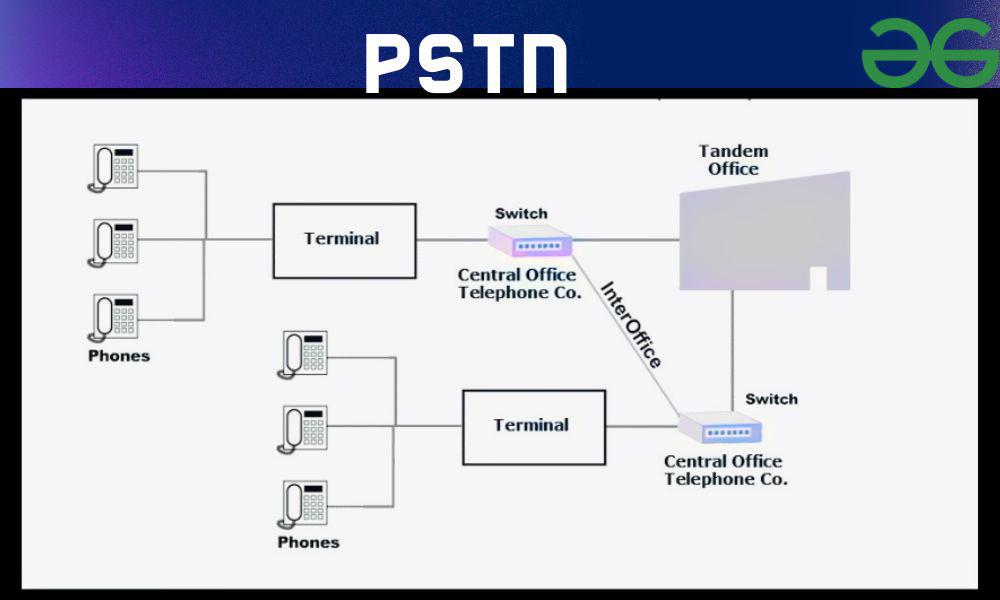
Advantages of PSTN
- PSTN works even during power outages. It's more dependable in emergencies and doesn't rely on internet connection. This makes it the preferred choice for emergency services and in areas with frequent power issues.
- PSTN usually provides clear, consistent call quality. There's less chance of echoes, delays, or dropped calls compared to VoIP. This is because PSTN uses dedicated lines for voice transmission, ensuring a stable connection.
Disadvantages of PSTN
- PSTN calls, especially long-distance and international, are often more expensive than VoIP. You might pay more for extra features too. The costs can add up quickly if you make frequent calls to different areas or countries.
- PSTN offers fewer advanced features compared to VoIP. Things like video calling or voicemail-to-email are not usually available or cost extra. Upgrading the PSTN system to add the new features can be costly and may require the new hardware.
Difference between VoIP and PSTN
| VoIP | PSTN |
|---|---|
| Voice over a Internet Protocol uses the packet switching. | Public Switched Telephone Network uses circuit switching. |
| In VoIP, only an internet connection is required. | In PSTN, dedicated lines required from telecom company. |
| No dedicated path required between sender and receiver. | Dedicated path required between sender and receiver. |
| One VoIP lines require 100 kbps. | One link typically supports 64 kbps. |
| In VoIP, it acquires and releases bandwidth as it is needed. | Bandwidth is reserved in advance it requires as each line is 64 kbps. |
| In VoIP, Cost is not dependent on distance and time. | In PSTN, Cost is based on distance and time. |
| Extensions is a standard feature of VoIP. | Extensions requires extra costs in PSTN. |
| VoIP provides consistent voice quality but depends on bandwidth. | PSTN provides consistent voice quality. |
| The Call waiting, call forwarding and call transfer are the standard features of a VoIP. | The Call waiting, call forwarding and call transfer are usually the standard features in a PSTN but sometimes it costs the extra for this. |
| Scalability and upgrades requires improved internet bandwidth. | Scalability and upgrades requires substantial hardware additions. |
Conclusion
The VoIP and a PSTN are the ways to make phone calls. VoIP uses the internet to send your voice while the PSTN uses special phone lines. VoIP is new and cheaper for the long distance calls. It needs a good internet connection to work well. The PSTN is old but more reliable and dont depend on the internet. It is widely used especially for the emergency calls. Both systems let us talk to people far away but they do it in a different ways.