
Point-to-Point Protocol (PPP) is a Layer 2 WAN protocol that encapsulates network-layer packets for reliable, full-duplex communication over point-to-point links.
- Operates at the Data Link Layer (Layer 2)
- Used over serial cables, cellular links, and fiber optics
- Supports encapsulation of multiple network-layer protocols
- Provides full-duplex, bidirectional data transmission
- Ensures sequential packet delivery
- Uses frames as the basic unit of transmission
- Requires 8 bytes for encapsulation overhead
PPP Encapsulation Frame Fields
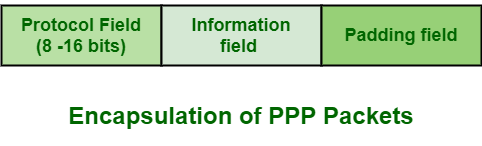
1. Protocol Field
- Size: 1 or 2 bytes
- Identifies the protocol carried in the frame
- Supports protocols like IP, LCP, PAP, and CHAP
2. Information Field
- Size: 0 to 1500 bytes
- Contains the actual datagram of the specified protocol
3. Padding Field
- Optional field
- Pads data up to the Maximum Receive Unit (MRU)
- Must be distinguishable from actual data
| Protocol Number | Protocol Name |
|---|---|
| 0001 | Padding Protocol |
| 0003 to 001f | Reserved (transparency inefficient) |
| 00cf | Reserved (PPP NLPID) |
| 8001 to 801 | Unused |
| 807d | Unused |
| 0021 | IP (Internet Protocol) |
| 8021 | IPCP (Internet Protocol Control Protocol) (NCP for IP) |
| 002d | Van Jacobson TCP/IP header compression (RFC 1144) |
| 002f | Van Jacobson IP header compression |
| c021 | Link Control Protocol |
| c023 | Password Authentication Protocol |
| c025 | Link Quality Report |
| c223 | Challenge Handshake Authentication Protocol |
PPP is widely used due to its flexibility, protocol independence, and support for authentication and multiprotocol communication.