

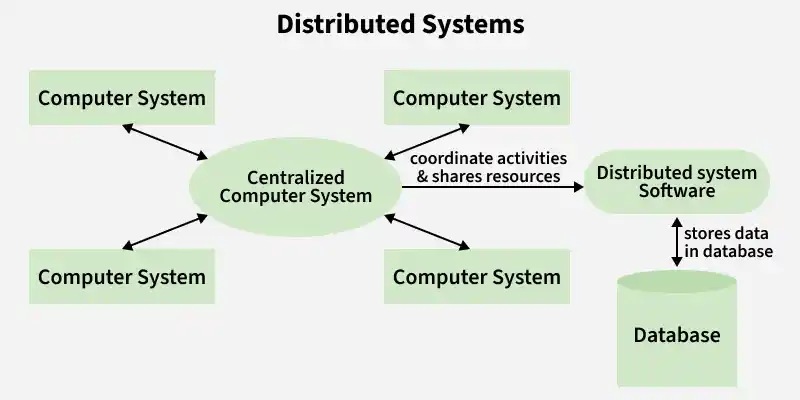
A distributed system is a group of independent computers, called nodes, that work together as a single system. These nodes communicate over a network to share data, resources, and tasks to achieve a common goal. It ensures coordination between multiple systems while appearing unified to the user.
- Consists of multiple independent computers (nodes) working together over a network.
- Nodes communicate and share data, resources, and tasks while appearing as a single system to users.
Real-World Examples
These examples show how distributed systems are used in real applications to handle large-scale data, improve performance, and ensure reliability.
- Online Banking Systems: Banks use distributed systems where branches, ATMs, and servers communicate to process transactions reliably.
- E-Commerce Platforms: Platforms like Amazon or Flipkart process orders, payments, and inventory across multiple servers to handle high traffic and ensure a smooth user experience.
- Social Media Platforms: Applications like Facebook, X, and Instagram use multiple data centers to store and process massive amounts of user data efficiently.
- Online Gaming Systems: Multiplayer games like PUBG use multiple servers to manage game sessions and player data, reducing latency and supporting real-time gameplay.
Types of Distributed Systems
Distributed systems can be classified into different types based on how nodes are organized, how they communicate, and how tasks are distributed across the system.
1. Client-Server Systems
A client-server system is a distributed system where a central server provides services and multiple clients request those services over a network.
- Server manages data and processing.
- Clients send requests and receive responses.
- Example: Gmail or online banking systems.
2. Peer-to-Peer (P2P) Systems
A peer-to-peer system is a distributed system where nodes can act as both clients and servers without relying on a central server.
- No central server is required.
- Nodes directly share resources with each other.
- Example: BitTorrent and blockchain networks.
3. Clustered Systems
A clustered system is a group of closely connected computers that work together as a single system to improve performance and reliability.
- Nodes work together in a tightly connected network.
- Tasks are distributed among nodes for better performance.
- Example: Search engine clusters and supercomputers.
4. Cloud-Based Distributed Systems
A cloud-based distributed system uses cloud infrastructure where computing resources are distributed across multiple servers and data centers.
- Resources can be scaled on demand.
- Services and resources are accessed over a network.
- Example: AWS, Microsoft Azure, and Google Cloud.
Working
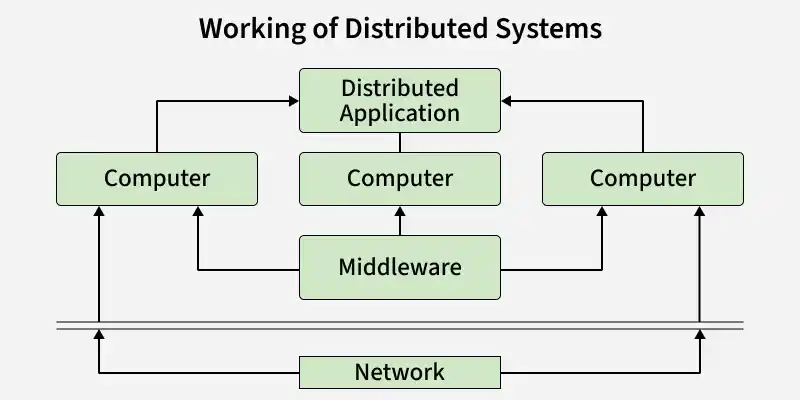
A distributed system works by dividing tasks among multiple nodes, which communicate and coordinate over a network to achieve a common goal.
- Nodes communicate with each other over a network using communication protocols or middleware.
- Data and tasks are distributed across multiple nodes for parallel processing and resource sharing.
- Nodes process data locally and share results with other nodes when required.
- The system coordinates nodes to maintain consistency, reliability, and fault tolerance.
Advantages
- Resource Sharing: Allows nodes to share data, files, and resources efficiently.
- Scalability: Makes it easy to handle increasing workloads by adding more nodes.
- Reliability: Allows the system to continue operating even when some nodes fail.
- Performance: Distributes workloads across multiple nodes for faster processing.
Disadvantages
- Complexity: Makes designing, managing, and maintaining the system more difficult.
- Security: Multiple nodes and network connections increase security risks.
- Network Dependency: System performance depends on network speed, latency, and reliability.
- Data Consistency: Keeping data synchronized across multiple nodes can be challenging.
Distributed Systems vs Microservices
| Distributed System | Microservices |
|---|---|
| A collection of independent computers or nodes that work together as a single system. | An architectural style that divides an application into small, independent services. |
| Focuses on communication and coordination between multiple machines. | Focuses on designing applications as loosely coupled services. |
| Improves scalability, performance, and reliability. | Allows services to be developed and deployed independently. |
| Can use different architectural approaches, including client-server, P2P, and clusters. | Each service typically handles a specific business functionality. |
| Not all distributed systems use microservices. | Microservices typically form a distributed system because services communicate over a network. |