67% found this document useful (3 votes)
3K views6 pages

Contact Lenses for Chickens: A Case Study

The document presents a case study analyzing Optical Distortion Inc.'s innovative product: contact lenses designed to partially blind laying hens. This product reduces cannibalism in chicken farms by disrupting social hierarchies. It provides significant cost savings over traditional debeaking through reduced mortality, no lost eggs, and lower food costs. For ODI to successfully market this product, the summary recommends setting an initial price of $0.24 per pair that captures the product's savings for farmers while ensuring profits for ODI during its three-year patent protection period.

Uploaded by

genesisolivero
Copyright
© © All Rights Reserved
We take content rights seriously. If you suspect this is your content, claim it here.
Available Formats
Download as PDF, TXT or read online on Scribd
67% found this document useful (3 votes)
3K views6 pages

Contact Lenses for Chickens: A Case Study

The document presents a case study analyzing Optical Distortion Inc.'s innovative product: contact lenses designed to partially blind laying hens. This product reduces cannibalism in chicken farms by disrupting social hierarchies. It provides significant cost savings over traditional debeaking through reduced mortality, no lost eggs, and lower food costs. For ODI to successfully market this product, the summary recommends setting an initial price of $0.24 per pair that captures the product's savings for farmers while ensuring profits for ODI during its three-year patent protection period.

Uploaded by

genesisolivero
Copyright
© © All Rights Reserved
We take content rights seriously. If you suspect this is your content, claim it here.
Available Formats
Download as PDF, TXT or read online on Scribd
  • Introduction
  • Experiment Details
  • Product Introduction and Cost Analysis
  • Market Strategy

Genesis Olivero

Case Study: Optical Distortion, Inc. (A)

The objective of the case study is to analyze the introduction to the market of an

innovative product manufactured by Optical Distortion, Inc .: contact lenses specifically

designed for laying hens. This product partially blinds the view of the hens, resulting in less

feed consumption and easier handling of these due to the elimination of social hierarchies

between the hens and, therefore, cannibalism that occurs in the cages. This means a solution,

capable of generating significant cost savings for farmers. A profitable marketing plan can

convert ODI's unique new product into a successful business.

The case study presents two options that could solve the problem of cannibalism. The

first consists of cutting the beak of the birds (debeaking), reducing the efficiency of the beak

as a weapon. This operation subjects the hens to trauma, consequently to a temporary weight

loss and a delay in egg production of at least one week (One egg every 5 months). There was

also the risk of leaving the beak too long or too short. This mechanism generates a reduction

in mortality due to cannibalism from 25% to 9%. The process can be executed by an

experienced team of three people with a $ 2.5 / hour salary and could cut 220 spikes per hour.

The second alternative is that presented by Optical Distortion, Inc. through the contact lenses

for chickens. The effect of the product is to generate induced astigmatism in chickens, thus

reducing their field of vision, putting an end to aggressiveness and cannibalism in farms.

As mentioned in the case study, “chickens respond psychologically to the color of their

environment. When birds are placed in a red-colored environment, deaths due to cannibalism

are reduced, for this reason, the contact lenses are designed red.”. This method reduces the

mortality due to cannibalism to 4.5%. A trained crew of three, similar to the debeaking crew,

could install the lenses in about 225 chickens per hour. This process does not create trauma to
the hens as debeaking does. The chickens were up and about within a few hours, and neither

weight loss nor reduction in egg production was noticeable. Another important aspect is the

difference in food cost between both processes. A debeaked chicken could eat only if the feed

in the trough was at least 3/8” deep. However, this was not needed with ODI, since it does not

affect their beak. A study, conducted by Gil Jaeger, suggests that food disappearance per 100

birds per day was reduced from 24.46 pounds when the feed in the trough was 2” deep to

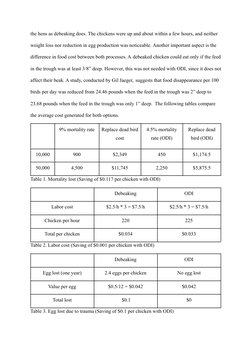
23.68 pounds when the feed in the trough was only 1” deep. The following tables compare

the average cost generated for both options.

9% mortality rate Replace dead bird 4.5% mortality Replace dead


cost rate (ODI) bird (ODI)

10,000 900 $2,349 450 $1,174.5

50,000 4,500 $11,745 2,250 $5,875.5

Table 1. Mortality lost (Saving of $0.117 per chicken with ODI)

Debeaking ODI

Labor cost $2.5/h * 3 = $7.5/h $2.5/h * 3 = $7.5/h

Chicken per hour 220 225

Total per chicken $0.034 $0.033

Table 2. Labor cost (Saving of $0.001 per chicken with ODI)

Debeaking ODI

Egg lost (one year) 2.4 eggs per chicken No egg lost

Value per egg $0.5/12 = $0.042 $0.042

Total lost $0.1 $0

Table 3. Egg lost due to trauma (Saving of $0.1 per chicken with ODI)
Debeaking ODI

Food cost $7.04 per chicken $6.8151

Table 4. Food cost (Savings of $0.225 per chicken with ODI)

All these savings lead to a total of $0.44 per chicken when the farmer chooses to use ODI

instead of debeaking. As it can be seen, this product can generate a huge saving for the

farmer.

The next point to treat is where and to whom should the product be introduced. ODI

should enter the market through the region-by-region strategy, starting with California, which

has 521 potential clients with farms between 20,000 and 100,000 chickens. After the 3-year

protection that the patent provides, ODI could face a level of strong competition that would

undoubtedly be able to imitate its product, reducing the market share gained thus far. That is

why an aggressive launch and distribution strategy is required. It is pointless to invest in

small farms (10,000 or fewer birds) since these farms are declining at a rate of 25% per year.

Medium farms (10,000–50,000 birds) and large farms (over 50,000 birds) are mostly

operated professionally. The medium farms are usually still owned and managed by the

farmer, while large farms are administrated by several people. ODI should focus on medium

and large farms because clients with large farms have professional knowledge, so they will

understand the rationale advantages of wearing ODI lenses. However, farm owners may

hesitate in investing in ODI, due to the price they would have to pay for it and the time that

would take to start seeing the benefits of it. For this reason, the should not be too high.

Now to calculate the initial price for this product some costs should be taken into

consideration. To manufacture the product, the use of hydrophilic polymer is required, which

allows the design of soft lenses that do not cause irritation or bleeding in the chickens' eyes.

1
Based on Gil Jaeger’s study 156 pounds of feed could be saved per day for 20,000 chickens. That is
56,940 pounds or 28.47 tons of chicken feed yearly. At $158 per ton of chicken feed this would leed to
(28.47*158) / 20,000 = $0.225.
Daniel Garrison obtained a long-term license from New World for the exclusive use of

hydrophilic polymer for nonhuman applications. New World agreed not to produce the

polymer for other firms seeking nonhuman markets, nor to carry out development work on

related polymers for such firms. ODI, in turn, agreed to pay New World $50,000 ($25,000 per

year for the first two years) and to purchase its lenses exclusively from New World. New

World would manufacture the lenses and sell them to ODI at a price of $0.032 per pair (in

bulk), regardless of quantity. ODI was to supply New World with injection molds (at a cost of

$12,000 each). Each injection mold had an annual capacity of 7.2 million pairs and an

expected life of 15 million pairs. In summary, the acquisition cost of each pair of glasses is

$0.032. The unit cost of the injection molds is $0.002 ( $ 12,000 for each mold divided by its

annual capacity of 7.2 million pairs per year). The plastic boxes (250 pairs per box) would

cost $0.10 each and could be filled by ODI at $0.14 per box. Order processing and shipping

were estimated at $0.18 per box.

Lenses cost per pair (from NWP to ODI) $0.032

Mold injection cost (each is US$12,0000 12,000 / 15,000,000 = US$ 0.0008


with a lifetime of 15 million pairs)

Box cost (for 250 pairs each) $0.10 + $0.14 + $0.18 = $0.42

Box cost (for 1 pair) $0.42 / 250 pairs = $0.0017

Total $0.0345 per pair

Table 5. Lenses total cost per pairs.

There also will be annual costs: The West Coast regional office and warehouse would be

about $196,000 per year, plus about $40,000 for each salesperson (each with 80 farms) and

$35,000 for each technical representative (each for 5 salespeople). ODI should be marketing

on a national basis within two to three years, which would require four to five regional

offices. Monthly advertising of approximately $100,000 per year, headquarters expenses from
$184,000 per year at a volume of 20 million pairs and $25,000 to NWP. To calculated the

number required of salesperson and technical representative the following table of California

farm was used.

No of Farms No. of Chickens

Flock Size 20,000–49,000 320 9,517,453

Flock size 50,000–99,000 114 7,459,944

Flock size 100,000 and over 87 22,952,283

Total 521 39,929,680

Table 6. Characteristics of California Chicken Farms, 1969.

As shown in table 6, there is a total of 521 chicken farms in California. To assign each

salesperson 80 farms, there would be needed 7 salesperson and two technical representatives,

costing a total of $350,000. These along with the costs mentioned before generates a cost

total of $855,000 yearly. As stated in the case study, the minimum unit value of the ODI

contact lenses for chicken is $20 per box of 250 pairs or $0.08 per pair. This price is too low

compared to the savings of the farmer when choosing to use this product. Is suggested to

place the price at a level where both parts are beneficiated, this would be at $0.24 per pair.

This price was chosen considering that Optical Distortion, Inc. has patents in effect for the

first three years. It would be reasonable to enter with a high price strategy, in order to obtain

the most benefits and market share before the product can be replicated or competition

appears. Additionally, this will serve to build the brand and image of a pioneering company

in this technology, which will give a competitive advantage for future sustainability in the

face of possible competition.

In conclusion, introducing the lenses at a low price initially in the hope of raising it

later will not work due to the nature of clients and the market. Chicken farmers, even the big
ones, might react very unfavorably if they get the idea that they have been taken. Also,

considering that Optical Distortion, Inc. has patents in effect for only the first three years, it

would be reasonable to enter with a high price strategy in order to get the most benefits

before the product can be replicated or competition appears. ODI should go on the market

with a moderate-high price, considering the savings margin it provides to the farmers is very

high. The minimum price is much lower and can lead to a greater commercial effort, so a

launch price of $0.24 is suggested. Customers with large farms have the professional

knowledge to understand the rationale advantages of using ODI lenses. If ODI wants to

become a market leader, the company must develop aggressive promotion and

customer-oriented strategy to improving customer service and relationships with potential

customers, in order to build customer loyalty, allowing ODI to obtain the largest market

share, even after the patent shield has expired. ODI, after consolidating in California, should

seek to expand to other regions, before its future competition, serving a larger target, which

will contribute to greater recognition and reliability of the product by its customers.

Common questions

Powered by AI

The patent protection for ODI's contact lenses is effective for three years, providing a unique market opportunity to establish the product without immediate competition . This allows ODI to adopt a high-price strategy initially to maximize profits and market share before competitors can replicate the technology . By doing so, ODI can reinforce its brand image as a pioneer in the field, which is critical for sustaining a competitive advantage post-patent expiry . The focus on a region-by-region market entry, starting with California, is also strategically aligned with leveraging the patent period for a gradual expansion .

The $0.24 per pair pricing for ODI contact lenses considers the savings that customers realize, such as reduced mortality and lower feed costs, which total $0.44 per chicken when using ODI lenses instead of debeaking . This price is structured to provide benefits to both ODI and its customers. For ODI, it ensures profitability by capitalizing on the three-year patent protection that inhibits competition . For customers, while the lenses are priced above the minimum $0.08 box production cost, the substantial economic savings from reduced poultry mortality and feed efficiency make the higher price justifiable . The pricing strategy benefits ODI by allowing it to capture the highest possible market share and revenue during its patent-protected period, while also ensuring visible cost savings for farmers .

When expanding beyond California, ODI should prioritize several strategic considerations. The timing of the expansion is critical; it must occur before the patent expires to maximize market share and establish brand loyalty . Regional analysis to identify markets with high poultry production and similar operational scales as California farms can optimize resource allocation and marketing efforts. Capitalizing on established success narratives and customer testimonials from the California launch can aid credibility and adoption in new markets. Additionally, investment in sales and distribution channels tailored to regional differences will be essential. Strategic partnerships with local agricultural organizations and influencers can also enhance penetration and acceptance . Continuous innovation to improve product features and cost-efficiency should not be neglected to retain a competitive edge as market dynamics evolve .

ODI contact lenses offer several advantages over traditional debeaking. Firstly, they reduce mortality rates due to cannibalism to 4.5%, compared to 9% with debeaking . They also eliminate the trauma associated with debeaking, which can cause weight loss and delay in egg production . Additionally, ODI lenses lead to lower feed costs, as the lenses do not interfere with the hens' ability to feed, whereas debeaked hens require deeper feed troughs . This results in a total savings of $0.44 per chicken when using ODI lenses compared to debeaking . Overall, these advantages lead to significant economic benefits for farmers, making the lenses a more cost-effective and humane solution .

Despite the evident economic savings and humane benefits, farmers might hesitate to adopt ODI lenses due to the upfront costs, operational changes required, and uncertainty about the new technology's effectiveness . Farmers with traditional practices may also be skeptical of the lenses' impact on productivity and animal health. To address these concerns, ODI should focus on comprehensive demonstrations and case studies that showcase measurable benefits in operational cost savings and improved animal welfare. Additionally, offering a trial period or satisfaction guarantee could reduce perceived risk and encourage adoption. Personalized support to assist with the initial implementation may further help in mitigating resistance .

ODI's market entry strategy is designed to minimize competition and overcome client hesitations. By focusing on large and medium farms, ODI targets operations where professional management can appreciate the economic and welfare benefits of the lenses . The high-price strategy capitalizes on the short-term patent protection, which prevents immediate imitation, securing market presence before competitors emerge . Additionally, the regional approach, starting with California, allows ODI to establish strong local sales and technical support, addressing client concerns about transition cost and product efficacy . The potential savings realized by farmers help mitigate reluctance due to initial price perception, aligning client adoption with tangible economic benefits .

The exclusive licensing agreement with New World provides ODI with significant financial and strategic benefits in its early market phase. Financially, the agreement guarantees a stable and predictable cost structure for producing the lenses, with New World selling them to ODI at a fixed price of $0.032 per pair . Strategically, this exclusivity prevents other companies from accessing the same technology, ensuring that ODI remains the sole provider of this unique product in the nonhuman market, essentially shielding it from immediate product-based competition . This exclusivity supports ODI's high-price strategy to capitalize on patent protection, reinforcing its brand as an innovative leader in agricultural technology .

The supply and production agreements between ODI and New World have a substantial impact on ODI's cost structure and competitive position. ODI acquired a license for exclusive use of the hydrophilic polymer used in lenses, with New World agreeing to manufacture lenses solely for ODI. This exclusivity, along with a fixed lens cost of $0.032 per pair, ensures stable input costs . Additionally, ODI’s cost structure is optimized through injection molds that have a high capacity and low unit cost, allowing economies of scale in production . These agreements safeguard ODI's competitive advantage by preventing others from entering the market with similar polymer technology and enable cost-effective production, critical for maintaining profit margins under the high-price strategy intended for the initial market .

ODI's contact lenses exploit psychological influences by inducing astigmatism and altering color perception, which pacifies chickens, reduces aggressiveness, and subsequently cannibalism . The lenses are colored red, which is known to reduce aggressive behavior in chickens as they respond less aggressively to their environment . This psychological manipulation is crucial as it enhances welfare by mitigating the need for painful physical interventions like debeaking. By addressing behavioral causes of cannibalism, ODI's solution promotes a more humane approach while maintaining or improving economic performance for poultry farmers .

To build customer loyalty and expand market share after the patent expires, ODI should focus on creating strong customer relationships and providing superior service. Implementing a customer-oriented strategy that emphasizes the cost-effectiveness, animal welfare benefits, and reliability of the lenses is critical . Regular follow-ups, technical support, and educational resources can reinforce the value perception among farm owners. ODI must also innovate and potentially iterate on their product to maintain a competitive edge. Secure partnerships with influential stakeholders in the poultry industry can further enhance credibility. Cultivating a brand identity as a pioneer in humane and cost-saving agricultural technologies will position ODI favorably against incoming competitors .

Genesis Olivero
Case Study: Optical Distortion, Inc. (A)
The objective of the case study is to analyze the introduction to th
the hens as debeaking does. The chickens were up and about within a few hours, and neither
weight loss nor reduction in egg p
Debeaking
ODI
Food cost
$7.04 per chicken
$6.8151
Table 4. Food cost (Savings of $0.225 per chicken with ODI)
All these savin
Daniel Garrison obtained a long-term license from New World for the exclusive use of
hydrophilic polymer for nonhuman applica
$184,000 per year at a volume of 20 million pairs and $25,000 to NWP. To calculated the
number required of salesperson and te
ones, might react very unfavorably if they get the idea that they have been taken. Also,
considering that Optical Distortion,

You might also like