Refresh Your Home For Fall
To see product details, add this item to your cart. You can always remove it later.
Shipper / Seller
Amazon.com
Amazon.com
Shipper / Seller
Amazon.com
Returns
30-day refund / replacement
This item can be returned in its original condition for a full refund or replacement within 30 days of receipt.
Read full return policy
Payment
Secure transaction
Your transaction is secure
We work hard to protect your security and privacy. Our payment security system encrypts your information during transmission. We don’t share your credit card details with third-party sellers, and we don’t sell your information to others. Learn more
Gift options
Available at checkout
Available at checkout This item is a gift. Change
At checkout, you can add a custom message, a gift receipt for easy returns and have the item gift-wrapped
Added to

Sorry, there was a problem.

There was an error retrieving your Wish Lists. Please try again.

Sorry, there was a problem.

List unavailable.
Kindle app logo image

Download the free Kindle app and start reading Kindle books instantly on your smartphone, tablet, or computer - no Kindle device required.

Read instantly on your browser with Kindle for Web.

Using your mobile phone camera - scan the code below and download the Kindle app.

QR code to download the Kindle App

  • Observability Engineering: Achieving Production Excellence

Follow the authors

Get new release updates & improved recommendations
See all
Something went wrong. Please try your request again later.

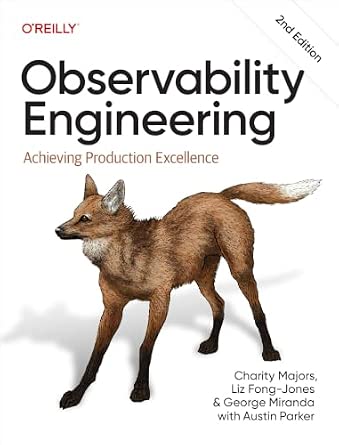
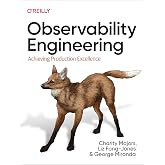
Observability Engineering: Achieving Production Excellence

5.0 out of 5 stars (2)

Purchase options and add-ons

Observability is the only way to engineer, manage, and improve the business-critical systems that customers depend on every day—and as the complexity of software grows, so does the need for observability. With this thoroughly revised second edition, authors Charity Majors, Liz Fong-Jones, and George Miranda take inventory of the current state of the field and explain how practitioners can evolve their observability practices from collecting separate, disparate signals to unified data workflows.

This book is for any software engineering team, large or small, that must understand the unique customer experience in order to ship quality code and features that customers want, at the right velocity. You'll discover the value that observable systems bring and learn concrete steps you can follow to achieve an observability-driven development practice yourself. And four completely new chapters explore recent trends such as large language models, frontend observability, cost optimization/performance engineering, and practical open source tooling.

  • Understand the impact observability has across the entire software development lifecycle
  • Learn how and why different functional teams use observability with service-level objectives
  • Implement modern observability practices in your organization
  • Maximize the cost-effectiveness of observability tooling
  • Produce quality code for context-aware system debugging and maintenance
  • Use data-rich analytics to quickly find answers when maintaining site reliability

Frequently bought together

This item: Observability Engineering: Achieving Production Excellence
$54.11
Get it as soon as Saturday, Sep 19
In Stock
Ships from and sold by Amazon.com.
+
$56.86
Get it as soon as Saturday, Sep 19
In Stock
Ships from and sold by Amazon.com.
+
$52.40
Get it as soon as Saturday, Sep 19
In Stock
Ships from and sold by Amazon.com.
Total price: $00
To see our price, add these items to your cart.
Details
Added to Cart
Choose items to buy together.

Customers also bought or read

Loading...

From the brand


From the Publisher

What’s Different in the Second Edition

First, we have a new coauthor. We are delighted to welcome Austin Parker, with deep subject matter expertise in AI and OpenTelemetry.

We’re also excited to incorporate a broader range of voices for this edition of the book, featuring a stellar lineup of guest writers. The opportunity to spotlight some of the people we look up to and enjoy working with has been one of the greatest pleasures of putting this book together.

In order of presentation in the book:

  • Jeremy Morrell wrote one of the most comprehensive guides to using wide events and creating custom attributes that we’ve ever seen. He has contributed greatly to an update of Chapter 5, “Structured Events Are the Building Blocks of Observability”, and has entirely contributed Chapter 6, “Making Structured Events Arbitrarily Wide”.
  • Boris Tane explored agentic AI use cases and examined the principles necessary to generate and retain context, which continues to be key for success as we shift toward more automation. We think you’ll enjoy the principles outlined in his contributed content, Chapter 10, “The Role of AI Agents for Observability”.
  • Mat Vine provided an in-depth case study on SLOs adoption for an updated look at its challenges and solutions. This replaces the Honeycomb-focused use case previously used in Chapter 11, “Using Service Level Objectives for Reliability”.
  • The engineering team at ClickHouse contributed an in-depth look at how their open source datastore is tuned to meet the needs of observability workloads in Chapter 14, “Efficient Data Storage with ClickHouse”. This new chapter provides an alternative implementation to the Honeycomb storage engine, detailed in Chapter 13, “Efficient Data Storage with Retriever”.
  • Mike Kelly contributed an in-depth look at telemetry management by examining challenges and solutions through the lens of the open source Bindplane project in Chapter 16, “Telemetry Management with Pipelines”.
  • Frank Chen, guest contributor in the first edition, returned to the second edition with a look at ontologies and how to think about your entire instrumentation chain in Chapter 17, “Ontologies as a Shared Language for Humans and AI”.

  • Hugo Santos contributed greatly to an update of Frank Chen’s first-edition take on instrumenting tests and continuous delivery pipelines in a new Chapter 18, “Observability for CI/CD Pipelines”.
  • Hanson Ho and Matt Klein presented a look at the complex and challenging workflows necessary for implementing high-observability workflows in the mobile device domain in Chapter 19, “Observability for Mobile and Frontend”.
  • Phillip Carter contributed greatly when applying the principles in this book to the world of running generative AI applications in production in Chapter 21, “Observability for Large Language Models”.
  • Kesha Mykhailov contributed a first-person narrative of the observability journey at Fin (formerly Intercom) in Chapter 22, “Fin’s Case Study in Modern Engineering”. This chapter demonstrates how many of the concepts detailed in the book often come together in real-world scenarios.
  • Darragh Curran contributed an open letter to chief technology officers (CTOs) detailing how his organization used observability to tackle the problem of accelerating organizational learning speed in an AI era in Chapter 23, “Organizational Learning Speed Is Now Your Biggest Constraint: An Open Letter to CTOs”.
  • Rick Clark contributed a deep dive into driving change without formal authority in Chapter 28, “The Organizational Shift”. This chapter covers how to recruit champions, drive consensus, and shepherd disruptive transformational change through complex sociotechnical systems.
  • Hazel Weakly wrote a wonderful foreword for us on the shifting horizons of software development, and contributed greatly to Chapter 31, “Instrumentation for Observability Teams”, especially for teams operating in highly secure environments.

Observability Engineering: Achieving Production Excellence

Second, we have two parallel tracks of guidance for engineers who write code: one track for AI-assisted development and the other for classic development. You’ll find both tracks in each chapter on instrumentation and analysis. Instead of anchoring our guidance in any one particular technology or tool, we describe the principles necessary for success and how they affect outcomes.

Lastly, we’ve restructured the material into chapter groups based on functional roles. The first edition of this book was “about observability,” for “everyone.” This edition aims for a more targeted conceptual structure.

Editorial Reviews

Review

Beyond a compelling narrative for the benefits of observability, this book also articulates what kind of telemetry is key, but also how to use this information well. It helps you understand what telemetry you need to send, how you need to process and explore this data, as well as presenting a host of real-world case studies.

Sam Newman, author of "Patterns of Building Resilient Microservices", "Data Design for Microservices", and more.

From the Author

.

Product details

  • Publisher ‏ : ‎ O'Reilly Media
  • Publication date ‏ : ‎ July 21, 2026
  • Edition ‏ : ‎ 2nd
  • Language ‏ : ‎ English
  • Print length ‏ : ‎ 629 pages
  • ISBN-10 ‏ : ‎ 1098179927
  • ISBN-13 ‏ : ‎ 978-1098179922
  • Item Weight ‏ : ‎ 2.4 pounds
  • Dimensions ‏ : ‎ 7 x 2 x 9.19 inches
  • Best Sellers Rank: #91,443 in Books (See Top 100 in Books)
  • Customer Reviews:
    5.0 out of 5 stars (2)

About the authors

Follow authors to get new release updates, plus improved recommendations.